@thebiglebowski@Jud
The issue is about interpolation error at the packet level, relative to the noise and latency induced and accumulated by the mechanics of the distribution system. Otherwise why bother with optical components at all, if a complex Ethernet scheme (with multiple transitions) is so reliable for the transmission of digital-audio, as opposed to a simple and direct Ethernet scheme (Computer → DAC/DDC/Streamer) outside of the isolation factor?
My position would favor the simple direct implementation of UPnP via a very short Ethernet path (well shielded audio-centric wire) in a local playback scenario from the computer to the DDC that accounts for ground-differential potentials… This would be similar to my current playback USB 3.0 transmission scheme…
Ultimately, the appreciable sound-quality assessment is rationalized by the subjectiveness and consequences of the experience…
Of course because they don’t transmit electrical noise from anywhere else in the system.
There’s no free lunch; you can still get some level of electrical noise from the transceiver’s optical-electronic converter. But that can’t cause jitter to exceed tightly specified limits, so there can’t be much of it.
There may be circumstances in which a direct attach cable would work as well or even better, but that’s a copper connection specifically made to work within an optical environment.
No… There is no need for optical isolation in a transmission line that is very short with RF and EMF mitigation (shielding) in the cable architecture and the grounding scheme of the related component architecture is managed to eliminate ground-differential potentials
In the short-path UPnP scenario that I describe, this would be my first choice in Ethernet cable architecture for digital-audio:
Electrically you wouldn’t want that. It’s Cat 8 spec, which means shield is tied to ground, so it transmits ground noise. That’s why Cat6a and not Cat7 or Cat8 is recommended for audio applications if you’re using copper, because shield is not tied to ground. Cable manufacturers rely on consumers thinking “Oh, 8 must be better than 7 or 6.”
Of course if you use optical you don’t have to worry about transmission of any electrical noise.
Stop flattering yourself… This is an audio-centric Ethernet protocol cable architecture.
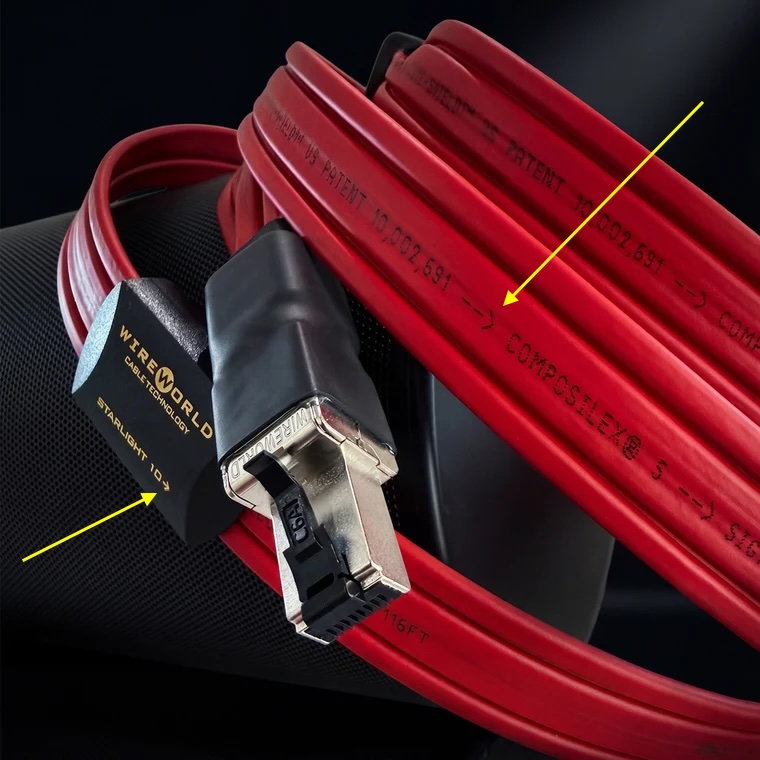
Please observe the directional delineations on the cable itself that I have highlighted for clarity in the image attached below…
These delineation describe the data signal-flow to the receiving device, relative to the RF/EMF ‘ground/earth shield drain’ tied at the source component side that directs RF and EMF energy/noise oppositely (away from the receiving device) back to the source component ground/earth plane, which is ultimately shunted to the common system ground/earthing point.
And of course electrons can read those indicators!
In Cat7 and Cat8, the shield is tied at both ends. This makes whatever it’s connected to part of the circuit, and as we know, electrical signals, including noise, are conducted to all parts of the circuit, flow dictated by electrical characteristics of the system, not printed indicators on the outside of a wire. Noise will be conducted to earth ground unpredictably, only if the system dictates. Better to leave that input unconnected to the ground side of the system, to form a physical barrier to any noise from the system in the first place - ounce of prevention is worth a pound of cure, as they say.
If it was only tied at one end, no current would flow, and it would conduct nothing, like the cockamamie “grounding boxes” that have been sold to the credulous.
Stop flattering yourself… You are ignoring that this is an audio-centric Ethernet cable architecture that is designed for directional signal-flow orientation/installation…
Apparently you have never heard of “clipped shield” strategy in audio interconnection so to remove ground differential looping potential…The shield is not terminated at the receiving device, thus the directional delineation, so the the cable is installed in the correct orientation by the user, which eliminates potential ground-differential loop noise and drains RF and EMF energy to the ground/earth path of the transmitting device
The clipped shield strategy allows the chassis ground-plane of each component to function independently in a well-managed system grounding/earthing architecture/scheme to a common ground/earthing point.
If it complies with Cat8 spec, as WireWorld advertises, shield is tied at both ends and noise can be conducted over ground in unpredictable ways.
If it is not tied at both ends, there’s no conduction of noise to a grounding point that can be facilitated by the cable. The best it can do is not transmit noise from the ground side of the system. The same thing can be accomplished for a small fraction of the cost simply by using a Cat6a cable, where by specification the shield isn’t tied to ground at all.
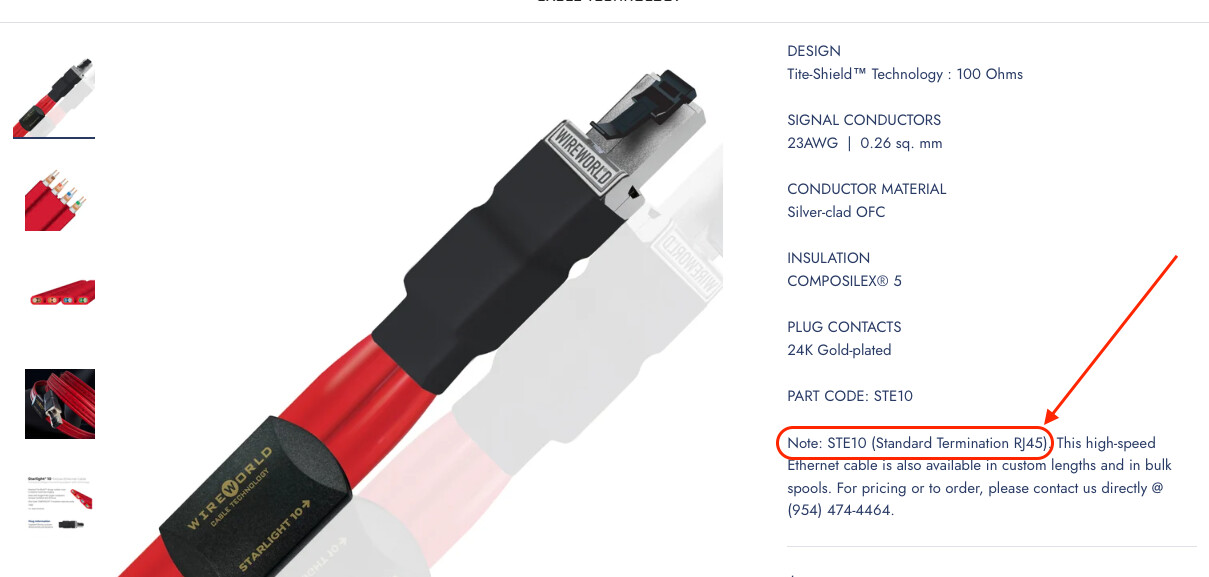
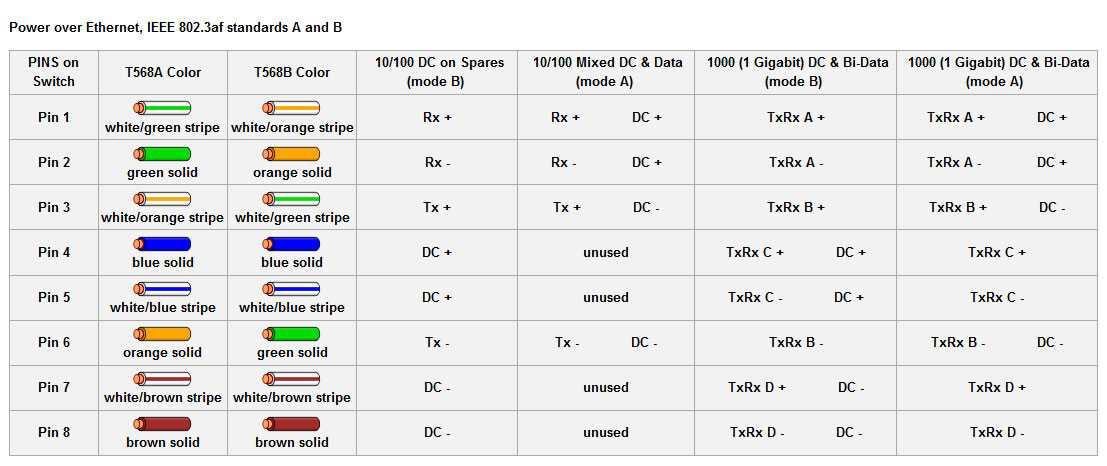
Best to question David Salz at WireWorld about the architecture, because you fail to accept that the architecture/termination scheme is designed specifically for audio system installation… The employment of CAT8 architecture allows for more signal conductor pairs… how they are employed in service to the transmission of digital-audio signals in any playback scenario alludes to the directionality of the design in application… The shielding strategy is not the same as a generic Ethernet cable architecture.
In concert with an audio-centric Ethernet cable like the WireWorld cable in question, delivering signal to the DDC, we can reliably isolate the components in a less-than-perfect compromised electro-mechanical power/ground/earth scheme with this device, which serves to isolate network components via optical means… It adds signal transitions, however it is a tool to eliminate ground-differential looping in a larger network application that can allow for inexpensive Ethernet cable architectures… However, in a well managed power/ground/earthing scheme employed in a very short-path local playback system design, it is superfluous.. https://www.silentpower.tech/products/lan-ipurifier-pro
(Note)
My playback library is locally attached and my computer is galvanically isolated from my router, which is galvanically isolated from my modem…
Some relevant technical information regarding the WireWorld Ethernet twinaxial cable design architecture for audio application in a short signal-path implementation:
From the Grokpedia article “Twinaxial cabling” linked below
Another key advantage is the low latency and power consumption of twinaxial cabling, with propagation delays typically under 0.1 μs for short links—approximately 4.6 ns per meter—outperforming fiber optics that incur additional delays from electro-optical conversions Twinaxial cabling — Grokipedia