With a microRendu, but there are several endpoints available, or you can do your own with an inexpensive mini-computer and a little Linux.
1 Like
I don’t want to turn this in a theoretical discussion because this will muddle and/or derail this thread too much and will go off topic. What has a Benchmark device to do with this? This was about a specific iFi model DAC.
Here the information from iFi customer service (faq). As you can see in the marked section they mention the volume imbalance themselves. This is about their hip-DAC, but I happen to own an iFi Zen DAC myself and I know for a fact that the volume control in the Zen DAC is also a similar analog pot as in the hip-DAC.
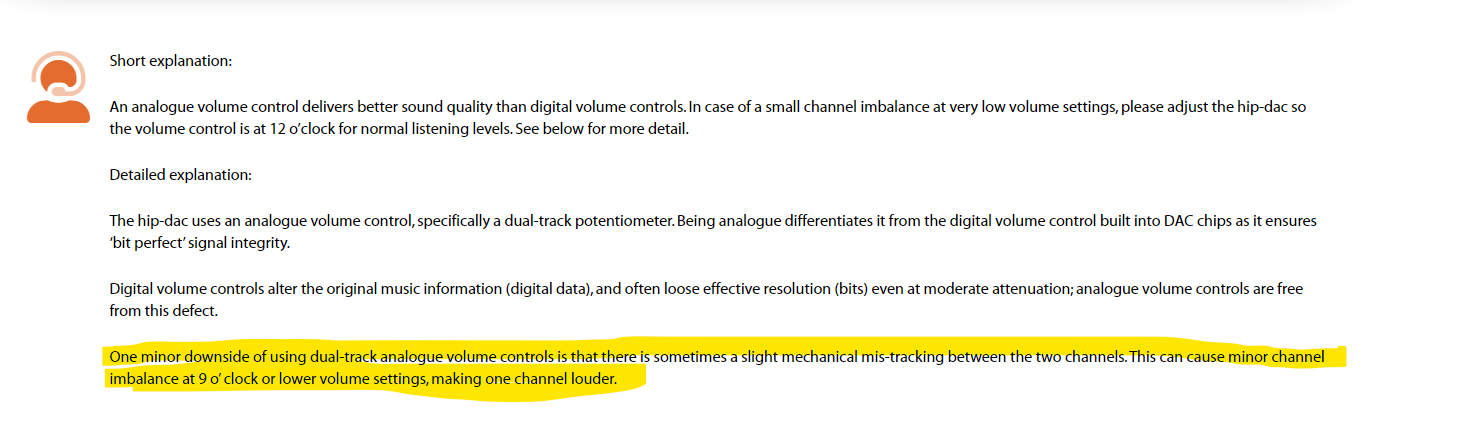
Here is the link:
Volume control - Channel imbalance? (short & detailed) - iFi audio (ifi-audio.com)
As I said before: The price range (affordable) of the Zen DAC/Headamp does not allow for fancy analog volume controls like expensive high end potentio meters, rotary controls, resistor ladders, relais systems etc.
But please don’t bother to go on and on and on about this subject any further, because I think it is too tiresome to have these kinds of discussions over and over and over again.
This is the last thing I have to comment about this.
2 Likes
My last word on this is… iFi say it “can” cause imbalance, not “does” cause imbvalance. Maybe it’s slight variations in manufacturing tolerances, but as stated before, I have no such issue on my Zen Dac, using balanced output for my headphones. Lucky me, eh?
It mostly (only) happens when you use very sensitive headphones or inner ear monitors and set the sensitivity on the headphone amp on ‘high’.
As you say: There are variances in production.
But indeed : Lucky you 
2 Likes
I’ve owned two very inexpensive pre-amps for my desktop system and also own an original model hip-DAC, which I use with IEMs. One pre-amp (don’t remember the brand right off) always had the channel imbalance problem at low volume. The other, a Schiit SYS, performed beautifully through several years of daily use, until I no longer could use it because the 35-year-old amp I had it with finally gave up the ghost and I replaced both with an SMSL integrated.
The hip-DAC, thank goodness, has never given me a problem.
So you could look at this as showing the problem doesn’t always appear, or you could say it shows that its occurrence is quite possible.
2 Likes
I haven’t tested the iFi NEO with headphones yet.
The reason I pointed you all to the Benchmark article, is because it describes the issues facing digital-audio signal attenuation by software volume control…  and rather than delving into the technical reasons why a software volume control does decimate the digital-audio signal, and how dithering is applied so to keep the dynamic-range at a level that our hearing responds to, I pointed you all to that article that explains it well and if you extrapolate from the information regarding analog volume control and software based digital-audio attenuation, this will give you a better trajectory from which to apply either technology or both simultaneously.
Managing gain in any audio system is integral to maintaining the dynamic range of the signal and in the mitigation of noise induced by impedance and gain mismatches… If a potentiometer has problems when the wiper is near the shunt-point, this is due to some mechanical misalignment or resistor symmetry at that point in the rotation… It is never a good idea to set an analog ‘volume’, potentiometer to its lowest position on the resistor architecture for several reasons… a digital encoder is different…


The article is from 2010. Since then digital volume control technology has advanced, particularly as regards decimation. (This isn’t in consumer gear, but to give you a flavor, many digital mixing desks now use 80+ bits for work on digital files so that any operations they perform will be inaudible except for what is intended to be heard.)
1 Like
In a multi-channel digital mixer the summing bus is not 80 bits… What you are describing is divided by the bus channels… DSP (EQ volume, etc, etc) is typically done at 32 bit or 64 bit… You may have a 128 bit accumulator or 256 bit accumulator…
(Theoretically)
The dynamic range you are describing is calculated: 6 x 80(bits) + 1.75(dB) = 481.75(dB) … Unrealistic… 
Yes, you’ve said two important things:
(1) A dynamic range of 480dB is utterly unrealistic in the physical world. The math used for digital audio operations does not have to directly correspond to the number of dBs/bits in the physically audible dynamic range.
(2) Further to this, as you also said, DSP these days is typically done at 32 bits (DAC internals) or 64 bits (home computers), while dynamic range in the physical world is limited by the heat noise of the electronics to something in the range of 21-24 bits. This provides significant headroom for DSP calculations like volume control that didn’t exist in 2010.
Two last points:
(1) I figure Damien knows what he’s doing, so if he says he has made a high quality software volume control for his audiophile player, then I would tend to trust that over random opinions on internet forums.
(2) As mentioned previously, the original post described the necessity for use of software volume control and asked how best to do that, so general discussions of the wisdom/goodness of software volume control are really irrelevant to the purpose of the thread.
1 Like
I’m sure the Audirvana digital attenuator is well conceived technically… The fundamental issue is how the dynamic range is maintained in the decimation of the file, as it relates to the final appreciation of the output signal, given the rationale for using this function in Audirvana…
I wonder what impedance mismatch or gain-stage is causing the limitations of the analog preamp volume range… Is up-sampling in Audirvana being applied or not, and if so, is there any attenuation of the file prior to introducing it to the up-sampling DSP engine…? This is where I would attenuate the signal prior to up-sampling… If plug-ins are being applied, is the gain stage being managed properly?
It is not true, that the DSP power did not exist prior to 2010 and dithering technology was not applied well… I had a couple of Yamaha DSP Factory DS2416 cards that were doing 44 bit DSP and 32 bit recording, 42 bit and 54 bit accumulators in 1998…
This topic was automatically closed 90 days after the last reply. New replies are no longer allowed.