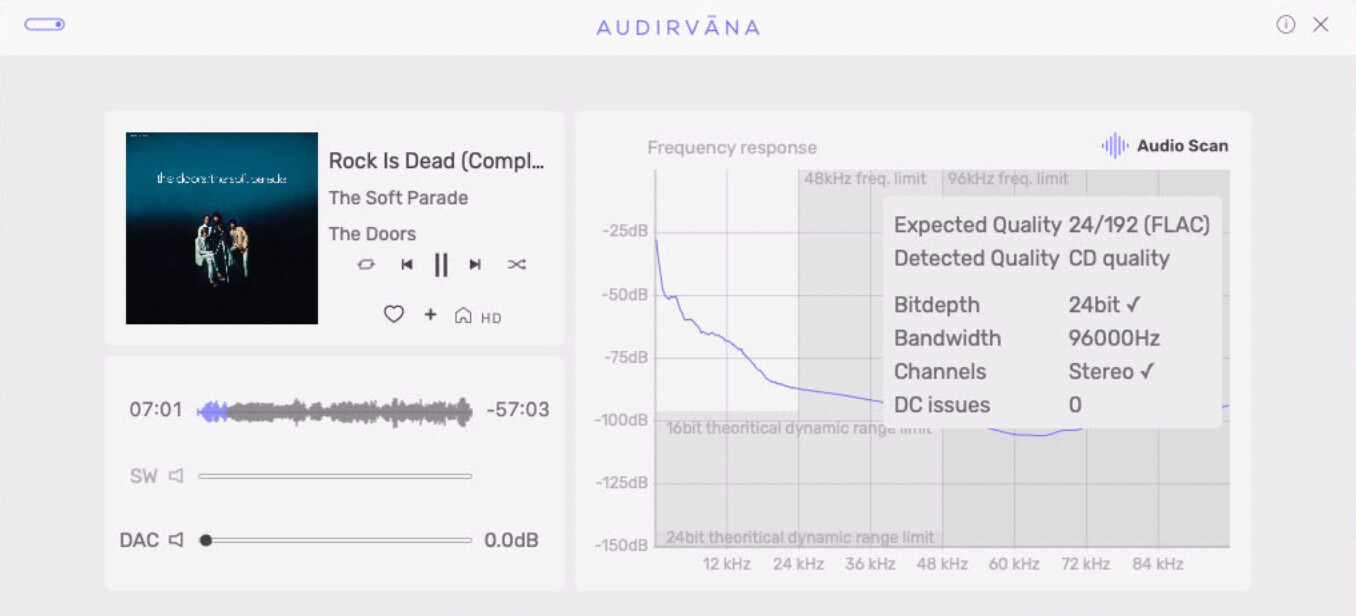
That Audio Scan is supposed to be a feature in Audirvana… but, looks like a little bit like a failure to me… that ‘‘feature’’ never gets updates?
Can’t remember that well known company name that released it in France, but still, not really reliable… you think, damn i will trash those files, they are not real HD, but then, you realized that thing is not even reliable or at todays standard…
Also when we want to post a new thread, can we have the choice to post that new thread in Audirvana category… still not existing… found Origin exist, but then, people with same bug with Studio will not care to see thread in Origin or vice versa…
You got burned if you thought you were getting a 24/192kHz file…
The digital iteration of this recording was originally mastered at 24/96kHz from the original 1" analog master eight track tapes, that were done for the DVD Audio release “Doors/Perception”… This FLAC iteration may have been from the DSD64 hybrid SACD master created from that 24/96kHz master, that was decimated to 24/96kHz… It all depends on where you acquired or purchased this file…
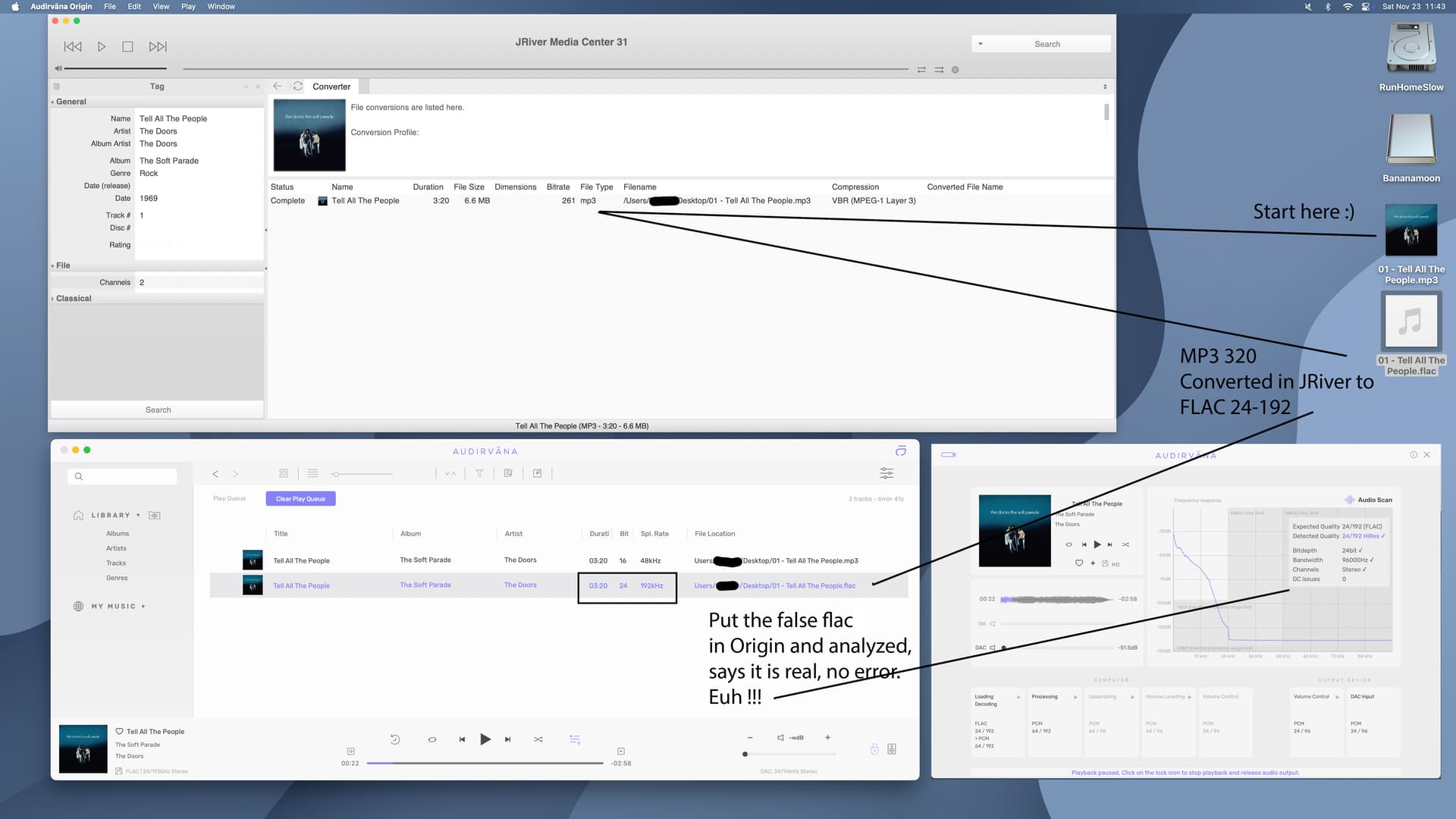
It sees the 24/192kHz file correctly (your source .mp3 stuffed with zero’s) and displays the Nyquist Frequency of the upsampled .mp3 file → FLAC file correctly which is 96kHz.… You will see displayed in the frequency response graph, that the actual audio bandwidth is reflecting the .mp3 source file bandwidth.
It has alway been my perspective, that this tool is doing it’s best to provide real-world information about the actual frequency bandwidth of the file being analyzed… In your demonstration, it is doing this… It doesn’t matter much about what the file format being analyzed is… How far can it go back? What if the MP3 file was an iteration of another format/sample-rate?
You can see in your original screen-shot of the 24/192kHz file, that the response graph is showing the file as having a relative dynamic range of a 16/bit A/D encoding (approximately 96dB)… The analog master-tape did not have this level of dynamic range (Maybe 68dB) vs the theoretical max of a 24bit recording which is 144dB… We also see that the frequency response is relative to an analog tape recording being digitized/encoded at 96kHz… Therefore the analysis tool ‘Detected Quality’ extrapolates from the encoded data, that it is relative to CD dynamic-range quality with extended frequency response of a 192kHz encoding, where the Nyquist Frequency is 96kHz.
The advantage of the 24bit encoding is that the source signal dynamic range is fully exposed and audibly revealed and not buried in the sampling noise of a lower resolution digitization.
It is important to know the provenance of the files you my aquire…
From the Wikipedia article “Dynamic Range” linked below:
German magnetic tape in 1941 was reported to have had a dynamic range of 60 dB,[26] though modern day restoration experts of such tapes note 45-50 dB as the observed dynamic range.[27]Ampex tape recorders in the 1950s achieved 60 dB in practical usage,[26] In the 1960s, improvements in tape formulation processes resulted in 7 dB greater range,[28]: 158 and Ray Dolby developed the Dolby A-Type noise reduction system that increased low- and mid-frequency dynamic range on magnetic tape by 10 dB, and high-frequency by 15 dB, using companding (compression and expansion) of four frequency bands.[28]: 169 The peak of professional analog magnetic recording tape technology reached 90 dB dynamic range in the midband frequencies at 3% distortion, or about 80 dB in practical broadband applications.[28]: 158 The Dolby SR noise reduction system gave a 20 dB further increased range resulting in 110 dB in the midband frequencies at 3% distortion.[28]: 172
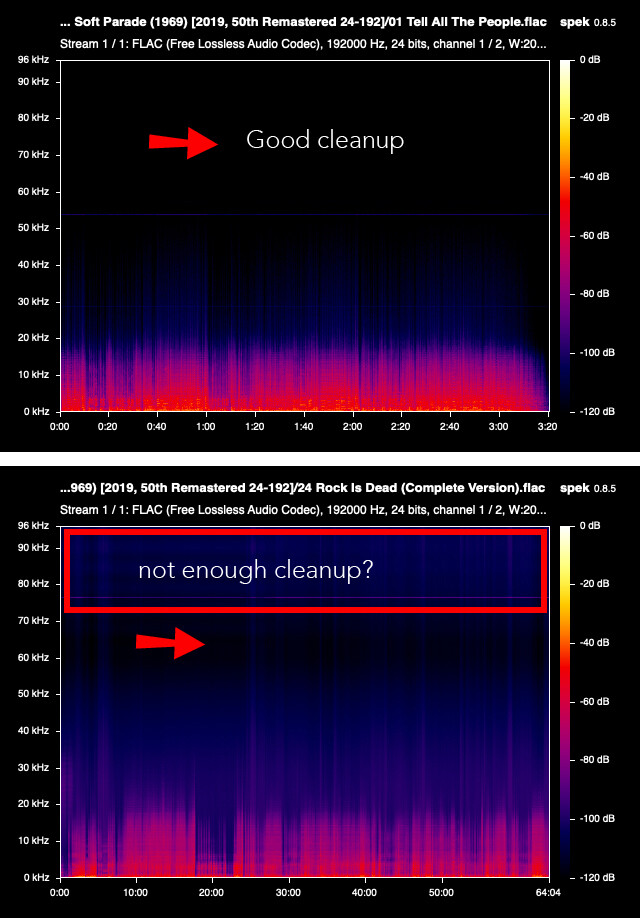
So, i have downloaded SPEC to see what it looks like, not too helpful software to understand with hints, but, with the first song of The Soft Parade as 24/192 compared to a bonus faulty song still at 24-192 that Audirvana Scan tells me, that it is a CD resolution file, i can maybe see if i understand a bit those graphs, that:
In the first song that Audirvana sees as a good 24/192, that they clean up good in the top in black…
and in the faulty song that is still 24/192 Audirvana just see that they clean up not enough up there, they left some CD resolution thing in the top of the graph… that we can’t hear anyway…
is that correct?
still a 24-192, but looks like a 16/44 or 24/44 file…
because CD can’t be 24bits
The primary sample-rate of the A/D encoding defines the Nyquist Frequency (Fs) of every subsequent digital interaction… If the file was original encoded as 24/96kHz and subsequently upsampled to 24/192kHz this encoding will reveal artifacts up-to and beyond the 96kHz Nyquist filter cut-off that were inherent in the original 24/96kHz encoding due to the filter ringing and pass band noise… This why r8Brain and SoX provide parametric adjustments of the filter performance at the Nyquist Fs so to reduce their influence or completely render them inaudible.
@Lolodesiles what do you think about those 2 pictures? is it just a not so good cleanup like with a picture with photoshop, that you erase the bad part of the image but not enough with a smaller brush that leaves artifacts on top of it, if someone is looking at the real file or the big picture like here in the hires file, there is still cd version artifacts even if the file is hires?
It’s pretty easy to see the difference in spectral energy in the second image… It appears to have been decimated… maybe from a lossy compressed file (MP3) as it appears to have spectral energy missing in key sections of the frequency spectrum… The density of spectral energy in the first image is reflecting a signal closer to a lossless encoding… The artifacts in the second image is displaying, is related to the bit-depth and sample-rate of the source file, which will not sound as good as the signal described in the first image… There is no doubt about this.
Too bad i can’t find a way to delete this thread now, that i have made.
Will talk to another person in private…
Again, feel free to answer a last time after my last post,
since you are like a bulldog, and never let go…
Now, it might be from a mp3 !
Anyway feel free to talk to HDtracks about that, here is the link.
They explicitly wrote on that download that they are many differents bits/depth different files, 24-44, 24-48, 24-96, 24-192, but They were missled from Rhino/Elektra on that track, selling it to People as 24/192.
This is a problem with Doors digital releases… they were some of the first digital-audio transfers available on Compact Disc and subsequent iterations that were upsampled to higher resolutions as the technology progressed… The SACD releases were derived from these earlier transfers to PCM digital and modulated to 2.8MHz DSD64.
The “ignore” function of this forum works very well. It’s been years my experience here got improved.
Interesting thread, it’s important to question, try things and confront findings.
I gave up on “HD” music as I found for most albums the best isn’t the latest remaster, and the CD quality provides enough satisfaction to my ears (and with my system), more than the extra frequencies I get from a less appealing master. But that’s also because I mostly listen to old stuff with an old sound signature I want to be preserved.
First of all, to me HD music is a marketing thing, like megapixels race in photography, and often the so called better sound is due to a specific “remaster” which is not necesserely better …
I have a pretty decent system, Anthem STR separated, Paradigm Persona’s 3F & Persona Sub, Viablue cables, Isotek power line cleaner etc., but i don’t bother knowing if HD files are better, i listen to music
@RunHomeSlow@Yohmi@Lolodesiles
The salient element is correlated to the resolution of the original source master… High-resolution remasters from an analog master tape for example, may indeed reveal contextual harmonic, dynamic and spatial detail that was not captured in a lower resolution A/D encoding… The 2xHD products are an excellent example of this reality… However, we know that Warner digitized a large number of their historical tape archive at 24/96kHz… So, when analyzing products derived from the WEA (Warner, Elektra, Asylum) this reality is an important bit of information… This was a business decision not necessarily tied to ultimate fidelity of the archives.…
This Audio Science Review article will provide more insight, as to the value of high-resolution digital recordings and the high-resolution digitization of analog tape and vinyl source masters without getting too deep into the subject… especially regarding the archival of historically important analog master source recordings.
This information below, regarding the resolution of analog tape, will provide more insight into the rationale for high-resolution digitization of analog tape masters.
NOTHING SOUNDS LIKE TAPE
WHY DOES MUSIC RECORDED ON ANALOG TAPE SOUND SO GOOD?
To understand why, a professional tape recorder provides the most lifelike reproduction revolves around a couple of important factors. The key lies in the inherent technology of the tape itself. Audio tape in use during the 1950s and ’60s provided approximately 65,000,000 magnetic particles per second of recording a quarter inch format at 15 inches per second (ips) tape speed. Each magnetic oxide particle or groups of particles takes on either a north or south orientation after exiting the recording head. Starting to sound like digital bit stream? Well yes and no. However there is one huge difference between analog tape recordings and even the best digital recordings.
RESOLUTION
The highest digital resolution today offers 4,608,000 bits switching per second. Not bad. Big improvement over the standard Red Book CD but it is not even close to sub-micron particle resolution of ATR Master Tape. Sound of Tape — ATR Magnetics
Note: 1-bit PDM DSD (Bit Stream) encoding today is capable of recording and archiving analog sources at 11.2 Million bits switching per second. (DSD256)
I hate to bump this older thread but I have a concern.
Audio Scan has always been reliable for me but there was this one instance where I analyzed FLAC files that were ripped directly off of an actual CD.
Some of the files came back as mp3 quality (128 kbps), how is this possible?
Does it mean that the original source of the tracks were mastered in mp3 but then encoded as FLAC? Keep in mind this is a CD from the late 1990s, I don’t know if this was a common practice back in those days.
Is the CD a commercially available disc from a legitimate record label…? A Compact Disc encoding is LPCM 16bit/44.14kHz not FLAC… FLAC evolved from the .mp3 and .aac era… So more-likely-than-not the CD is a bootleg or a CD-R copy.





 like here in the hires file, there is still cd version artifacts even if the file is hires?