Audirvana EQ vs FabFilterPro Q4

@Jud @AndyBell
Here’s some reference recordings:

Recordings

On 2 October 1912, Frank La Forge recorded the adagio movement with a studio orchestra for the Victor Talking Machine Company; the recording was issued as Victor 55030-A.[43] In 1922, Frederic Lamondmade the first complete recording with the Royal Albert Hall Orchestra under Eugene Goossens.[44] In 1945, Walter Gieseking made a stereophonic tape recording for German radio with the Grosses Funkorchester under Artur Rother. It is one of the earliest stereo recordings and one of about 300 such recordings made during the war, of which five survived. During the quiet passages, anti-aircraft weapons can be heard.[45] As part of complete recordings of Beethoven’s piano concertos, Piano Concerto No. 5 was recorded by Claudio Arrau in 1958,[46] Wilhelm Kempff in 1961,[47] Vladimir Ashkenazy in 1972,[48]Alicia de Larrocha in 1983,[49] Hélène Grimaud in 2006,[50] and Glenn Gould.[51] Other recordings were done by Alfred Brendel in 1976,[52] Friedrich Gulda in 1971,[53] and Murray Perahia in 1986.[54]
Piano Concerto No. 5 (Beethoven) - Wikipedia

1 Like

Lowering it doesn’t help - with Realtime Control, playback is S L O W… It’s only with the VST plugins enabled that this happens.

The upsampling doesn’t even complete… it halts abruptly about 75% in…

I’m thinking it’s a bug with the Windows version… I may ask for support - they’ve answered questions and even sent me a test version for other issues I’ve raised…

2 Likes

I’m on macOS using M2 Max MacStudio with 64GB… I only allocate 8GB for pre-load memory… previous platform was i7 quad-core MacBook Pro, macOS with 16GB where I allocated 4GB for pre-load buffering and never had the issue you are experiencing with modulating all PCM files to DSD128 and HRTF processing (before EQ Studio became available).

Thanks, have heard the Barenboim, will check out the Jarvi.

For something a bit different you may want to have a listen to Jordi Savall. Period instruments, HIP (historically informed performance). So to a reasonably close approximation, how it would have been heard in Beethoven’s time.

1 Like

Thanks!

Perplexity.ai made these recommendations:

https://www.perplexity.ai/search/2197bdfb-df28-4105-b81b-da8aa9482941

I think I’m spoilt for choice!

1 Like

I’ve now done a comparison of upscaling (PCM), upscaling (DSD), and no upscaling.

I retained my EQ settings for the headphones, Redline Monitor and extra EQ to add warmth.

I tried a variety of tracks (Beethoven’s 5th 1st movement), Yes ‘Heart of the Sunrise’ and some Genesis - all dynamic tracks with plenty of dramatic sections and quiet moments.

TBH if the upsampling made a difference I couldn’t hear it…

I wonder if the ESS’s treatment of DSD means I wouldn’t hear what DSD has to offer or if the HD560s just don’t have the capacity to make the differences apparent. Or maybe my hearing just isn’t that acute. Or maybe the extra processing I’m doing is masking the differences…

I live in a flat with very poor sound insulation, so investing in a decent amp and speakers wouldn’t be practical.

I wonder if there are also diminishing returns as well.

In the photography world, I have tested photographic software designed to enlarge and sharpen images.

Viewed ‘normally’ on screen or in a modest print, it’s hard to see any difference. ‘Pixel peep’ on screen or view a huge print (6 feet wide or more) close up and the differences are apparent.

Maybe not a perfect analogy, but it seems similar to me.

What I can say is that my setup sounds better than anything I’ve had before. I can hear things in tracks I’ve listened to for 50 years that I’ve not heard before. So I’m happy with my investment, but think I may not be able to squeeze more out of it.

Which is fine, actually. Now I can get on with enjoying the music, which was the whole point of doing this.

2 Likes

I suggest the best sample-rate conversion strategy in your case, is to stay with ‘Power of Two’ for all PCM files and “Convert to PCM” for DSD file handling… The DAC platform will be allowed to perform without the added burden of the gross sample-rate processing on the platform resources/topology, where the computer will be better capable.

The ESS DAC will homogenize the output signal by virtue of the chipset DSP and the output circuitry… Spend more time critically listening to simpler music in juxtaposition. Upsampling does not add any contextual harmonic, dynamic and spatial information that was not already encoded in the master source file… What upsampling does is reveal the low-level information that is hidden in the noise of lower-resolution signals and with good filtering choices will remove aliasing noise by moving the Nyquist Frequency (Fs) cut-off beyond real-world human hearing… The source file Fs is codified in the master encoding and no information is created in the interpolation. Only zero values are inserted in the file to increase the sample-rate… The increased sample-rate presents a more ‘analog’ waveform to the output circuitry… This is where the ESS chipset finds its appeal, in its ability to take a lower sample-rate signal and convert it to a very high sample-rate and then decimate this signal for output through its proprietary DSP before conversion to an analog signal output… (digital-audio signals are analog, really)
So, no matter what file type or sample-rate the input to the ESS chipset is, it will eventually homogenize the signal through the processing chain. The key for less potential for noise (jitter) is to reduce the level of onboard processing to the lowest level possible.

If you cannot discern a tangible difference between no upsampling and r8Brain doing the conversions… There could be several factors at play… The common denominator is your listening habits (active or passive listener) your hearing acuity, the capabilities of the headphone amp in the DAC, and the headphone cable and the electro-mechanical noise floor of your playback system (power/ground and power-signal quality), and RF and EMF noise.

There is always room for improvement… However, once you have nailed-down the basics of noise mitigation in the system power/ground/earth and RF and EMF mitigation or isolation, those improvements become more and more subtle and become evident with familiarity… This is the point of diminishing returns.

It’s an adventure that is still evolving.
:notes: :eye: :headphones: :eye: :notes:

1 Like

Now I can get on with enjoying the music, which was the whole point of doing this.

:+1: :+1:

3 Likes

Thanks @Agoldnear

Perplexity.ai also suggested that the HD560S headphones might not have sufficient sensitivity in the frequencies upsampling cleans for me to hear it.

If that’s the case it seems something of a paradox that I could upgrade my headphones to be able to hear the inaudible noise so I can verify that upsampling removed it.

Of course, I say this humorously, but I don’t want to keep upgrading for tiny gains. I don’t have the funds for that.

Yesterday I did try again and noticed occasional slight ‘clicking’ sounds with upscaling on that weren’t there with it off. That’s with power of two and its default settings (r8brain).

For the moment I’m leaving upsampling off and enjoying the music. I may revisit it later…

1 Like

Make sure you have engaged automatic gain reduction in the EQ settings…

Try lowering the output Volume control by -1dB to -3dB… Adding any plug-in adds approximately 2dB of gain to the signal… The added dynamic range created in the up-sampling process may be slightly clipping the DAC input… See how that works…

  • In Linear Pulse Code Modulation LPCM: (6db = 1bit)
  • Theoretical dynamic range of a digital-audio signal is calculated as:
    [ 6db x (number of bits) + 1.75mv = (dynamic range) ]
  • The Volume control is processed at 32bits

‘Sensitivity’ is related to the micro and macro dynamic response of the transducer(s) to contextual harmonic dynamic energies. This can also apply to the headphone amplifier performance. The headphone amplifier is the primary controller of the transducer behavior in both speaker dampening and dynamic response. The headphone cable plays into both factors as well.

:notes: :eye: :headphones: :eye: :notes:

Thanks

The headphone cable is the one supplied by Sennheiser. My man cave is such that I don’t need to add any extensions to it.

My EQs have auto gain switched on.

I’ll fiddle some more with the settings over the coming days.

I suspect there’s some interference, as the clicking only occurs (or I only hear it) during really quiet passages, with upsampling. No upsampling: no clicks.

1 Like

One possibility is that better upsampling may lead to what are called “intersample overs.”

When digital recordings are done “hot” (up near the 0dB level), while the samples themselves are all less than 0dB, oversampling can expose waveform peaks that exceed 0dB. If there’s a spot in Audirvana’s settings to back off digital volume for PCM oversampling (I know there’s one for DSD but can’t recall for PCM and not home to check), try that or try upsampling to DSD and backing off 3 to 6dB (unless Audirvana automatically does it for you).

Perplexity is falling victim to the common AI trap of repeating canards found in the samples it inputs. Oversampling has nothing whatever to do with hearing ultrasonics.

I can post a separate topic sometime today, so as not to interfere with this one, on what oversampling is really about.

If I have not done so previously here in this thread, you can use my experience with using EQ Studio, Redline Monitor and modulating/up-sampling of all PCM files to 5.6MHz (DSD128) using r8Brain as a point of reference…

I have no such noise on any given recording… which includes those files produced in the context of the “loudness wars” where ISP’s (Inter-Sample Peaks) were introduced in files that were normalized in poorly mastered digital-audio products. These files need identification and gain reduction should be managed to compensate for ISP’s via the output Volume as a global process, which could be as little as - 0.5dB reduction.

If you reduce the output gain (volume) in Audirvāna, this peak clipping distortion will disappear and you will not lose contextual resolution by doing so… you will be reducing the amplitude/gain of the signal that has been expanded in the up-sampling process…

If you were up-sampling 16/44.1kHz files, the theoretical maximum dynamic range of the file has been expanded from approximately 96dB [6(db) x 16 (bits) + 1.75mv ≈96dB ] to an approximate dynamic range of 192dB [6(db) x 32 (bits) + 1.75mv ≈192dB ]…
If you add another +2db for the inserted plug-in, you can see that the DAC input is easily receiving its maximum signal level… In the case of the DX3 Pro+ DAC its real-world maximum dynamic range at 1kHz is approximately 122dB and the integrated headphone amp has an approximate maximum dynamic range of 120dB. Averaged real-world playback dynamic range output will be less than 24bits… few if any PCM-centric DACs will produce 24bits of dynamic range, and remember the actual dynamic-range of any PCM file is codified in the master encoding bit-depth.

Managing gain-structure is essential in any case…

In the case of headphone cables, it is typical of manufacturers to supply a ‘good’ cable, but rarely a ‘great’ cable due to cost considerations. Cable architecture and materials make an audible difference.

Not all headphone amps are equally capable for any given set of headphones.

:notes: :eye: :headphones: :eye: :notes:

@Agoldnear @Jud

Thanks for all the assistance!

I reconfigured my setup, used a different PC, and changed the USB cable connecting the PC to the DAC. Clicking is no longer evident, with or without upsampling.

Then I noticed, with upsampling to DSD, a major, but not what I wanted, difference - the left and right channels had swapped. I confirmed this by putting on The Beatles Abbey Road, where some tracks start with music in only one channel - they had swapped!

AI told me it’s a known issue with DSD and some ESS DACS, possibly correctable with firmware… Thankfully, I have a plugin that can swap the channels, so I can compensate easily enough.

Figuring all this out took up most of the time I had set aside for listening, so I’ll revisit listening with and without upsampling (PCM and DSD) sometime this week.

At least this showed upsampling was doing something, even if it’s not what I expected…

Andy

???
I have never heard of this anomaly in ESS DAC chipsets… If the phase was inverted in the chipset, all signals would be inverted because all signals are processed in the DSP architecture and output in the same format… It is highly questionable that only the DSD input signal would have the L/R phase inverted.
Maybe the DAC is defective.

*A search for this anomaly does not return results to corroborate.

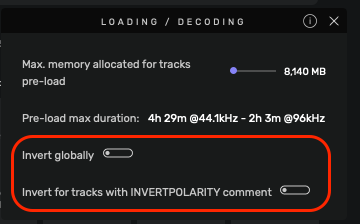
You may have some recordings that are produced with the phase inverted and those recordings can have their phase inverted in Audirvāna dynamically via the track/album meta-data.

Test your playback system phase continuity with this:

Note: Also, I suggest that you don’t modulate PCM to DSD with this DAC, if you are playing DSD files, these should be converted to PCM “Convert to PCM” in Audirvāna.

:notes: :eye: :headphones: :eye: :notes:

Just tested it again to make sure I’m not hearing things - on this DAC, DSD upsampling switches channels. The Invert settings did not make a difference…

I changed to my portable DAC, Fosi DS1 (has the same DAC chip), and the channels did not switch with DSD upsampling…

Whatever the cause, I will stick with PCM upsampling… and set the Convert To PCM for DSD files…

@AndyBell
If you are using i2s, the DAC may invert the channels in DSD.
But this will happen with or without upsampling.

Seems the DAC is defective… :thinking:
It obviously doesn’t have anything to do with upsampling/modulation of PCM files to DSD…

:+1:

Hope you can get the Topping replaced… I see they just released the new D900 Ultra Flagship DAC and will be releasing its companion headphone-amp A900 soon.

Your anomaly, feeds into the less-than-favorable Topping quality-control narrative.

:notes: :eye: :headphones: :eye: :notes: