The M21 uses delta sigma 8 x oversampling conversion so it is not recommended to “up-sample” the digital audio that is being sent to the M21 within a media player option. Defeat all up-sampling features in your media player or CD transport. Up-sampling the data before the M21 will yield poor results and always use the original source audio bit and sample rates, so for example if the source is 44.1k then have the media player send this data unprocessed to the M21and let the M21 reconstruct the data correctly. https://www.bricasti.com/manuals/M21_manual.pdf
If only you understood the real-world of digital-audio signal transmission and digital-system platform topology and DSP…, I’d like to have you tell me about “slew-rate” and how this pertains to playback sound-quality…
It all boils down to the reality of the final audition… In the context of DSD256 vs DSD512 and 1024 iterations of DSD128 and DSD256 recordings, you better have rock-solid evidence there is tangible contextual characteristics revealed by those sample-rates that are perceived by a consensus of audiophile listeners:
The M21 has 2 completely isolated fully differential channels, each with its own dedicated linear power supply, D/A converter, DDS clocking, and analog level control circuitry. This design insures that analog cross talk is virtually non existent, that the necessary power requirements for each channel are well met and isolated from each other and the digital processing is isolated, having its own power supply. With our twin DAC design, the dynamic range for each channel is optimized by using the stereo ADI 1955 D/A converter in a mono configuration, or an optional Ladder DAC for PCM conversion, clocking is for each channel done directly at each DAC with a technique called DDS (direct digital synthesis) which takes clock induced jitter to immeasurable levels, and DSD is converted with our own one bit analog converter.
DSD playback with the M21 is done via DoP and as such can be read with any input, but most common is the USB. DoP is DSD over PCM and for DSD 64 is the 1 data bit stream embedded in a 176.4k 16 bit PCM data stream with the extra 8 bits out of the 24 bits used for identifying that it is DSD not PCM. This is true DSD and not PCM conversion. When using a computer audio setup, the media player should be set to send out the DSD as DoP, the M21 will see that as 176.4k pcm for DSD 64fs or 352.8k for DSD 128fs, read the data header and see that it is actually DSD and unpack the data in our digital signal processor as the original DSD data, and send it out to the DAC for conversion to analog.
The M21 features 3 digital audio conversion paths, 2 for PCM which utilizes a sigma delta or ladder dac types, and for DSD is a true one bit modulator of our own design and unique to the industry. This DSD conversion is done on the M21s analog level boards and is a true 1 bit analog converter followed by an analog post noise filter. The result is a true a pure DSD play back unlike any other converter in the market. It is recommended that this feature be selected in the status menu labeled NDSD. The other choice is DSD PCM and this will set the path to use the ADI 1955 as the multi-bit converter which will impart a different sound character than the native one.
To use it all you need is DFF or DSF files, set the media player to play the files as DoP, and the M21 will play them. When DSD is received for playback the status and filter displays will read DSD, and when it next plays a PCM file it will revert to your last used PCM filter and display will update accordingly. Playback is seamless as any other PCM sample rate change. If the M21 does not display DSD when playing back DSD source then check your media player settings for DSD and insure that it is being sent as DoP.
When using USB and the LAN the M21 supports both DSD 64, one bit at 64 times 44.1k sample rate, and DSD 128 or double that rate. DSD 64 is the SACD standard and 99% of all content is released and mastered at this rate. There is some content appearing that is DSD 128 or 2x the rate but for the most part you will find DSD 64 as the standard.
When selecting NDSD DSD setting, the DSD post noise filtering is done in the analog domain so there are no DSD filter settings. An artifact of DSD processing is the buildup of ultrasonic noise and with DSD 64; this noise starts at 24 kHz and rises to peak level at -50 dB at 50k and beyond. In the M21 set to NDSD DSD this filter is implemented with a simple low order low pass analog filter for the very best sonic performance.
Note the only mention of “8x” is for “INT8x” mode, standing for “interpolation 8x.” Interpolation is the type of filtering done when upsampling PCM input 8x. It has nothing to do with DSD.
Did you also happen to notice that the last and longest of your several Bricasti quotes contradicts your statement that the M21 upsamples 352.8kHz 8x to 2.8mHz?
When using a computer audio setup, the media player should be set to send out the DSD as DoP, the M21 will see that as 176.4k pcm for DSD 64fs or 352.8k for DSD 128fs
What’s the sample rate for DSD128?
And since 352.8k is the normal PCM sample rate for DSD128 via DoP, where’s the “8x delta-sigma upsampling”?
8 x 352.8kHz = 2,822.4 kHz … easily done in FPGA or ASIC… then filtered to whatever they want to output… just like Digital to Analog Veritas in Extremis or PGGB
If you fail to grasp the concept of 8X up-sampling, then the M21 is not your DAC… Apparently you are unable to extrapolate from the description of the up-sampling filter process… We can easily see that the system is fully capable of 11.2Mz operation… I’m certain the signal topology and DSP is operating at a far higher frequency…
Digital Input Section:
This is the center section of the unit; it provides 6 digital inputs selectable from the front panel. This section has its own linear power supply and is isolated from the analog sections, providing excellent low noise performance and helps to eliminates digital noise from entering the analog chain via the power supplies and ground plane. This section features an Analog Devices Sharc DSP that is used to run the front panel, general DSP operations of the M21, to control and synchronize the DDS clocking on each channel, and to provide a selection of our own over sampled anti-aliasing filters.
The lower board contains the Sigma Delta PCM dac, clocking and analog output buffers. Each channel’s digital section has its own Analog Devices 1955 DAC used for PCM conversion, it is coupled with a dedicated DDS clocking circuit located millimeters away from the DAC, assuring extremely low jitter and minimal trace length for the clock signal and precise clock synchronization of the left and right boards is handled by the Sharc DSP on the main digital processing board.
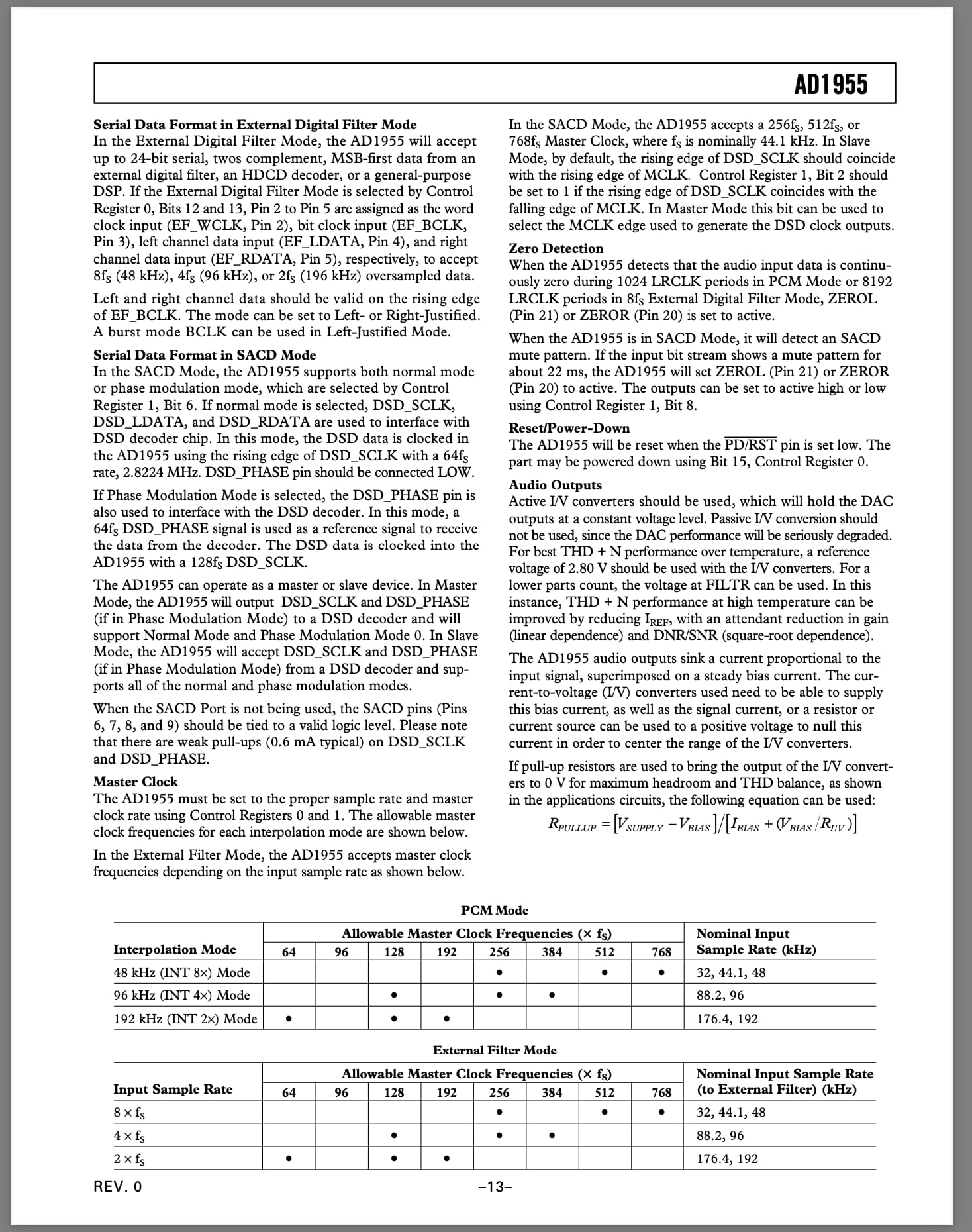
From the AD1955 D/A applications documentation:
(Note the 8X clock frequency capabilities in ‘slave’ mode/external filter mode…)
What this is telling us is that the the DSP in the M21 will externally process at whatever 8x Fs is sent to the filter DSP, and then decimates this signal into the realm of the sample-rate of the D/A output circuit… which is in the case of using the AD1955, that Fs would be a maximum 768kHz… The ladder D/A circuit may be different…
From page 8 of the manual:
PCM playback oversampling filter:
… This filter only affects PCM playback and not DSD.
(I’ve read that the new MDx DAC upgrade board supports 15 different filters… the manual needs to be updated to reflect the MDx upgrade.)
You are messing everything.
Upsampling is not about improving the sound of the original file.
Upsampling only allows reaching the optimal point of the DAC, and this point differs according to the design of each DAC.
But I told you already on the other thread that I won’t feed you, until you do what you have to do.
As there’s no ignore button on this forum, stop calling me!
It’s true that the MScaler is designed for a single purpose, and is optimized for it. It allows it doing good job with limited computing resources.
Yet, the horsepower of a computer is so superior that it allows running a variety of better algorithms, and many Chord users prefer software upsampling with SRC-DX.