I am very pleased to use Qobuz and Audirvana on my Macbook pro Intel Core 7 USB connected to a SMSL SU 10 DAC DSD512 compatible. I read that MacOs is limited to DSD256, I cannot select DSD512 in Audirvana, I selected DSD256 and the DAC displays DoP 1.6896 MHz which is what ?
I would like to replace the DAC with a better one and benefit from the DSD512 or even 1024 formats, I need to understand DoP / DSD correspondance.
The SMSL SU10 supports raw native 1-bit 22.4MHz PDM (DSD512)… There are no DSD512 or DSD1024 recordings, these are iterations modulated from lower resolution DXD or DSD recordings. Also, there are no 705.6 or 768kHz recordings, as these are up-sampled iterations of lower sample-rate recordings or they are decimations from higher sample-rate DSD recordings. The state-of-the-art recordings are done at 1-bit /11.2MHz PDM (DSD256).
macOS requires that DSD files to be transmitted via DoP (DSD over PCM) protocol, which is dependent on the PCM sample-rate abilities of the DAC, to transport the 1-bit signal to a DoP capable DAC where the 1-bit signal is extracted from the dummy PCM carrier file by the DoP processor of the DAC platform, and delivered to the D/A circuitry, as described in the Audirvana Knowledge base article linked below…
Your DAC, like many, supports PCM sample-rates to 768kHz and DSD256 via DoP… The DoP PCM carrier sample-rate for DSD512 is 1411.2kHz (2 x 705.6kHz) … The maximum DSD sample-rate that your DAC supports via DoP over USB is DSD256, where the PCM carrier sample-rate is 24/705.6kHz… Your DAC would need to support 1411.2kHz PCM to play DSD512 via DoP and it would need to support DSD512 via DoP… not very common.
Another consideration with the SU 10 is that it employs the ESS chipset(s) that convert all DSD signals to PCM for processing in the Hyperstream architecture, which ultimately outputs a multi-bit “DSD-wide” signal for digital to analog conversion… There is no pure 1-bit PDM (DSD) signal path to simple low-pass filtered D/A circuitry… I suggest that you convert all DSD files to PCM in Audirvāna so to off-load the decimation process from the ESS chipset DSP, so to lower intrinsic noise (jitter).
Dop means ‘DSD over PCM’. The name says it: DSD files are ‘encoded’ into PCM signals, because your DAC doesn’t support DSD. So, the displays tell you it plays DSD over PCM. It seems it is upsampled by the DAC.
It is quite simple: if you want to listen to DSD native files, you need to have a DSD native compatible DAC. What some people seem to do is instruct Audirvana to transcode all their incoming streams or file playback into DSD and let Audirvana feed the DAC with a DSD signal, because they appreciate the result. It is up to you to decide if that’s the case for you. It helps then to have a DAC that can convert DSD natively.
This is incorrect… The DAC supports PCM and it supports DSD256 via DoP on the USB bus. macOS transmits DSD files via DoP…
This is correct for all forms of DSD signal decoding, (DoP or native), where the DAC architecture supports a direct 1-bit PDM signal-path from either a DoP transmission or a raw native transmission to simple low-pass filtered digital to analog signal circuitry.
I suggest using ‘Power of Two’ up-sampling strategy which will produce the logically correct sample-rate result… For example:
All files with sample-rate multiples of 44.14kHz → 705.6kHz
All files with sample-rate multiples of 48kHz → 768kHz
The DAC is the limiting factor for DoP transmission of any given DSD sample-rate… In the case of your DAC, the limiting factor is that it supports up-to 705.6kHz which is the PCM carrier-file sample-rate for DoP transmission of DSD256 on the USB bus… If you were to use UPnP transmission protocol on the Ethernet bus, raw native DSD can be transmitted to a DAC or DDC that supports native DSD via a network connection.
As I stated previously, there are no DSD512 or DSD1024 recordings... DSD256 is the state-of-the-art recording format in the industry… All DSD512 and DSD1024 files are modulated (up-sampled) iterations of lower sample-rate encodings… It is questionable if one is able to discern any tangibly audible differences between a native DSD256 recording and an iteration of that same recording having been modulated to DSD512… This is the reason you see DSD256 support by most DAC platform designers… Theoretically, due to the nature of a 1-bit PDM signal, a 22.4MHz (DSD512) signal may produce some level of tangible audio quality by producing a smoother waveform to the output circuitry as compared to a 11.2MHz (DSD256) signal waveform… But, this is debatable and highly subjective. The Nyquist cut-off frequency (Fc) of both DSD256 and DSD512 (and all DSD sample-rates) is far, far, far, beyond human hearing perception, (1.6MHz for DSD64, 2.8MHz for DSD128, 5.8MHz for DSD256 and 11.2MHz for DSD512)… If a DSD256 encoding is modulated to DSD512, there is nothing gained, as the modulation process to 22.4MHz only inserts zero-values to increase the sample-rate… the DSD256 file is played fully-intact with the frequency response and dynamic-range that was codified in the original 1-bit 11.2MHz encoded master. The only esoteric theoretical gain, is that a more refined waveform is presented to the output circuitry where any perceptible improvement is again, highly subjective in the assessment of the output sound-quality on any given playback scenario and even in the evaluation of PCM files being modulated to DSD64, DSD128 and DSD256 vs DSD512… DSD512 and DSD1024 file playback is esoteric and in my personal opinion, inconsequential for all, except for those who are less informed about the provenance of the DSD512 encoding, or those very experienced in the comparison of a natively recorded DSD256 production to the modulated DSD512 iteration of that production.
You are the final arbiter of this… However, in the case of the ESS chipset architecture, pure native DSD playback is not possible, However, the output quality of these PCM-centric chipsets implementing their Hyperstream II technology, are widely accepted as very nice sounding DACs, but in comparison to a DSD-centric DAC, there is a differential that appears to the discerning audiophile to favor the pure 1-bit PDM signal path to simple low-pass filtered D/A output circuitry.
(Edit)-- In the case of the Nyquist FIR Filter Cut-off frequency employed in the playback of a DSD file, these cut-off frequencies will be a sub-set of the primary Nyquist Frequency of the 1-bit PDM sample-rate, determined by the analog FIR filter implemented in the DAC architecture… these Fc will vary from design to design.
Again, thank you very much for your detailed explanation. I will stay with PCM 768, if possible. You are right about the DSD above 256, but it is always tempting to go for the max. I read a test of the Cen.Grand DSDAC 1 Deluxe, which can up sample up to 1024 automatically. The tester was not positive about the 512, and even negative about the 1024, apparently more aggressive. Beside that, this DAC seems to be a buy, I am tempted to try it, since I cannot listen to it around Brussels.
Now, about the up-sampling in Audirvana, I also agree with you with the power of 2 parameter. But, playing Qobuz files I get clocs (or pocs, noise) on almost all recordings every +/- 30 sec with the max frequency parameter. Also, in power of 2 plus brutal stops and restarts of the music. I got it also in DSD256, then I selected a lower rate. What is the cause of it ? My Mac has only 8 GB, half of it for Audirvana, and is dedicated to it, no other user app running, is it the reason ?
Drop your playback preload memory allocation to 1-2GB… because you are using 50% or more of your System RAM for preload memory… More System RAM is required for other operational functions…
Stick with ‘Power of Two’ up-sampling strategy.
There is no maximum recorded resolution beyond 11.2MHz (DSD256)
When modulating PCM files to 1-bit PDM, the frequency response and dynamic-range of the source master encoding is not changed, these elements are codified in the original master… Only zero-values are inserted to increase the sample-rate, and because of the increased dynamic-range of the DSD signal, the low-level details of the original PCM encoding and the frequency response is fully realized… PCM files up-to DXD 352.8kHz and 384kHz are fully realized when modulated to DSD128 or DSD256…
Ok, power of 2 is superior to max frequency, musically. I reduced the RAM allocation to 3 GB works dellightfull. I am in the concert hall.
I have one 2 km away where I can listen twice a month to chamber orchestra at 2- 10m from the soloists. And also master classes. It is a famous school for soloists : Chapelle musicale Reine Elisabeth.
I have 64GB of system RAM in my M2 Max, Mac Studio and allocate 13GB for playback memory, where I modulate all PCM files to DSD256 after applying Studio EQ and Crossfeed (Virtual LR) because I am headphone-centric. I have found that it is a balance and I lean towards performance/sound-quality, being less concerned about the play queue capacity… You will notice that the CPU activity will increase as the play queue is being filled until complete, this activity will influence the playback sound-quality on less powerful platform topologies.
I understand that my mac bp needs more RAM. On my Mac with 2 GB RAM allocated to Audirvana,
CPU never exceeds 30 % and most of the time around 10%. When I allocated 6 GB RAM CPU was frequently at 89%. So, is a RAM upgrade necessary to 32 GB ? Coupled with a M4 ?
A powerfull Mac seems cheaper and more effective since the software can be upgraded and is more powerfull than a crazy audiophile streamer and can up-sample files to a lazy pricey DAC ? Ok, I would like to find a lazy DAC, I am fed up to spend money on audiophile supreme stuff ugraded every 2 years. Sorry. I am not alone to buy cars cheaper than audiophile thought gems.
I will first check it with my other Mac book pro M2 next week. I am taking some days off abroad.
Kind regards and sorry for my humor not intended at you of course.
More System RAM is better in all cases… It allows Audirvāna to fully exploit the platform resources with the lowest possible latency and memory bus throughput demands of the audio-engine and the functional macOS operational demands on the platform topologies… Also, more System RAM will help the platform accommodate the future of digital-audio playback scenarios. … Apple has yet to integrate a digital-audio processing sub-system as they have done with video processing.
MacOS always transmits DoP when asked to send DSD over a direct USB connection. (Except in the exceedingly rare case of a custom USB MacOS driver for that particular DAC.) It will send “native” DSD if you use UPnP (Ethernet or WiFi - your system may or may not have this capability). Windows and Linux are usually capable of sending “native” DSD over a direct USB connection.
DoP requires twice the bit rate for the same resolution as “native” DSD, so for example a DAC capable of DSD512 with native DSD will have a maximum input of DSD256 with DoP. This is because extra bits are needed to tell the DAC to treat the DoP signal as DSD rather than PCM.
It is possible your preference is being affected by the fact that DSD signals are reduced in volume by 6dB relative to PCM. Louder sounds better - more full and spacious, bigger bass, etc. Try to carefully equalize the volume by measurement (the AudioTools app for iPhone by Studio Six Digital has a loudness graphing app that works well for this) and do your comparison that way. If your preference remains the same, that’s fine, but at least the comparison will be a little more valid.
This simple explanation you provide has always been very confusing and grossly misconstrued by many, when not put into detailed context… More directly put… It is more about PCM sample-rate support… The DoP carrier sample-rate for DSD512 is 1411.2kHz,
However…
The DoP Standard outline/overview clearly explains the nature of the technology and bandwidth requirements extrapolated into higher DSD sample-rates being packaged in the DoP carrier file…
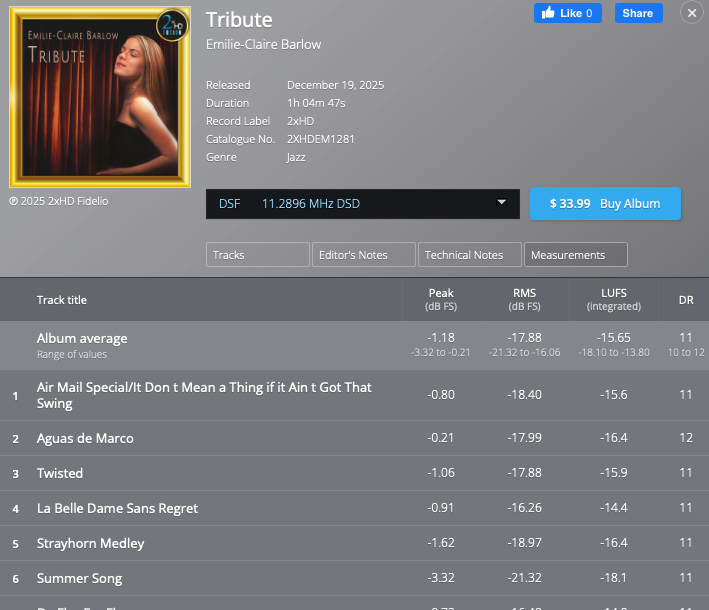
This is primarily associated to SACD production… You will notice in this measurements screenshot below, of a recent 11.2MHz downloadable album production, that most of the track peaks, are near full-scale.
Of course I agree, that balancing amplitude (output) levels is critical in making comparative assessments of sound-quality as this is intrinsically-tied to the response contour of our hearing acuity as visualized by the Equal Loudness Contour:
However, in the context of Audirvāna modulation of PCM to DSD, the gain-reduction parameter of the DSD modulator is primarily there to manage the output gain structure to the DAC so to avoid overloading its architecture… Some DAC architectures have more head-room than others, and ISP’s (Inter-Sample Peaks) can be exacerbated in the process, so gain management is essential and that reduction of gain before up-sampling is critical in the mitigation of these distortions of the resulting signal, and the overloading of the DAC architecture.
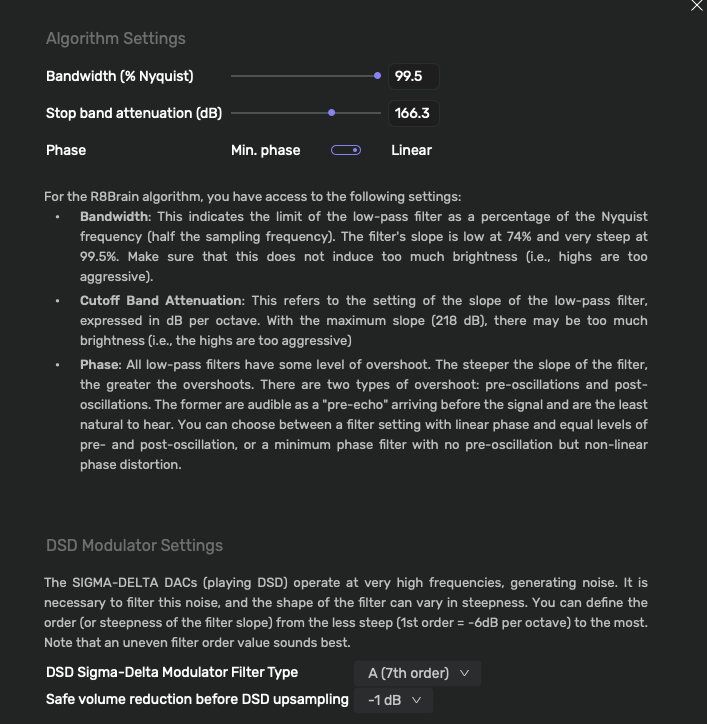
Here is a screenshot of my r8Brain configuration, where I reduce the gain (-1dB) before modulating PCM files to DSD256, so to mitigate the potential worse-case ISP’s that may exist in any given master encoding… My DAC has enough head-room to handle the dynamic range of the resulting DSD256 file… If it didn’t handle the dynamic-range, then I would need to lower the gain a bit more to accommodate the DAC.


 … Apple has yet to integrate a digital-audio processing sub-system as they have done with video processing.