Your experience is limited to basic tinkering, and you don’t know what you are talking about.
Do your homework.
Laser light is analog… it is just a different way to translate data for transmission… The pulses of light are interpreted by an Opto-isolator/interpolator that produces electronic signals on metal pathways in your devices…
We are talking about fiber.
How Qobuz or Netflix stream the DATA over thousands of kilometers without noise and without jitter, and keeping it bit-perfect?
Surely not with your hacks.
I can’t take seriously anybody that thinks “1’s and 0’s” are something other than analog voltages of an electronic waveform…


Fiber optics use laser light pulses to transmit the data… 
@Cloclo try transmitting signals on kilometers of plastic fiber… do you think you will get what you transmitted at the other end…? you might be lucky to get something intelligible…
I have no time for senseless chat.
Electrical current is an analog medium in which there are plenty of interferences. Fiber is a digital medium in which only the data is streamed and nothing else. That’s why the noise of the analog medium is 100% filtered during the conversion of the DAT to optical.
Good night.
You are posting hundreds of links.
Read once a link that someone else posts, and educate yourself.
How do you think the optical signal is derived and translated into? You need to go back to school…
I don’t argue the AfterDark device is not effective…
Do we not have in the transition between fiber and copper introduced jitter and noise?
Matt
And…breathe 

2 Likes
An honest question, but is noise and jitter audible to the average person?
Or is it something that’s only audible with sophisticated equipment, designed to identify it?
2 Likes
Definition of Analog Signal
Analog signal is a kind of continuous wave form that changes over time. An anlaog signal is further classified into simple and composite signals. A simple analog signal is a sine wave that cannot be decomposed further. On the other hand, a composite analog signal can be further decomposed into multiple sine waves.
An analog signal is described using amplitude, period or frequency and phase. Amplitude marks the maximum height of the signal. Frequency marks the rate at which signal is changing. Phase marks the position of the wave with respect to time zero.
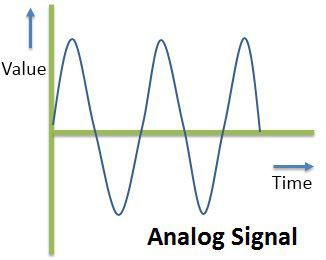
An analog signal is not immune to noise hence, it faces distortion and decrease the quality of transmission. The range of value in an analog signal is not fixed.
Definition of Digital Signal
Digital signals also carry information like analog signals but is somewhat is different from analog signals. Digital signal is noncontinuous, discrete time signal. Digital signal carries information or data in the binary form i.e. a digital signal represent information in the form of bits. Digital signal can be further decomposed into simple sine waves that are called harmonics. Each simple wave has different amplitude, frequency and phase. Digital signal is described with bit rate and bit interval. Bit interval describes the time require for sending a single bit. On the other hand, bit rate describes the frequency of bit interval.
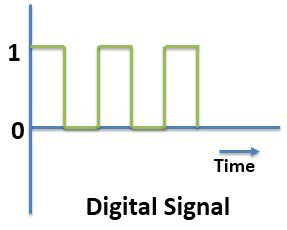
A digital signal is more immune to the noise; hence, it hardly faces any distortion. Digital signals are easier to transmit and are more reliable when compared to analog signals. Digital signal has a finite range of values. The digital signal consists 0s and 1s.
@Ironz
There are two factors.
The correct thing would be the smaller the USB cable the better, but it is more subject to interference.
Of course it will depend on the quality of the cable.
I preferred to buy with 1.5m.
I’ve already tested it with 30 cm and 1.5 m and I didn’t notice any difference in the sound.
1 Like
Nice, very nice 
Running Audirvana Studio on a 2011 Mac Mini. On other older machines I’ve tweaked to run a newer Mac OS. Did put a SSD in the guts and that makes it perfectly usable as many attest.
Not necessary for AS as it will run on Mac OS High Sierra. It is running on my Big Rig right now. Absolutely killer.
2 Likes
I could connect the iFi to the MBP’s second USB port. However that one gets used a lot for connecting an external hard drive or blu-ray writer.
My local collection is stored on a 400 gb SD card which is slotted in the same Hyper Drive hub as the iFi.
I personally have 0 issues with it 
1 Like
It happens with Toslink, but does not happen forcefully in other contexts.
In the case of this system, there’s a reclocker after this conversion with a CXCO clock, so jitter should be reduced to very little.
In an A/B comparison, everybody average audiophile or even a music lover can hear the drop in sound quality that occurs with noise and jitter.
1 Like
That might go against the typical “Audiophile” thinking, but it works great huh? This goes again to my personal theory that data flows we need for audio playback vs the capacity available with the current computer specifications is pretty easily available.
What hub are you using, I purchased one but it was not a good choice I returned it. I’m currently using just a Ethernet adapter and usb-c to usb-b to DAC cable. I’m still thinking to get another hub.
1 Like