i think the harder problem is to truly identify where the improvement is based… With the my employment of iGalvanic 3 with an extremely stable and clean power-supply signal feed and it’s re-clocking strategy using very accurate clocks, in concert with the galvanic isolation, my USB input signal is probably as good as the AfterDark configuration… However, I am not going to make this comparison at this point in my playback system design and components… If somebody wants to loan me an AfterDark system, I’ll take it for a spin and see how it handles in comparison to my current USB transmission pathway… 
I don’t have this AfterDark device, and did not try it.
But I’m familiar with the technologies with which it performs, because I use them. I have a half a dozen DACs, and I have iGalvanic. I can tell you that there’s no chance that your setup comes close to what this device is supposed to do.
Don’t bet on it… 
I do. I don’t believe that you have a magic DAC. I PMed you a link with its measurements a few days ago.
It’s not about the DAC… it is the system… Do understand my signal flow from my computer to my UD-501 and understand the nature of inducted harmonic resonance into the power plane of all of the devices involved in my playback system?
It’s not difficult to understand.
You probably reduce the noise, but you do not cancel it completely.
You may also reduce jitter a bit, but not that much.
If you think that further reduction of noise and jitter, is superfluous and that you won’t hear the difference, you are delusional.
Furthermore, if you do the math, and calculate the total price of all the components of your setup, they may cost as much as this device of AfterDark. Maybe even more, since it will be sold with a 10% off for Black Friday.
@Cloclo …No offense meant… If one thinks that one can eliminate ‘noise’ then this is delusional…
As much as I think you need some more insights… I refuse to indulge somebody that does not understand the analog nature of digital-audio signal transmission…
Thank you for bringing the AfterDark system to my attention… Maybe we will have something to discuss sometime in the future, when you are more edified on the nature of digital-audio signals… I understand the subjective assessments you have made and I appreciate your opinions and insight in these observations… but that appreciation is tempered by my skepticism that is tied to your obvious misunderstanding of the analog nature of digital-audio signals…


Excuse me, but your posts on this topic are BS, also on the other thread.
You try to play with semantics to pretend that the DATA is analog, when streamed or stored. The DATA is just DATA. It can be streamed or stored with analog or digital technologies.
When it is stored on a CD, is it analog? When it was stored on perforated cards, was it analog?
When it is streamed through fiber, it is streamed with a digital technology, though the devices need electrical current to work.
Okay smart-guy… "What is a “1” bit or a “0” bit?
You are expert in time-wasting.
I have other things to do this morning to discuss further.
It’s either one or the 0ther
The U-501 was a fine ship
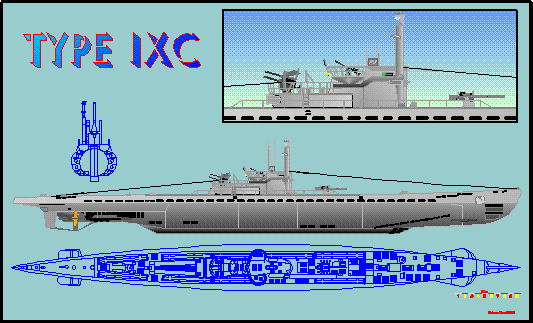
2 Likes
That made me laugh… I’m hoping you know what I’m getting at…
1 Like
@Cloclo The answer is: Yes and Yes… CDs are an analog storage medium and the digital bits are stored in the encoded disc as different length “pits”… it is read by an analog laser light refracting from the reflective analog substrate of the CD medium… A computer punch-card is an analog storage device, an analog piece of paper with analog holes of different length punched in it, that cause an optical reader to interpret the flashes of light as digital code that is transformed into electrical signals to be used in the computer CPU…
No it is streamed with digitized-audio code protocol, conveyed by analog laser light pulses…
You play again with semantics that do not hold water from a technological POV.
The answer is what @OffRode posted: “It’s either one or the other”.
When stored on a CD, on a perforated card, or streamed through fiber: you have a clear differentiation between 1s and 0s. And there’s nothing between, and no jitter at all.
In theory, when streamed by an electrical current, the differentiation should have been also clear by the difference of voltages. But in practice, the interferences in this analog medium provoke variations of the amplitude of the voltages. And they provoke variations of the curves of the waves.
If you don’t remove the noise, and don’t reclock the digital sound, the clocks of the DAC won’t perform at their best precision.
This link is not directly related to the topic that we are discussing, but it explains quite well all these issues that occur only in an analog medium.
Okay… but what is a “1” bit or a “0” bit…?. (hint: it’s not “one or the other” that was a joke that @OffRode was making)… The true bits are those that are stored and represent the encoded signal stored on any medium… In the case of a CD the short length ‘pits’ are read as a ‘!’ and the longer ‘pits’ are read as “0”…This encoded digital-audio protocol signal is translated into analog voltages by the interpolator that produces analog voltage signal pulses that the CPU can work with…
Land or pit are interpreted as 1 or 0 , one or the 0ther
1 Like
Thanks for clearing that up…
1 Like
The difference is that in a digital medium, the answer is always simple a Yes/No, and there’s nothing between.
In an electrical current, perfect Yes/No answers do not exist, and can not exist. Even in the best setup, there are variations in amplitude, and there are variations in timing. That’s the difference between an analog medium and a digital medium, though the DATA remains the same.
Yes/no or maybe accurately more like on/off
1 Like
Not so… I can demonstrate how the lands/pits can be misinterpreted by the laser not reading the leading-edge of a land/pit and the trailing-edge of the land/pit… I use a electromagnet to slightly heat the aluminum or gold plating covering the land/pits of a commercially encoded CD and improve the output quality of that CD, because I forced the metal plating to conform better to the leading and trailing edges of the land/pits… therefore reducing the potential for misinterpretation of the encoded signal… This same idea can be extrapolated into the electronic digital-audio signal waveform as it is being read by an interpolator… In the case of a user 'burned" CDR, the encoded signal is a transformation of the substrate color and length of the burned traces…