Here’s an image from the original linked page showing 8 channel input mixed to 2-channel stereo. As the article from which the image comes states, currently HQPP is less convenient to use than mixing through DXD with Pyramix. It just depends whether people think the sound is worth it.
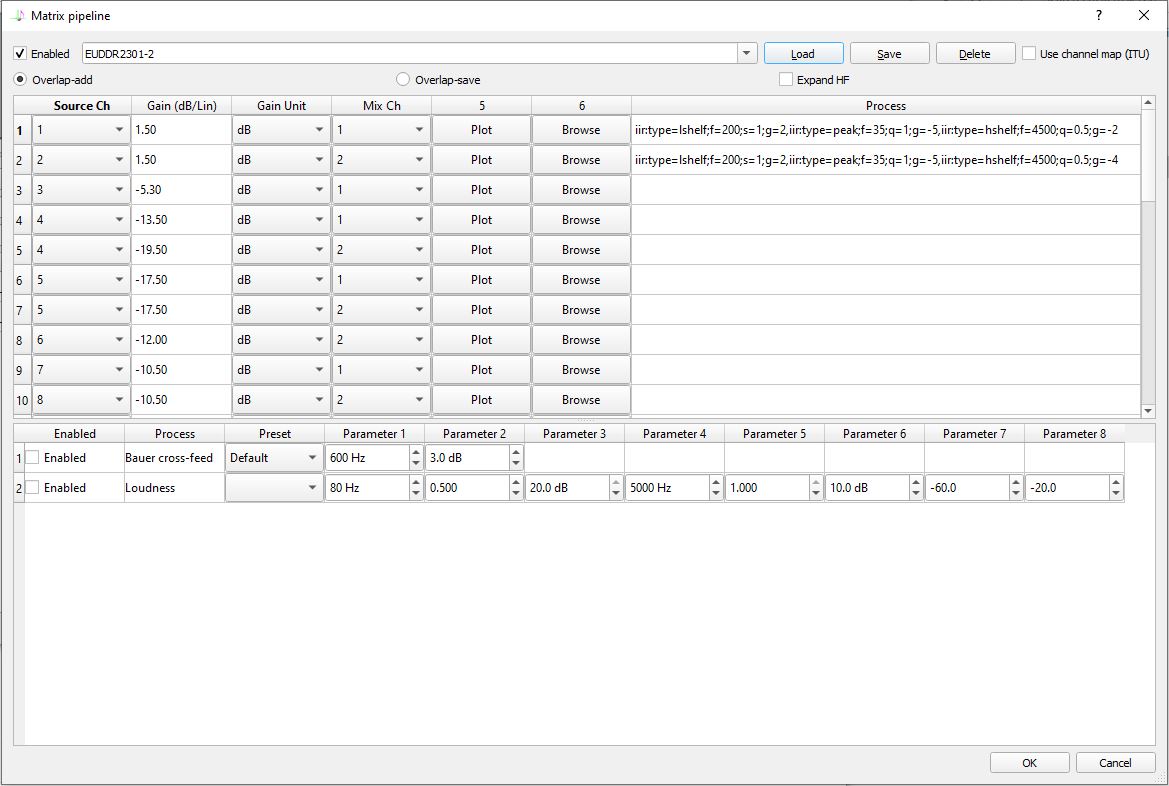
Thanks again… I believe that HQPP cannot handle more than 2-channels of 1-bit 11.2MHz PDM input from the ADC… Offline it may be able to handle more track files at lower sample-rates… However, in this 11.2MHz scenario, if you look more closely at this image of the mix GUI, you see only ‘Source CH’ 1 & 2 being processed…
It is plainly obvious the HQP editing/DSP flow is agonizing and really not practical… My bet is, a Multi-Channel 1-bit PDM 11.2MHz ADC encoding → High-End Analog Mix/Processing → 1-bit PDM 11.2MHz ADC → Master Encoding, sounds better… 
Mix channel 1 and 2, mixdown to stereo. The matrix path has ten channels (8 source channels, 4 and 5 being doubled) mixed down to two.
Okay… but those files were not recorded by HQPP…
From the album notes provided by NativeDSD:
“Lost in Venice, was mixed in post, but mixed entirely in DSD. Tom Caulfield at NativeDSD accomplished mixing channels from 12 different microphones: main pair, room pair and spot microphones. He did this following Gonzalo’s instructions using the remodulation capabilities in Signalyst HQPlayer 4 Professional.”
Most likely the tracks were recorded in Pyramix at 11.2MHz.
Even if this is the case, does it matter?
Isn’t it that big things always have small beginnings?
To stay with the original sample rate of DSD256 is the way to go but needs much more CPU power than to downsample to DXD rates.
So I bet a future Pyramix will work with the same principle.
You are right… The 1-bit PDM encoding sample-rate is the common denominator… However, the integrity of the original 11.2MHz encoding is compromised by the HQPP editing processing where the 1-bit PDM signal is modulated to multi-bit PDM (DSD-Wide) and subsequently decimated to the source 1-bit PDM sample-rate for output… In fact Tom Caulfield advises in the Positive Feedback article:
“…Just keep in mind what Tom Caulfield advised when talking with me: keep to a single pass with all changes built into that one pass through the software. DSD modulation is just like analog tape: multiple generations eventually accumulate audible artifacts. Always go back to your source files and feed them in with all the changes you need to make. Never add a modulation on top of a modulation.”
In reality, the sound of all recordings is intrinsically tied to the analog electronics and devices used in capturing the performance(s)… There is no ‘Pure DSD’ signal path in the A/D process… it is only subsequent of the capture of the sound-pressure waveforms by the microphones, that have converted those pressure waves into electrical voltages presented to the analog preamps and sampling electronics that interpolate those voltages into the 1-bit PDM encoding that codify the ‘digital-audio’ sample-rate signal voltages.
The primary sound of the encoding is intrinsically tied to the choice of the device components, production decisions about placement, environment, proximity, etc, etc, utilized in the capture process. There are no devices that capture sound-pressure waves at the transducer device and instantly interpolates them into 11.2MHz 1-bit PDM digital signals.
The likely-hood of efficient high-resolution 1-bit PDM mix editing and applied DSP of multiple tracks in the context of 11.2MHz is far, far off in the future and at this point in reasonable computational resources used in the post-production workflow. When this does come about, these processes will be at the mercy of the computational platform capabilities in-order to maintain the integrity of the multi-track 11.2MHz signal to output.
In the real-world, a post-production workflow that starts with the 1-bit PDM 11.2MHz sample-rate ADC (Analog to Digital Converter) encoding, being mixed and processed in the analog domain through high-end electronics and resampled with the 1-bit PDM 11.2MHz sample-rate ADC for mastering and distribution is the way to go… Just think about how many great sounding master recordings are available on tape and vinyl that are still today some of the benchmarks in sound and production quality… The 11.2MHz workflow as I have described above, will facilitate some of the finest productions we have ever known.

What about the possibility of ramifications?
1 Like
From the Positive Feedback article linked below:
What we mean by “Pure DSD”
I’m following Tom Caulfield’s lexicon here. Tom is NativeDSD’s mastering engineer and, to the best of my knowledge, he coined the term “Pure DSD.” So, I’m sticking with his definition and how he applies it in tagging files placed in the NativeDSD website catalog for download.
In short, a “Pure DSD” file is a DSD file that has been created from an analog input signal and has not experienced any processing in PCM. No trip out for a DXD project session in your digital audio workstation of choice to mix and sweeten it. No conversion from a PCM original recording. If the file has been converted to DSD from DXD or some other resolution of PCM (44.1kHz, 96kHz, 192kHz, etc.), it is not a Pure DSD file.
On the other hand, an analog tape converted directly to DSD via an A/D Converter would be Pure DSD, assuming no processing in PCM. And a recording converted to analog for mixing and any sweetening in an analog analog mixing board/desk, and then converted to DSD would also be Pure DSD, again assuming no processing in PCM. So, the term “Pure DSD” is a bit flexible in these respects. But, that flexibility is a reflection of the several ways recording and mastering engineers are working with DSD files to maintain them as “Pure DSD” while meeting the needs of the project and the desired outcomes.
To differentiate these, Tom has suggested the following two labels:
Pure DSD-Direct Mixed
This is the recording process where the DSD recorded original microphone tracking channels are mixed and optionally sweetened (EQ, reverb etc.) entirely in the DSD* domain, without conversion to another format.
Pure DSD-Analog Mixed
This is the recording process where the recorded microphone tracking channels are mixed and optionally sweetened (EQ, reverb etc.) in an analog mixing desk. The original tracking channels are converted to analog, processed in an analog mixing board, and then converted back to DSD. This category also includes on-the-fly, real-time, analog microphone channel mixing and optional sweetening during the recording session, whose output is then tracked to DSD.
There is no ranking implied in these different DSD Pure categories. Each is optimized for the music, recording type, and available source material. They each can be the best practical expression of the available resources and trade-offs. All are Pure DSD.
Master Tape Listening Experience with Pure DSD256 - Positive Feedback


If a fortification is a large fort, then a ramification….
1 Like
Rampart
2 Likes
Nah… this is a ‘ramification’… The fortress ramparts of conformity and insipidness have been breached…

There is a new thread on Steve Hoffman site about pure dsd also, many link in it, maybe some are the same as here?? Didn’t read either thread 
1 Like
Yep, same as here. 
2 Likes
I’ve now had a chance to listen to the samples. The sampler is nicely set up, 6 musical excerpts slightly longer than a minute each, consisting of 3 DSD256 recordings edited in DXD, each followed by the same recording edited without leaving the DSD domain.
Before I give my listening impressions, I’d be interested in hearing from others. Anyone?
I listened to it a few times.
The difference in sound quality between the two types of editing is very subtle.
For my personal taste, I found the DSD256 recordings edited in DXD to be slightly better.
1 Like
That’s interesting, because the DXD editing process loses (throws away) a significant level of the DSD256 sample resolution… 11.2 million samples per second in DSD256 reduced to 352.8 thousand samples per second in DXD which is then modulated to 11.2MHz subsequent of the edit… That’s a fair amount of encoded information tossed-away in the process… approximately 10.8 million samples per second… 
I agree the difference is quite subtle. (And I am only talking about my subjective reaction, knowing which file was which, so I’m not making any claims about an objective difference.)
I would say that my perception in my system was that the violin in particular had a bit more edginess to it on the DXD edited file. The violin sounded smoother to me on the DSD edited file without losing detail. In fact I thought I could hear background instruments a little better.
So overall I personally preferred the DSD edited file. But it’s quite possible this could all be in my head.
1 Like
Here I listened to the files through speakers.
I didn’t listen with headphones.
I agree with you, it’s just my subjective opinion.
1 Like
Did you get to listen to the files?