My mind is jittering a bit.. corrected the statement: "Decimation to 24/352.8kHz is a multiple of 44.14kHz… "
Also, don’t be afraid of DoP (DSD over PCM) encapsulation… This is just a technique to deliver 1-bit files embedded in a dummy PCM carrier file where it is extracted in the DAC architecture… no loss of signal integrity. This is how DSD is transmitted via USB on macOS platforms and with certain Windows drivers..


So this is the a simple explanation…
When modulating PCM files to 1-bit PDM (DSD) files, the resulting Nyquist Frequency Filter cut-off is pushed far beyond human perception and the dynamic range is increased… The Nyquist Fc of a 1-bit 2.8MHz (DSD64) is 1.4MHz… A 16/bit 44.1kHz file will have its Nyquist cut-off frequency (Fc) of 22kHz (no information beyond) and a dynamic-range of approximately 96dB (theoretic) these factors are codified in the encoding process… When this file is modulated to 1-bit PDM, nothing is added and nothing is lost, however, the dynamic-range is increased, which reveals the low-level details hidden in the quantization-noise of the 16bit file… A 1-bit PDM signal presents to a simple low-pass filtered digital-to-analog output circuit, a very smooth voltage waveform that is very similar to a pure analog voltage signal waveform... The modulated PCM source file will be presented fully, and naturally…
So, up-sampling PCM to higher resolution PCM sample-rates similarly moves the Nyquist Fc beyond human audibility, but with a quantization factor intrinsically tied to the target sample-rate and bit-depth and requires a more complex D/A circuit topology.
1 Like
Agoldnear,
I did a little more digging and I’m extremely perplexed. Please don’t feel obligated to answer; I’ve taken up enough of your time already.
This article states “DSD is actually converted natively via I2S and USB rather than first being converted into a PCM signal.” and “I2S: PCM 16 and 24 bits at 44.1kHz, 48kHz, 88.2kHz, 96kHz, 176.4kHz, 192kHz, 352.8kHz, 705.6kHz, and 768kHz; DoP64, DoP128, DoP256, DSD64, DSD128, DSD256.”
This article states “IS2 Digital input
-
Connector: HDMI
-
Format: PCM or DSD. DoP on all inputs as well as native DSD on 12S inputs”
It appears the above text was pulled from PS Audio’s own website:
“IS2 Digital input
-
Connector: HDMI
-
Format: PCM or DSD. DoP on all inputs as well as native DSD on 12S inputs”
Hifi News “The upgraded DAC, which feeds into a new ‘high slew rate, low feedback’ balanced output stage, offers seven digital filters, and provides file format handling to 768kHz PCM/DSD256 via the I2S connections and 384kHz/DSD128 over USB, while the coaxial input is compatible with 192kHz media and DoP64.”
I came across a handful of other sites stating the same, but I think you get the point. This is why I was certain it could do native DSD. I feel like I must be missing something. The info-graphic you provided, if I’m interpreting it correctly, seems to make native DSD an impossibility.
I’m going to reach out to PS Audio directly.
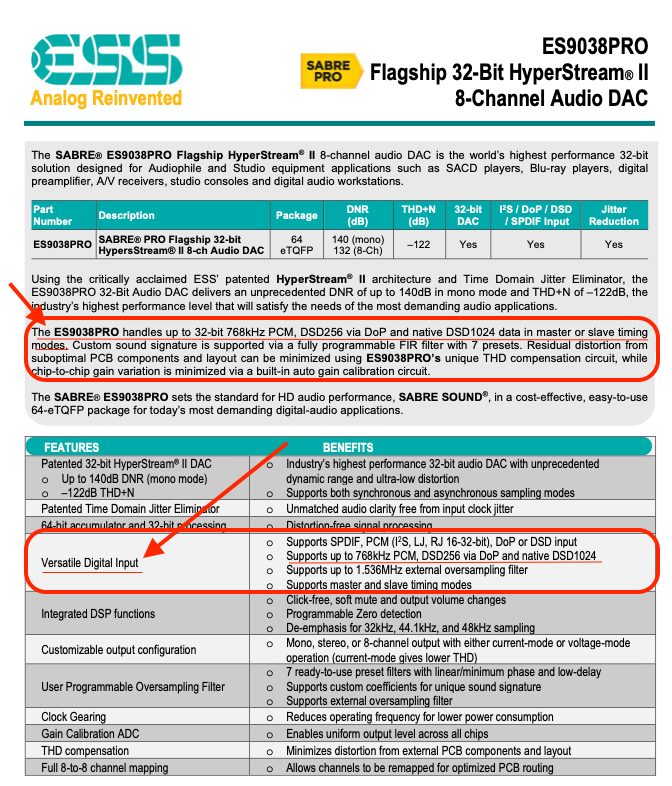
ESS 9038 PRO datasheet: “High Sample Rates Up to PCM 768kHz & native DSD1024” (pg. 1)
Your PCM modulation explanation should be in a textbook. The most succinct and clear explanation I’ve read.
It is the nature of the Hyperstream technology that is PCM-centric..
I2S is the fundamental signal connection of the chipset, so yes the output is multi-bit DSD commonly called “DSD-Wide”… there is no pure 1-bit PDM signal path to the output circuitry…
Don’t fall into the trap of trying to contort the information to fit a narrative…
The data-sheet is describing the input data sample-rate support… All of the on-chip DSP is done in the PCM domain… All signals are converted to a very high sample-rate in their proprietary Hyperstream DSP algorithm, down-converted and output as a typical multi-bit DSD-wide signal for analog conversion…
This is similar to how the CHORD DAVE WTA filter works…
Don’t be, it’s just opposing semantics about the same process. We’ll get to the important part in a minute.
The semantics are because ESS uses a hybrid process, not 1-bit DSD but something variously called “DSD-wide” or sometimes derisively “PCM-narrow,” which converts to multibit. This is not important.
What is important is what gives better performance. The performance of ESS chips, including this one, has been extensively measured, and DSD input gives slightly better results. (In particular, it minimizes a characteristic intermodulation distortion “hump” in the ESS output.) This is at low levels, so whether it is audible, who knows?
As a result, there are two answers: (1) Go with whatever sounds better to you. (2) If you like DSD256, no reason to change.
The rationale not to deliver modulated PCM → DSD files (DSD256 or any modulated DSD sample-rate) is, that it is redundant and requires a decimation process back to PCM in the ESS DSP sample-rate conversion architecture for Hyperstream processing… If you send a 352.8kHz up-sample file (44.14kHz base sample-rate/ Power of Two strategy) to the DAC, less processing overhead in the chipset is required and this reduces intrinsic noise related influence (jitter) on the digital-audio signal, because the decimation process is eliminated… Ultimately, ESS DAC chipsets produce a multi-bit DSD-Wide signal to the output circuitry… there is no simple 1-bit PDM signal path to a low-pass filtered D/A output circuit. [Note: the Airlens Streamer supports up-to 384kHz PCM]
If you send a native 1-bit PDM (DSD) file to the DAC chipset, it will decimate this file to PCM and up-sample to a relevant high sample-rate for processing and the ultimate multi-bit DSD-Wide signal for output (typically 8-bit), through the Hyperstream technology and symbiotic D/A architecture, at their target sample-rate and bit-depth.
There is no way to compare the output of the ESS system to a DSD-centric DAC architecture that provides a simple 1-bit PDM signal flow to output… If you are satisfied with the sound of the PS Audio DAC, then reducing all noise potentials will only enhance the experience… You will be the arbiter if my suggestion(s) make an audible difference to you… There is a reason PS Audio is DSD-centric at the high-end of the product line…