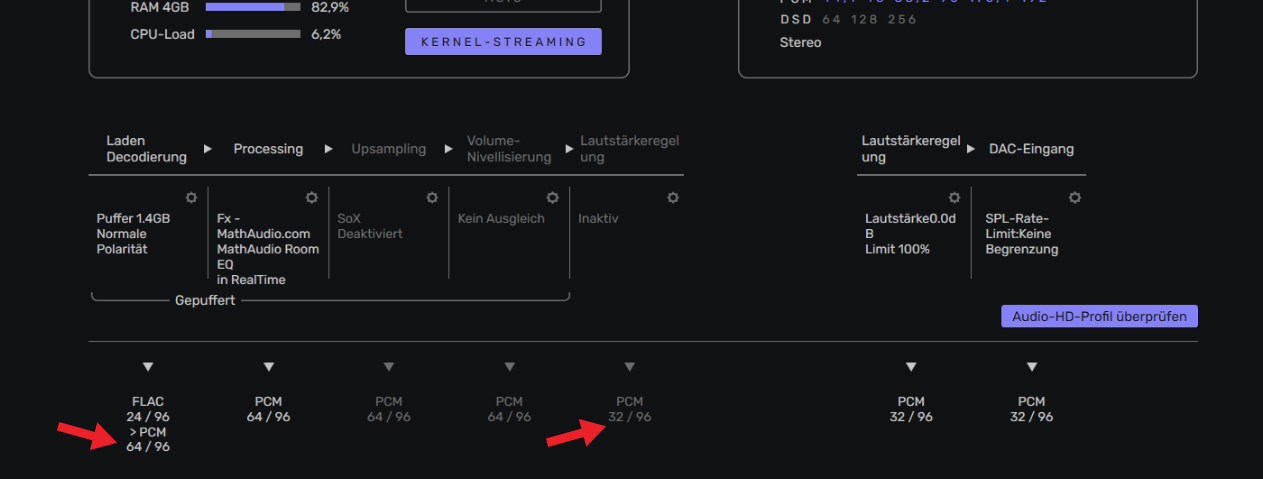
Thank you for this very interesting feedback. It is indeed possible that some editors keep an ASIO compatible interface but rely on windows layers to simplify their software.
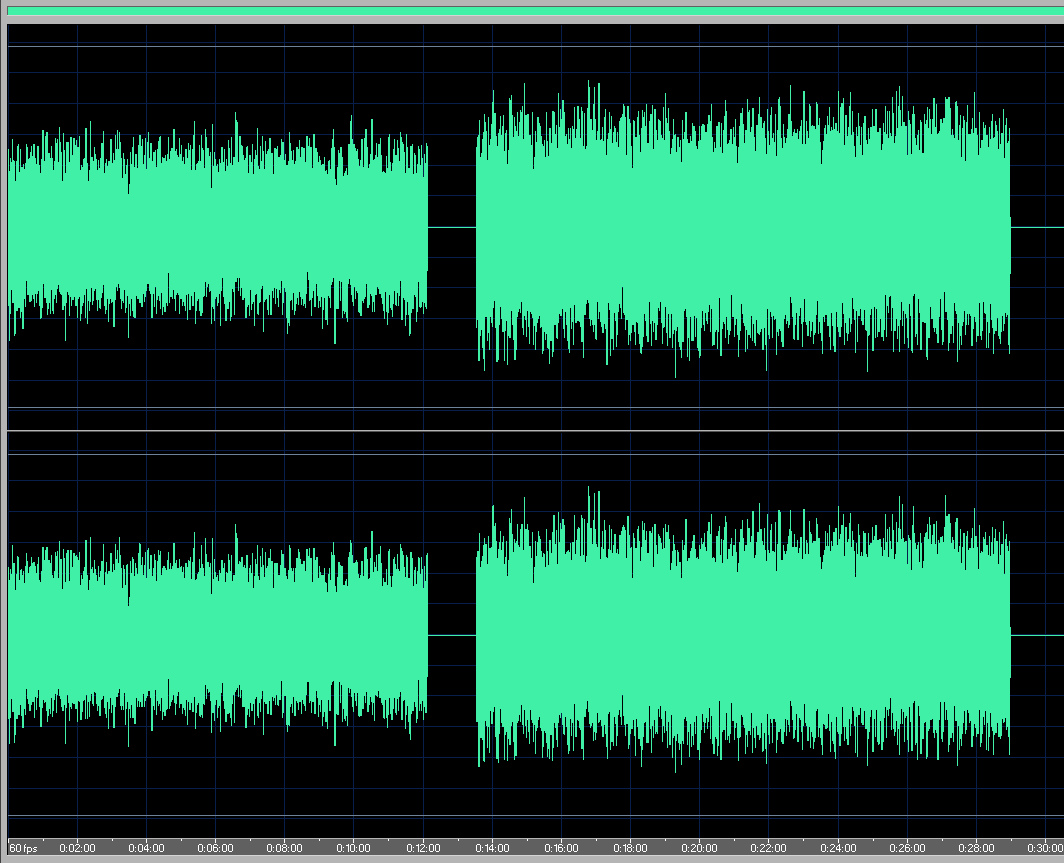
I can’t confirm that but, if true, it basically means that one of the Audirvana’s is not bit perfect. Because bit perfect should bypass (amongst other things) the volume controls of the OS and therefore both should be equally loud.
Edit:
Maybe I am superfluous here, but assuming you tested this without resampling and other forms of DSP of course.
Aha. As I also suspected.
Don’t know much about »bit perfect«, but I guess both examples are not, for I am using the MathAudio vst3. With the same settings for both Audirvanas, of course.
Guys, IMHO there’s no discernible difference between 3.5 and AS. AS is built from 3.5. If you can do A/B comparisons you might find you agree.
It depends a lot which versions you are comparing. And what equipment you are comparing on.
Indeed the latest 3.5.46 and 1.3 the difference is not huge but present.
AS 1.2 and below can sound quite a bit worse.
I re-did my pink noise comparison with de-activated vst3 moduls.
Result: AS output with a very small volume level difference of 0,17 dB, instead of 2,5 dB with my MathAudio vst3 activated. No idea why this seems to play such a big part in terms of different output volume levels 
That is why I asked if you where using resampling and/or DSP, because the only objective measurements (you can trust) are without resampling and digital signal processing. Any added element that alters the sound can introduce differences 
That is what I meant with bit-perfect (let both Audirvana pass through the sound without alterations and in both the volume slider on max).
can studio MQA?
3.5 indicates MQA with a green light.
Unlike EQ, if properly done, upsampling should not alter the sound. The sound remains bit-perfect even upsampled. But we call by convenience bi-perfect only the unresampled mode.
I’m very doubtful about that assumption. Upsampling does alter sound, and there are many algorithms and options to tweak the result. It also modifies the gain (and the AS information box warns about it).
If upsampling didn’t alter the sound, hopefully in a positive way ( but that’s subjective ) what would be the point?
A proper upsampling is not supposed to alter the sound. If it is not done by the CPU of the computer and the algorithms of the player, it will be done anyway by the processor of the DAC and the algorithm of the DAC.
For my DAC for instance, iFi guarantees it Bit-perfect all along the chain of upsampling.
I heard Damien years ago explaining it very well.
He said that Audirvana’s mode (algorithm), at the time it was iZotope, combined to the power of the CPU of the computer provides a better SQ than the upsampling by the DAC. The reason for that is the high quality of the algorithm of Audirvana and the fact that the CPU of the computer is more powerful than the processor of the DAC.
Since then DACs improved, but upsampling by players improved as well. So for a given DAC and a given player, you should listen to the upsampling by the player and to the upsampling by the DAC, and choose what you like better.
If you’re referring to the GTO filter, it’s a workaround to internally feed the DAC at maximum clock speed which can give better results for said chip (I use a Zen Dac with GTO filter and can testify the burr brown chip did sound different when the firmware update enabled the filter - but as a result it’s not bit-perfect anymore, the DAC is unaware of the original resolution). I don’t remember how it’s done but it could simply be adding “0”, which is neutral. Upsampling like Sox or r8brain like those implemented in Audirvana do have an impact on the sound, positively and negatively depending on the settings and the DAC receiving it.
Think about a picture. Sox and r8brain upscale the picture to a said definition, like bilinear or lanczos would. This isn’t neutral, if it was, then it’d just be either resizing the canvas but not the picture itself, or using nearest neighbour pixel doubling (and both these methods exist in audio I’m sure).
I’m definitely not a specialist about this, but as long as you have sliders with audible differences when playing with them while always maintaining the same resolution, it obviously alters sound.
It’s quite analogue indeed to a picture which’s resolution is increased.
It will be increased anyway, either by the player and the CPU of the computer or by the processor of the DAC and its algorithm.
If you prefer the sound of the upsampling of the player + CPU of the computer, it means, by analogy to the picture, that they provide a cleaner resolution than the DAC. If you prefer the upsampling by the DAC it means that it performs better with its own algorithm and processor than the player and the CPU, and provides a picture with a nicer resolution.
Sure. But if you plug in the same EQ module with the same settings as well into 3.5 and into AS, one might expect the same EQ-ed output from each of the given Audirvanas (3.5.46 and AS 1.3.0.0 in my case). Well, at least I expected that.
I have no idea why there is a difference between the two players with the same module.
I was talking only about upsampling. EQ is something different, it alters the sound.