Got me to spend some goofing off time fiddling about. First epiphany, I did have a USB cable feeding the Oppo 205. Sweet. Fired old reliable 3.5 up and input @mhsmit Sox settings, quickly realized the top end was way more than my conglomeration of equipment and my ears could live with. ESS Sabre thing?
Mac Mini M2, Oppo 205 Analog out, NAD M33 full Dirac, B&W 805D2, B&W 610 Sub, cheap ass cables and power right out of the UPS.
The Oppo 205 uses the ES9038PRO chipset… It’s more evidence that the filter parameters of the up-sampling algorithm(s) are generalizations that need refinement through experimentation, where very small changes in the values will have big impact on the output signal quality and are intrinsically bound to the playback system architecture… There is no way to replicate his playback system to corroborate his assertions…We can only get a feel for his improved perceptual appreciation of the sound of his system after applying up-sampling.
Also, you probably would need to adjust the Dirac response if you were already using the SoX up-sampling algorithm with different settings or r8Brain algorithm settings.
That was upsample to DSD128, listening to Pat Metheny Group stuff I know intimately on this system. Lyle Mays piano was jumping out but the cymbals and such were shrill. You don’t know until you try with your own system, room, ears.
Somewhat interesting to me because we’re both using the same tweeter I believe.
I only have 3.5 currently. Yep good call didn’t think about shutting off Dirac, but I use it with everything else and it makes a huge positive improvement.
All in system synergy I think?
So second epiphany, realizing I have a USB cable hooked up I enabled brand R and set up to upsample to DSD128, not to shabby.
@OffRode … A key thing to keep in mind…
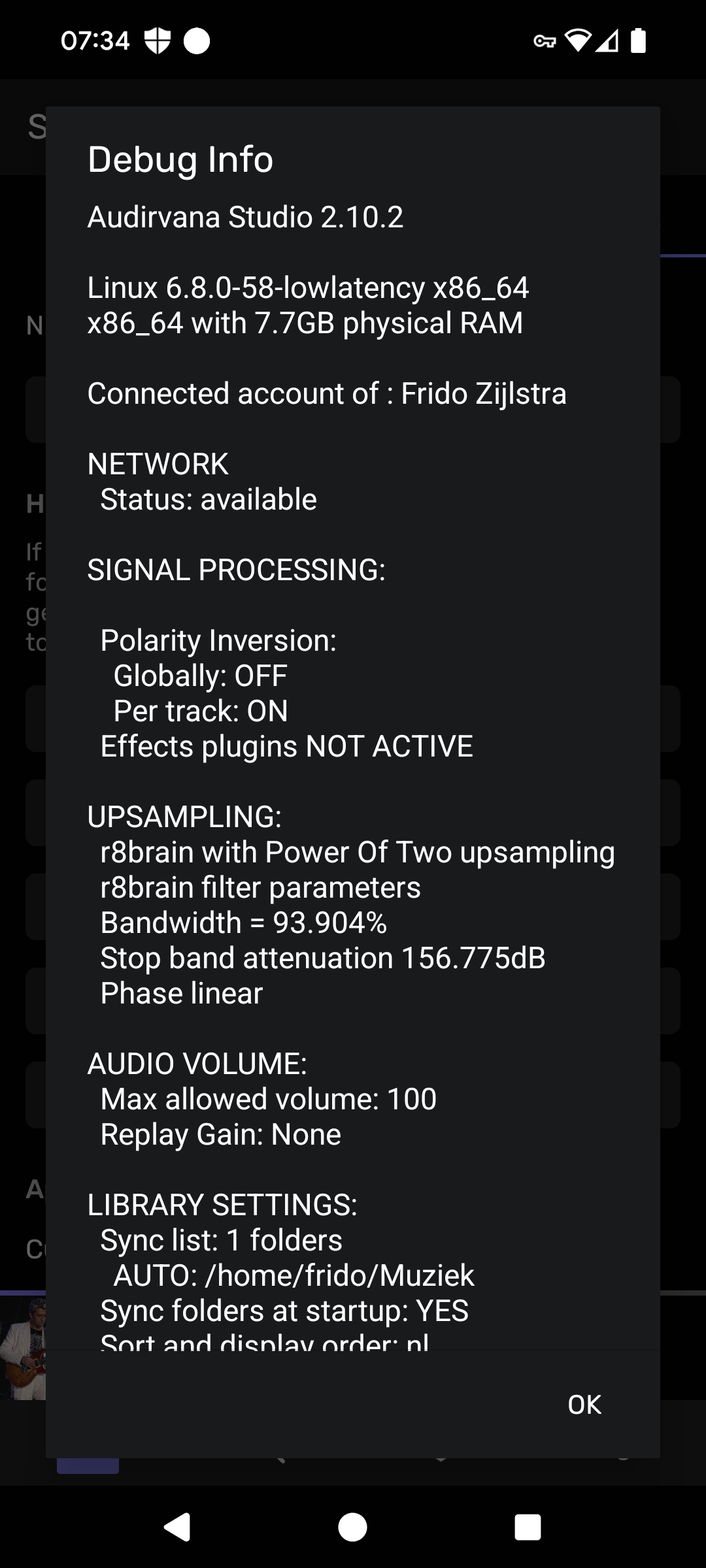
Just because the r8Brain module in Audirvāna has less parameters to adjust, does not mean it is less effective in operation… there are synergistic elements that are ganged to the visual controls and better understanding of the influence of stop band frequency amplitude and the differences between Linear Phase and Minimum Phase filter application and filter tap-length the better you can fine tune the output to suit ones aesthetic.
That’s something one should not leave out of the options when comparing. In my set up I have found yesterday that r8Brain has a greater positive effect than SoX. Sound has more body, especially in lower frequencies, without losing detail.
I can only guess why, I am by no means well educated on the technical side of things. But I just try to trust my ears.
There is one negative experience with r8Brain however which is rather annoying. Audirvāna is stable in my set up when using SoX. But with r8Brain it skips before the end of a song more often. About 30 seconds before the end it skips the rest and goes to the next song. Why is beyond me. Maybe you guys could help me to get rid of that behaviour.
Typically this is behavior would be related to available System RAM for in support of Audirvāna operations… The speed/throughput of the memory bus and the transfer-rate of the Library drive also play into this… Is your Library stored on the System drive? How is the library attached to the computer and what computer platform are you using?
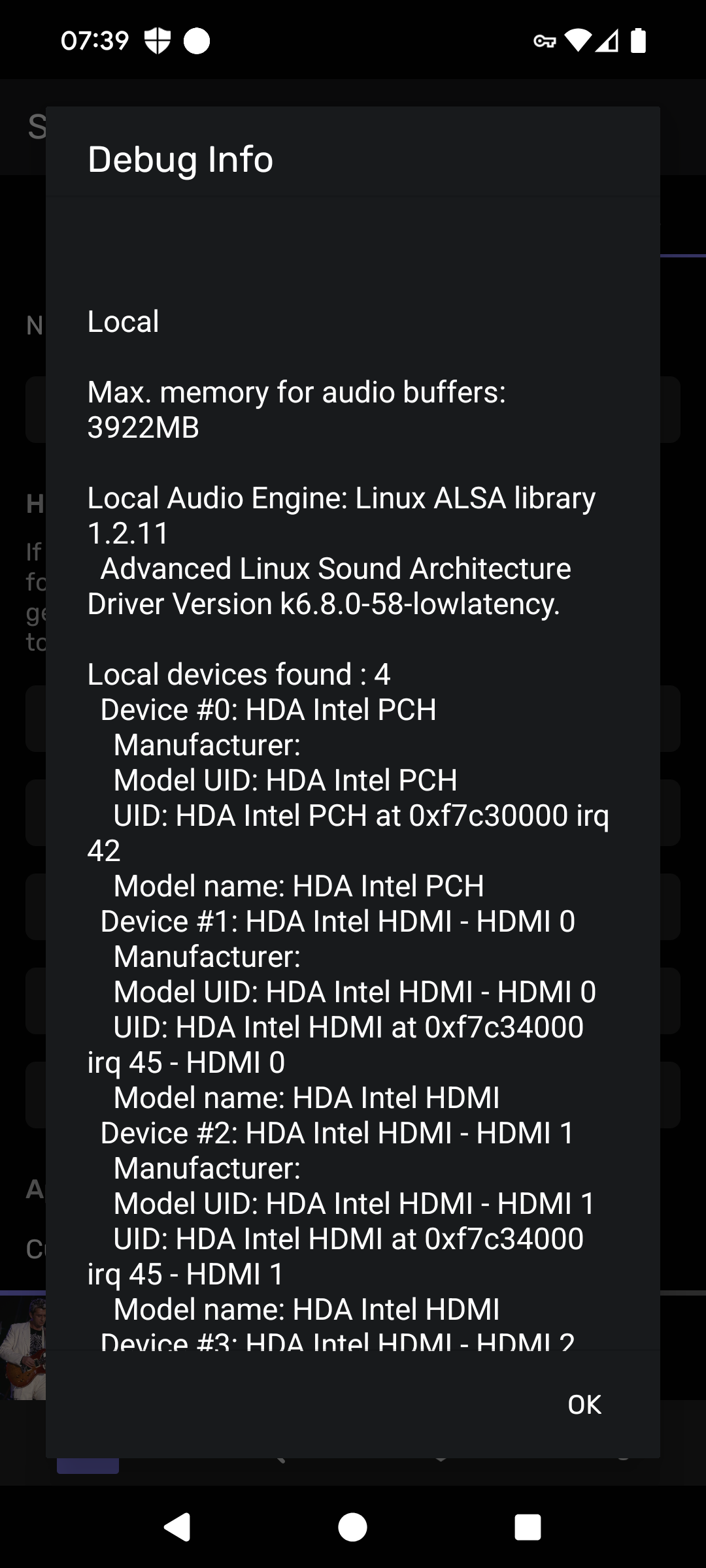
You are using about 50% of your available System RAM (7.7GB) for playback pre-load buffer memory (3.9GB)… Lower this to 1GB… If your Library is stored on your System drive, this is not good… best to use an outboard USB 3.0 SSD on a very short cable.
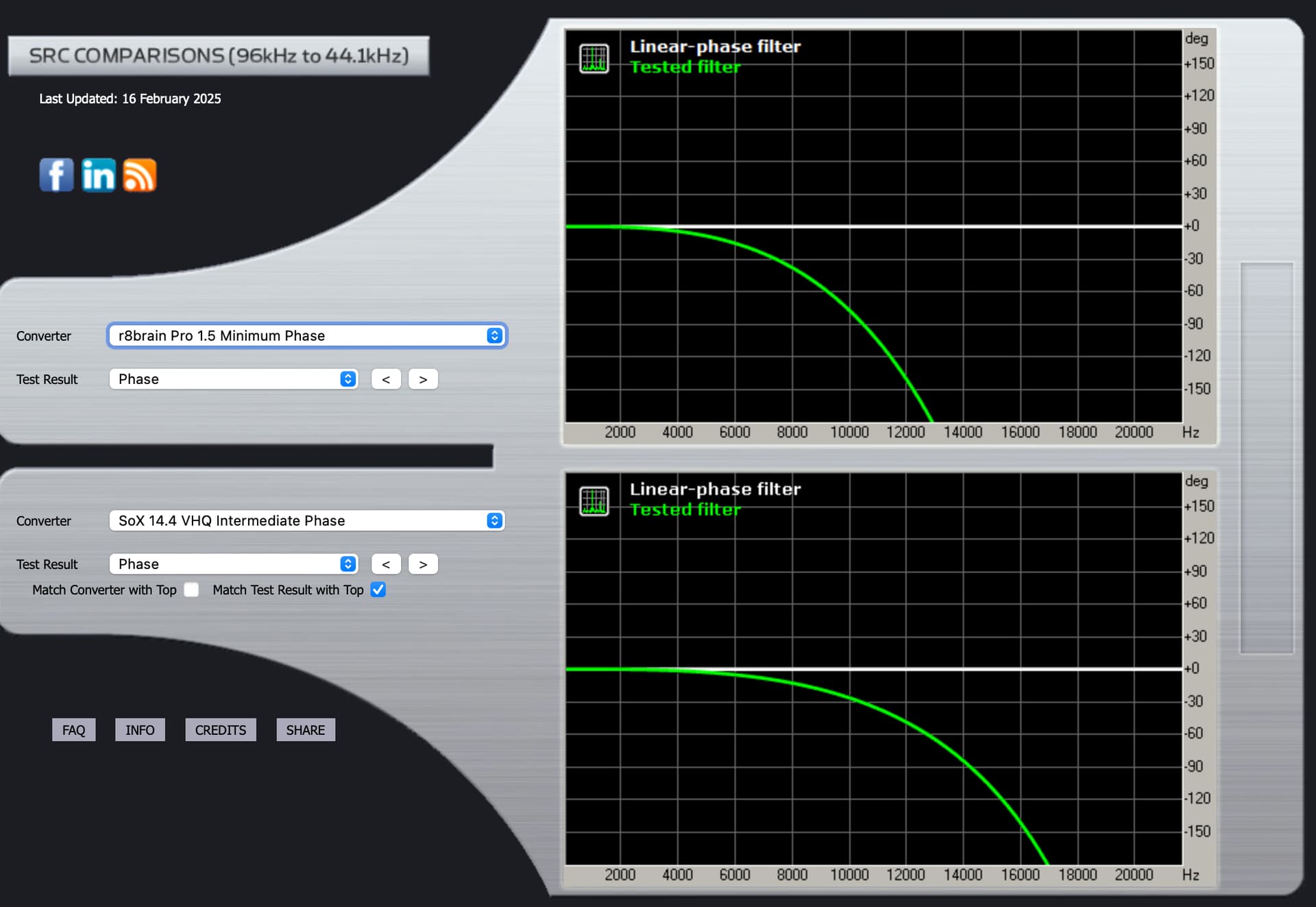
It’s a Canadian site that has barred access from the US for the time being, but if you could go to src.infinitewave.ca and copy and paste here the graphs you see there for R8brain and Sox, linear and minimum phase, on the impulse response and transition band measurements, we could discuss those. Thanks!
Wow, that is a very comprehensive and interesting comparison site. Through years of experimentation/listening I’ve arrived at an “intermediary” SoX phase setting, slanted towards linear phase (66%), for example. r8brain (as exposed in Audirvana) doesn’t currently seem to enable me to reach this phase curve. Which could explain why I ended up still preferring SoX.
Cool. Warmer bass (than with SoX) is also what I found when auditioning listening through my Yamaha Receiver with PCM and r8brain “Power of Two” subsampling. But for me realism of analog instruments (such as the harmonics of acoustic guitar and xylophone) suffered. I’m probably very sensitive to Phase. r8brain’s “Linear Phase” sounds less natural to me. And “Minimum Phase” isn’t ideal either.
I’m curious as to why the Phase filter isn’t more granularly adjustable with r8brain.
My personal experience has been that these settings are heavily dependent on the whole system. The more I spent optimizing power, the less aggressive my system started to sound. In the past, having a silver fuse in my main fuse holder resulted in way too aggressive highs… now I’m much more neutral between it and my gold-plated copper fuse.
I feel that system “optimizations” (beyond power including even things like Ethernet switch and USB cable) have removed more and more “aggression” from the system. The aggression turning out (to my ears) not part of the actual music.
As an analogy: It reminds me a bit of the “sharpness” controls on TVs. The first thing I do when I get a new TV is reduce it to 0. The initial impression is that of a softer image. But then I start to see the actual natural image, which, to me, gives the most satisfaction. Your preference may be different and that is fine!
Very nice equipment. I would definitely recommend trying upgraded power cables. Doesn’t need to be super expensive. I’m not a big fan of Temu and I ended up with mostly high stuff from a Canadian company called DR Acoustics, but I was tempted to try the blue “YYTCG EU 7NOCC” cable from Temu last year… at only around $40 it provided a very significant step up in sound quality from the standard black power cable*, It had the same neutral character of the higher-end cables, both to my Yamaha receiver or to the external LPS powering my Mac mini. The higher end cables, to my ears, resulted in an even blacker background, finer details (smoother air, less aggressive sibilance) and clearer soundstage.
I’ve also tried “cheap” Chinese cables from Amazon for another Yamaha receiver in my studio. One of them had silver injected into the wire and was the most expensive, but for me it sounded the worst. I believe in a good shielded pure copper power cable with solid gold-plated (or if you have the budget, rhodium) connectors.
In my latest Audirvana tweaking round (over multiple weeks) I heard the differences in minor adjustments much more clearly than ever. For example, previously, when I was still on Audirvana 3.5, I only heard differences when changing “SoX Filter Max. Length” with, say, 100 or 200 increments. Now with one of my tracks I even heard a difference in particular instruments when changing by 1 or 2 increments! It has really surprised me, in a positive way.
I did not do the physical system optimizations all at once. Even the room treatment in my new house took me three years to tune (where the challenge is to find solutions that sound good but also don’t look ugly)
*if you do decide to try out power cables, many recommend that you should get at least 5ft/1,5m. I once had a 1m AudioQuest power cable that indeed didn’t sound as good (with my UHD player) as a 2m one.
I know you have good reasons to include a UPS, but be aware that it can definitely affect sound quality. I am lucky to have moved to a country with a very reliable and stable power grid, with few thunderstorms around. In my previous house I invested in “whole house” surge protection. In my new house, I’m currently feeding the audio system straight through an audiophile 16A fuse, after the regular slow 16A fuse for each phase that goes into my house. There is obviously some inherent risk… so I understand if others opt for better protection.
When I built this house, I made sure that no switching devices are on the phase I use for audio (most Swedish houses already have three power phases to their main electricity cabinet and there’s no surcharge, which is amazing compared to many other countries).
In my previous house originally the LED light dimmers were on the same phase and this resulted in awful smearing that went away when I moved those electricity groups (their breakers) to one of the two other phases.
These changes all contributed to Audirvana’s upsampling tweak results becoming ever more evident and the music sounding ever more natural.