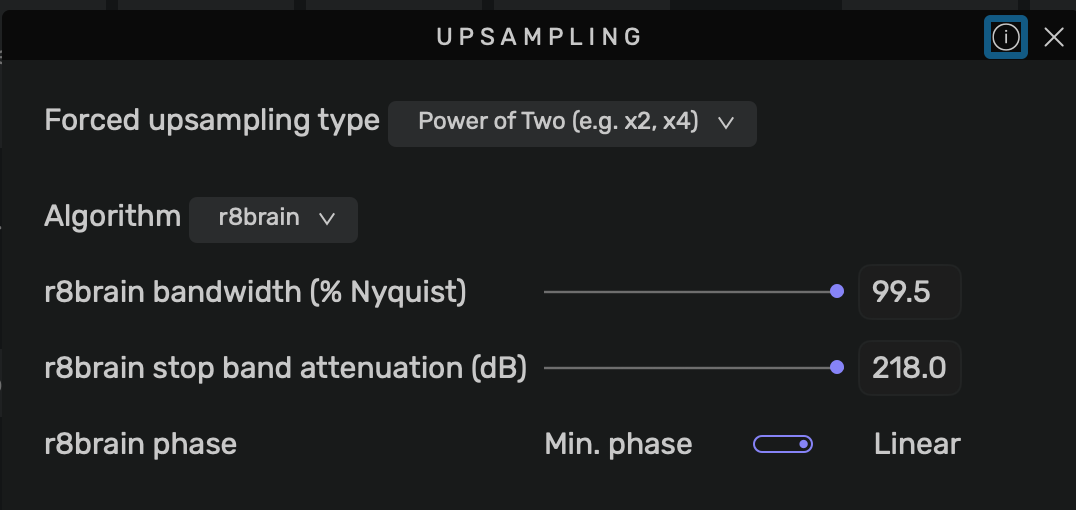
I read a long and detailed thread about ChatGPT guiding an analysis of tuning a system to the room. This is not that. It’s a much simpler and less instrumented experiment. System:
Mac Mini running Tahoe 26.4.1
Audirvana Origin 2.6.5 (20605)
Schiit Modius E DAC
Prima Luna Dialog 2 amp
KEF LS50 Meta speakers
The question I asked was simple: which sounded better to my ears: Upsampling deactivated or upsampling r8brain
I listened to some recommended music and compared using my ears and no additional instrumentation. The result: I preferred the sound with upsampling deactivated. Phrases come to mind like:
more “in the room”
more attack on the instruments
more space between instruments
I get that this is not rigorous, but I offer it up for whatever it is worth.
I suggest a better approach…
Read the Audirvāna Knowledge base on the functional parameters of r8Brain and then experiment with the stop band attenuation setting to fine tune the output to your playback system… I suggest starting with the stop band attenuation set to 166dB and adjust incrementally (+/-) from there as very small 1dB changes produce dramatic results…and keep the filter phase as ‘Linear’ and the Nyquist unchanged.
Make adjustments and listen and absorb over a couple of days… being vigilant of ear-fatigue in the assessment process.
Upsampling does nothing to the encoded spectral harmonic, dynamic-range and spatial relationships of the source encoding… It only reveals the entirety of the encoded dynamic-range of the source file… No contextual data is created in the upsampling algorithm… your system may react differently to the increased dynamic-range however…
Also the allocation of playback preload memory versus the available System RAM will have influence on the output, as the upsampling process demands more RAM and CPU overhead among other symbiotic system related operations, this is a balance in getting the best performance from Audirvāna.
Not surprising. The human brain is great at pattern matching. If you like the sound of your DAC’s internal upsampling and are accustomed to it, that’s going to sound “right” to you.
There are measurable reductions in distortion with correctly done upsampling, even if the DAC applies its own. But measurable doesn’t necessarily mean audible. And as noted above, people have their own preferences, and since they’re the ones listening, they’re the ones who have to be happy with the sound.
This must be defined more specifically in the context of the Nyquist cut-off frequency filter behavior… Any encoded digital-audio signal has its bandwidth-energy defined by the Nyquist filter that was applied in the recording/mastering process and is codified in the master encoding…
When the sample-rate and bit-depth is increased in the upsampling interpolation, the fundamental quantization noise of the lower bit-depth encoding is removed and the true dynamic-range of the lower bit-depth encoding is fully exposed and unmasked by the greater dynamic-range of the new bit-depth…
The frequency bandwidth/resolution of the source is codified in the mastering process and cannot be changed, unless a form of intelligent interpolation algorithm like the JVCKenwood K2HD processing or TEAC Root-NEO processing is applied… Any Inter-Sample Peaks, (ISP) artifacts in the master, will be present in the upsampling result… but may be inaudible due to the increased dynamic range of the new bit-depth factor… In the case of most available digital-audio content, the dynamic-range of the great majority of content, is limited to 16-bit and 24-bit dynamic-range… This is not a problem for DAC platforms capable of handling the 32-bit output of Audirvāna… However, may present audible ISP artifacts imbued in master encodings that were not mastered with enough attention to ISP’s, when the source file is 24-bit and the DAC platform is limited to 24-bit dynamic-range and is designed with very little headroom.
The primary advantages of upsampling/modulation is the increase in bit-depth (dynamic-range) and a resultant output signal sample-rate that is more refined and appears to the DAC platform output circuitry (D/A) as being more ‘analog’ in character than the original lower-sample rate source signal and the interpolation filter cut-off of the D/A circuitry is pushed well beyond human-hearing if implemented properly… this is where the DSP (filtering) in the DAC platform has a symbiotic relationship with the filter setting of the SDM (r8Brain or SoX).
Hi, @jud Thanks for your response. My situation is actually the reverse: r8Brain upsampling is what I was accustomed to. Turning upsampling off was new for me and to my ears sounded “better” where better is 100% subjective. I am going to follow @Agoldnear ‘s suggestion and see if it sounds better to my ears.
I have flip/flopped on this several times. R8Brain to my ears is extremely good. I have several Chord Electronics DAC’s which upsample way beyond 768 kHz. Upsampling in AS power of two to 705/768 kHz bypasses the 1st stage 16FS WTA upsampling/filtering in the Chord DAC but it will still undergo a 2nd stage 256 FS upsampling/filtering stage.
When comparing upsampling in AS or leaving the entire process to the Chord I found the tiniest of differences according to my brains interpretation, both routes were astonishingly good with no clear preference for me. In the end out of respect for the engineers at Chord Electronics I decided to leave upsampling off in AS and allow the Chord to do the job it is designed to do. This also has the added benefit that it puts my network under much less stress shifting just CD quality and HiRes files up to 24/192 around my home network. Just go with what sounds best to you………
This is a cognitive projection emanating from a state of Naïve Realism (psychology)…
A state of “appreciable aesthetic” is purely subjective, however, can be challenged by juxtaposition and reassessed contextually through a series of exposures, governed by an awareness of the biases we may apply to the experiential interpretation… Contextual bias, must be understood and vigilantly governed in the interpretation of subjective aesthetic perception, as the influence of bias is the dominate factor in experiential interpretation(s).
The bias of egocentric presumption can be misleading and strip one of the ability to learn, through first-hand experiential juxtaposition and challenges to well established biases of presumption and assumption, where the egocentric presumption leaves one devoid of potential information from which to establish a more stable state of cognitive certainty.
So, the question that remains is regarding the willingness to challenge our egocentric bias so to reach a more refined level of aesthetic value and contextual appreciation… I applaud all the are willing to face the challenge to their certainty…
I have done a comparison between upsampling deactivated and r8Brain with stop band attenuation set to 156. Based on preliminary listening I am unable to prefer one over the other. Probably says more about me (77 years old) than the system.
The interpretation is subject to the parametric variability of the r8Brain stop band attenuation factor in a symbiotic relationship with the Chord filter… It is not a given that the default r8Brain settings are functionally optimized for any given DAC platform and playback system… This is not saying that applying r8Brain in concert with any Chord DAC platform will reveal another level of aesthetic appreciation. But the technical potential exists for it, and may be just an incremental change of the stop band attenuation away… maybe not, it will be hard to remove the cognitive bias in this juxtaposition.
I suggest, finding a setting that you feel comfortable about and listen to a broad spectrum of your referenced recordings, and give your ears and mind a rest for a couple of days and come back to the setting and see how it is working… At this point there is more to be gained by the upsampling processing than not… Once you are familiar with the sound of your setting… experiment with incremental changes from that point, to find the point of diminishing returns…
The Chord filter is a long filter - a lot of “taps.” An impact of the filter touching the signal a great many times is that the signal will drop off rapidly at the frequency where the filter cuts.
Audirvāna’s default filter settings don’t begin to cut until nearly the Nyquist frequency. This may result in more high frequency bandwidth than you would get from the Chord filter.
Changing the default setting as Agoldnear suggested may well have brought the two filter responses closer.
The stop band level of harmonic energy is produced subsequent of Nyquist cut-off filter dynamics, where this harmonic energy is attenuated by the stop band function of the r8Brain algorithm.
(The OP’s DAC is a Schiit Audio ‘Modius E’) … I am presuming that you are trying to make some corollary to the functional capability of the primary Chord WTA filter processing to r8Brain processing.
I have a Chord Qutest DAC and don’t use any of Audirvana’s upsampling… I also have a PremaLuna tubed PreAmp, which with some 1962 Mazda Sifte tubes, in the first gain stage, delivers a delicious 3D Hollographic sound… And kinda knocks the digitalness off…
Mitch Barnett of Accurate Sound uses r8Brain in his convolver and has a graph that explains the Resampler settings… Sometimes a picture is worth a thousand words… See… HLC Plugin - Accurate Sound