If you are going to drag Mitch into this thread at least give him a proper introduction… Here is a video of Mitch Barnett of Accurate Sound… https://www.youtube.com/watch?v=yfGAUvyvdNU and what I call a sip from the fire hose…
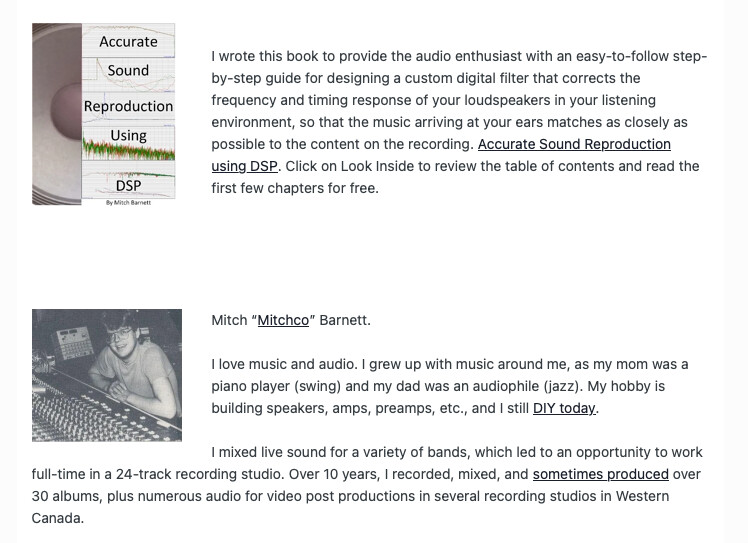
BTY… That article is from November 13, 2019… Mitch has done a lot of moving and shaking since then… Including creating his own SOTA Hang Loose Convolver… Which, BTY, no longer works correctly with Audirvana… Even though it is advertised in some obviously outdated videos of Audirvana marketing trash…
HLC is irrelevant in the context of the “Room Shaper” review…
One would say I am at the entrance to the rabbit hole with both feet well and truely anchored 
I have more than enough savvy to realise when something I am doing for pleasure becomes an obsession.
2 Likes
Thanks, I take it you are fully aware of how much AI is used inside high end audio equipment? Just saying
I’m a real human-being. with decades of experience to tap into… AI taps into me… And I am always learning…


1 Like
Arn`t we all 
1 Like
Pardon me, and I think the OP is the arbiter of what is relevant in his VST EQ/Convolution for tone and room correction thread…
And maybe the OP is looking for some Tube and Transformer warmth which can usually be found on some old skool parametric equalizer emulation plugins…
1 Like
 I believe you first usurped that privilege with this post…
and this post…
And finally this post…
A usurper who accuses another person of usurping is a classic example of psychological projection. In this scenario, the perpetrator deflects accountability and guilt by attributing their own negative behaviors and intentions onto another person, creating a smokescreen to distract from their own actions…
@u8myufo @Ddude003
Want to make the Mona Lisa look like Picasso’s “The Dream” ? Or Bob Ludwig masters sound like George Martin and Geoff Emerick productions.. Here you go… knock yourself out… You won’t find me in that pond…
https://www.izotope.com/en/products/tonal-balance-control-3/features.html
Now who is playing arbiter…?
It seems that you are -Trapped In The Mirror - my fren… Seek some help…
And I even have a setting in one of my Old Skool EQs called Mona Lisa Smile…
OP have a look at Plugin Doctor to see some of these EQ Broad Brush Strokes that get you Some Color and Saturation…
1 Like
Another ad hominem attack, married to a straw man 
@Agoldnear, lets step back a bit and clear a few facts up shall we? Im pretty sure I have mentioned to you in other posts, although I could be wrong, that all this is pretty new to me. I do not have reference equipment neither do I use original master recordings as such. My music taste is from all genres that evoke memories of my life in a nutshell.
A fair bit of what you have quoted to me might as well have been written in Arabic for somebody like myself. On the other hand quite a lot of your wording is quite condescending " Want to make the Mona Lisa look like Picasso’s The Dream” ? I have spent over 30 years in the construction industry, let`s take a scenario where you wanted to ask a question about that as a newcomer, and I replied with so much technical details that it just made you more confused than ever. You also seem to contradict yourself and I quote " No equalizer filter is perfect… No filter “Q” is perfect " Yet you were sure that what I was looking to achieve could be done with the built in EQ.
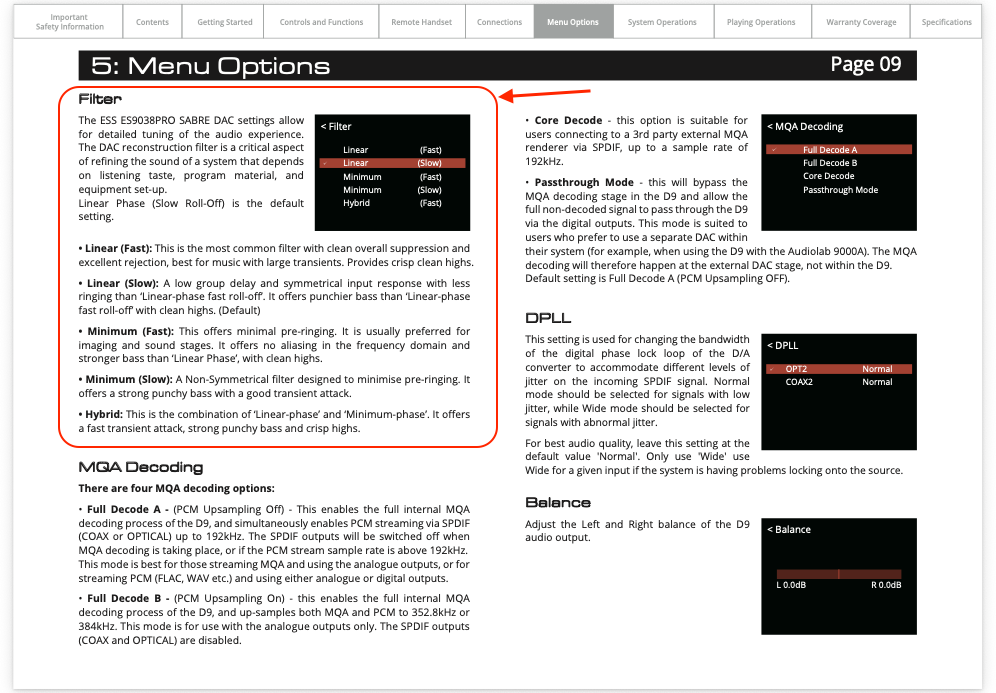
The Audiolab D9 DAC pre-amp is connected to a power amp by XLR cables and then on to a pair of Wharfdale EVO 5.3 speakers. Ill admit its by far high end HiFi hardware but still sounds pretty good. The Dac has five built in filters which I have experimented with and chosen one that almost gets things sounding how I want it, but imho still needs adjusting somewhere along the line by whatever method. My post was to simply ask if anyone was using FabFilter so that I may obtain some guidance, was that too much to ask? Maybe I need to do a room calibration and see what it throws up, maybe it will help maybe it wont,who knows?
… Just a metaphor for ‘creative’ equalization employed to suit any subjective aesthetic…
Again, referring to the influences of filter design in the process of fitting a ‘sound’ into a preferred subjective aesthetic with any given equalizer…
???.. There was only these questions posed…
And…
My only statements regarding Studio EQ…
The Audiolab D9 utilizes a state-of-the-art ESS ES9038PRO DAC chipset… The filters are designed to mitigate aliasing noise in the data interpolation within the DAC DSP, not for gross equalization… These filters affect the Nyquist Filter cut-off frequencies and the ratio of high-frequency spectra aliasing that is produced by the filter (Fc).
The ESS chipsets process all digital-audio signals in proprietary DSP (Sigma Delta Modulation (SDM) and Hyperstream), which up-samples PCM to a higher sample-rate for Hyperstream processing before presenting the signal to the digital-audio (D/A) circuitry for output… The ESS chipset system, decimates all 1-bit PDM (DSD) signals to PCM for DSP processing…
The playback system synergy of aggregate component architecture and the acoustical environment the transducers (speakers, headphones) are producing sound-waves, in concert with the hearing acuity of the subject listener(s), may benefit from more specific signal energy equalization. However, without some quantifiable understanding of the acoustical energy of the listening environment, applying equalization is purely a subjective process… not necessarily a bad thing, because ultimately it is all subjective.
In the case of the D9 DAC… You may find that employing up-sampling/modulation of all PCM using r8Brain in Audirvāna Studio will produce a more aesthetically pleasing output quality, by nature of offloading sample-rate interpolation (PCM up-sampling and DSD decimation), from the ESS chipset DSP which reduces processing overhead within the DAC system topology… Also, in the case of DSD playback, set Audirvāna to convert all DSD files to PCM, as there is no direct DSD signal-path to output in the ESS chipset architecture… I suggest using “Power of Two” up-sampling strategy which will produce the highest logical sample-rate and bit-depth the DAC supports, and the Hyperstream processing will take it from there.
Familiarity with Filter design and concept will help fine-tune the output sound.. In the case of r8Brain settings, I suggest leaving the Nyquist cut-off (fc) unchanged and using a Linear filter… The Stop Band Attenuation is the function that provides the gross harmonic adjustment… I suggest starting with a setting of 166dB and working from there incrementally up or down, as 1db steps dramatically influence the output quality… this requires a process of evaluation that will take time and in that process, an attention to hearing fatigue… So make a setting and evaluate this across the spectrum of your reference recordings over days…
I am not saying this is a replacement for environmental control of acoustic energy in your listening environment, nor a means to compensate for anomalies in hearing acuity that fits your personal aesthetic… It is part of a comprehensive approach to attaining that personal aesthetic that may include more surgical acoustic energy compensation and mitigation.
1 Like
Note:
Applying r8Brain interpolation will be affected by the ESS chipset filter settings… I suggest starting with ‘Linear (Slow)’ until you find a satisfying output quality using r8Brain… and then experiment with changing the ESS filter setting. Think of r8Brain as the ‘master’ filter and the ESS filter as symbiotic.
When you have extracted the most from Audirvāna/r8Brain and the ESS chipset and still looking for another sound as has been alluded to in other posts, this is about as vintage color as it gets for a plug-in:
Yes I already have it set to r8brain as my preference after trying Sox, also I have had Linear (slow) as my choice since first getting the DAC. Like I say, its all sounding pretty decent for me but just lacking that little something, Im just trying to determine what that little something is.
I know this can be another subjective topic, but I wonder if the introduction of a subwoofer would be of use? Is it true that adding one can add more fullness and warmth to the soundstage? I may well be able to borrow a decent one to try and see how that works out. On another note, do I need to be concerened with convolution and crossfeed at this point? I understand what crossfeed does, but I am not sure if enabling it will have a negative or positive effect on the settings I already have in place.