Adding a sub-woofer complicates things… This is where the Home Audio Fidelity ‘Room Shaper’ will be of benefit… this in concert with a measured acoustical response of the listening environment as can be done with ‘Home Curve’ and ‘REW’… Maybe all you need is the application of ‘Room Shaper’.
A couple of references to get you on the right track… These treatise produced by the renowned acousticians Dr. Floyd Toole and Sean Olive…
Note:
The amplifier is going to play a huge part in the ability of the speakers to reproduce the dynamic-range of the DAC output as they will allow… Level/Impedance matching is critical along with dampening-factor…
If i may be so bold as to suggest that your speakers specs show a 46 Hz – 24 kHz frequency range… You may be missing some thing in the 20 Hz to 45 Hz range… Bass… A subwoofer is not a must have and who knows if that is the something you are missing… And an active subwoofer is not so difficult to integrate into your system… Cordially, -DD-
There a several tools (some free) that can create FIR filters… A FIR filter can :
Response: Smoothes unevenness and peaks/dips caused by room modes.
Time-of-Flight/Phase: Corrects group delay and phase distortion, removing speaker distance-based delays.
Target Curve Alignment: Adjusts in-room response to match curves like Harman or Toole.
Excessive Boost Prevention: Uses Frequency-Dependent Regularization to avoid over-correcting.
Speaker Output Discrepancies: Corrects for L/R channel imbalances.
Excursion Protection: Protects speakers from over-excursion in low-frequency regions…
All you need is a REW (free), a USB measurement mic (not free), A FIR filter creations tool (some free and others not) and a convolver, oh snap, Audirvana3 has a built in convolver… Or choose one of several VST convolvers…
I assume this the average Schroeder frequency for a small room (e.g., home studios, listening rooms) typically falls between 100 Hz and 300 Hz, with 200 Hz being a commonly cited average value.
This frequency marks the transition zone where a room changes from acting as a resonator (low-frequency standing waves) to a reflector (mid-to-high frequency reverberation). Also, a common place to correct from 20 Hz up to the Schroeder frequency of the room…
Calculate what your rooms Schroeder frequency is and include this information when creating your own FIR filter… Many FIR filter design/creation tools allow different correction behaviors below and above the Schroeder frequency as well as through the transition zone…
Room Shaper (which I haven’t used myself) is apparently helpful in taming a subjective sound of too much or “muddy” bass. It does so by taking the bass frequencies where your room resonates (vibrates with the frequency, so you hear that frequency after it’s no longer being played in the recording) and cutting them off at the same time as the non-resonating bass frequencies. Clever idea.
Here’s a review from a few years ago that gives more detail:
Just wondering… Has @Jud and/or @Agoldnear actualy measured their rooms acoustic response with a calibrated acoustic measurement microphone, created any FIR filters and used any Convolver for Digital Room Correction of their own listening room??? Anyone using physical acoustic trapping, absorption and/or diffusion for acoustic room correction? I am…
I have been doing so for several years now and the science, technology, maths, techniques and tools get better and simpler all the time… Please, never mind my long computering career in image and signal processing… From the handheld to the supercomputer…
And guys… I am not disputing that Mitch gave the Room Shaper a great review at the time… And Mitch has gone forward and created other tools and services that went beyond the Room Shaper… And even now he is continuing to create hardware and software solutions for the A/V community…
And to help the OP with his original question… I have demoed FabFilterProQ4… You can use Plugin Doctor or Bertom Audio EQ Curve Analyzer to take a look at the EQ curves of, what you might call, other interesting EQs… In my experience you can pretty much match the EQ curves of any EQ plugin with FabFilterProQ4… What you can’t match with FabFilterProQ4 is the secret sauce, tube and transformer saturation emulation…
I once had a career installing money-no-object home theater systems as a THX certified technician… Work out the details for yourself… Probably installed more High-End and Mid-Fi in-home systems than you can imagine and also in another period of my career designed recording studio control-rooms… Along the way, I met Floyd Toole and Sean Olive at JBL/Harman International where I was a participant in double-blind listening studies at the Spin-O-Rama there at JBL/Harman IntL as a peer.. Work the details out for yourself.
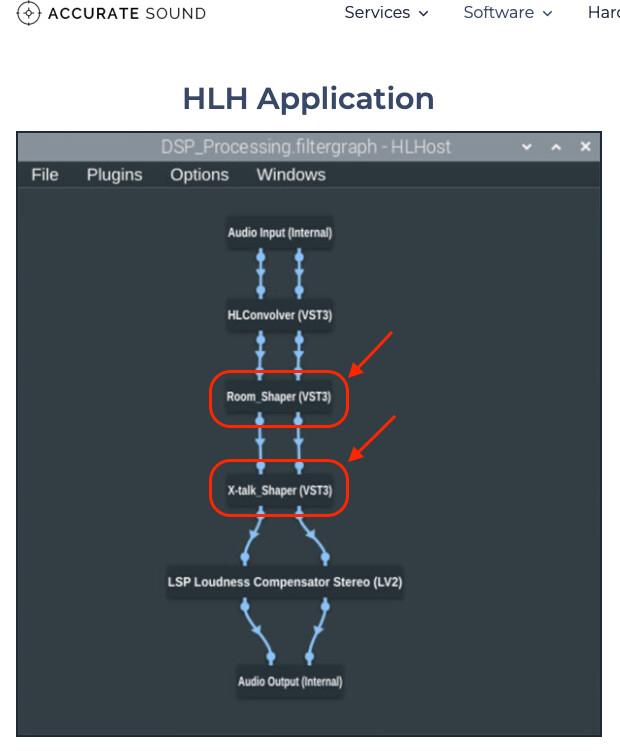
You cannot compare Room Shaper with Hang Loose Convolver… The Home Audio Fidelity Room Shaper and X-Talk Shaper plug-ins are prominently displayed on the landing page for Hang Loose DSP Software Suite…
I’ve been involved as a Sound Engineer and Recording Engineer since the 70’s, involved with digital-audio music production /recording from the beginning. I hold a degree in Electronics and Mechanical Design and I am a musician also versed in Electronic Music and Synthesis, among being involved In Psychoacoustics… And I just completed my 72nd trip around the Sun. … Really been an audiophile since I was a couple of years old… I still have 78 RPM records from my childhood.
Not everybody buys into that story… especially being applied to a codified source master recording that has this ‘magic’ imbued in the production.
Well guys I have been following. But if youd be so kind to read this bit from me I`d appreciate it.
Having had two heart attacks relatively close to each other a few years back, my brain like most in that situation is damaged. Thought processes go out the window, I can only describe it as formatting a hard drive, and you end up a with a sector of the brain which is of no use. On the plus side I am switched off to things like work when I am at home, pretty relaxing if I`m honest. On the negative side, if I am trying to absorb information from reading something I have to go over it several times before any part of that information stays locked in. Reading through your replies is evident that you are trying to help me, but in all honesty it just becomes a jumbled mess in my head.
So, I have loaded HouseCurve on to my phone, and tomorrow as I am off work I will look into it. This being I assume the first place for me to start, and progress from there if need be. A typical example of what I have mentioned is. Does HouseCurve just give me a graph of whats going on, or does it produce a FIR file I can load into Audirvana? Perhaps if after I run it tomorrow I post up any info, you could advise (in layman`s terms) what steps I then may need to follow.
Thanks.
Edit: If I understand things correctly, I will need to load a convolution plugin into Audirvana, and then run it and import the FIR wav file, is that correct or am I getting ahead of myself?
There is no rush… and no real simple answer… I suggest reading through the Toole/Olive treatises and grok them as best you can to get a clearer understanding of speaker room interactions and their orientation in the space, and apply the information regarding the dynamics of physical orientation/placement in-order to mitigate standing waves and room-modes…
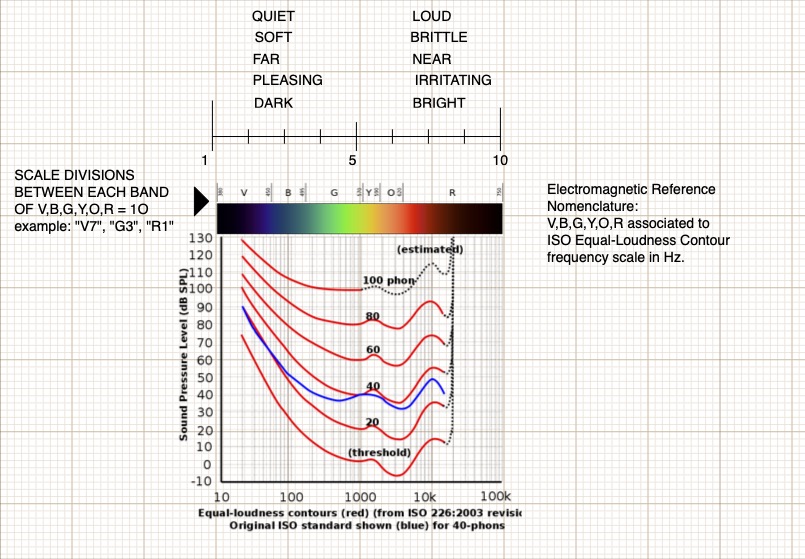
And, in concert, have your personal audiogram available as a reference to temper the subjective assessment and augment the target equalization contour.. Obviously, a personal audiogram is limited in the context of multiple listeners, however, if you are the primary arbiter of the final output sound-quality you need to understand your hearing acuity in this context of room/speaker correction… Then measure the environment.
Tweaking a playback system is an ongoing process… things change in the playback system components and listening environment and our perceptions…
You might actually read the Hang Loose Convolver Documents instead of looking at the pretty pictures…
First off, a properly designed FIR filter will do all that the Room Shaper does and more… As an Audio Engineer you should know this… Secondly, the HLC with a set of properly designed FIR filters and .cfg file can also include Cross Talk Cancellation Filter… Thirdly the above pretty picture is just showing, how with the Hang Loose Host, one can string together a small signal chain of various plugins…
Page 183 of the Hang_Loose_DSP_Suite_Operations_Guide clearly shows how to accomplish a Cross Talk Cancellation Filter…
Audirvana Studio v3.x includes its own imbedded Convolution DSP solution… Maybe @Agoldnear can walk you thru its usage… I use a plugin convolver for its extra features that the Audirvana convolver does not have…
No, I’ve never done room equalization DSP. (I’ve got the calibrated mic and helpful instructions from Mitch, who is a wonderfully nice guy, but life is busy and I haven’t gotten around to it.) I just figured my position of ignorance might actually help the OP if I could try to explain the way Room Shaper is supposed to work (at least as I understand it) in simple non-technical terms. I have no doubt finite impulse response (FIR) filters can be created to do what Room Shaper does, or that Mitch’s suite of products can.
But if I can make a suggestion, it seems to me the OP could really use some answers to his questions in simple, direct, easy to follow language, rather than receiving so many different pieces of advice about possible other avenues. I’m not equipped to do that, since I have no experience, but you folks certainly are.
@Ddude003
There has never been a question about the application of HLC or HLH… However, we see that Room Shaper can be a part of that "small signal chain of various plugins…" Nobody has claimed that Room Shaper does anything more than what it does in the context of sound reproduction in a room… I don’t know of any FIR that can dynamically manage low-frequency energy in the time-domain that Room Shaper is doing… Maybe you can enlighten us in this respect, for the edification of us all.
However, as @Jud alludes… we are getting pretty deep in the weeds here it appears, in the context of the OP rationalizations for an alternative to Studio EQ… I hope @u8myufo will find elements in the materials presented here that will help him reach his personal playback sound-quality aesthetic, and choose a reasonable path to get there, because we have not covered the breadth of potentials in the appreciable, subjective assessment of sound-quality of any given playback scenario.
Nope… FIR filters are not dynamic… However, there are many EQ plugins on the market that do dynamic EQ and other types of signal processing, including FabFilterPro4 which plays the same part as the several years ago Room Shaper…
I will bow out of this thread as it appears the OP is going down the golden path that @Agoldnear is leading him down… Good luck @u8myufo in your journey toward AV Nirvana…
Jud, maybe I should block Agloldenear and unblock you… PS - I am wired to help people… And it seems pretty difficult in this environment… Lastly guys have a look at:
To lay this to rest… “Dynamic Equalization” is not dynamically working in the time-domain of reverberated harmonic energy as is Room Shaper technology… Dynamic Equalization is targeted compression and is being conflated in a false equivalency to Room Shaper technology.
Thanks @Ddude003, I mentioned about loading a convolution plugin into Audirvana as it was part of what I was reading, this is just a snippet from asking Google, if correct.
Acquire Impulse Responses. You will need stereo or multi-channel .wav files created by acoustic measurement software (e.g., REW, Audiolense, Acourate) or generated by tools like Home Audio Fidelity. Install a Convolver Plugin Audirvana acts as a host. Install a dedicated convolution plugin, such as Hang Loose Convolver (HLC) Often recommended for high-resolution processing.
SIR3 Known for low-latency, true-stereo capability.



 imbued in the production.


 what steps I then may need to follow.