When I was testing upsampling vs. no upsampling I DID have bitdepth set to 24 max. Again, the difference between upsampling with stop band attenuation set to 218 and set to 126 was dramatic. At 126 I am unable to discern the difference between upsampling and no upsampling.
Makes some sense. When you reduce the stop band attenuation or when you don’t upsample, there’s less reduction of ultrasonics in the signal Audirvana sends to the DAC.
Speaking of “making sense” the Kalista Mantax DAC lists for $77,500. Be the first in your neighborhood.
I understand very well the influence of the stop band attenuation level… as you remember, it was me that recommended starting around 166dB and working from there… Of course, the extreme 218dB is easily discernible when juxtaposed to your current setting…
The other factor in the up-sampling process, is the increased dynamic-range in the file by virtue of the 64-bit math when truncated to 32-bit for output to a 32-bit DAC, which reveals the full dynamic-range of the 16-bit source file… Now of course a 24-bit result will have a dynamic-range greater than the 16-bit source file but not as wide as the 32-bit result… This is my point… not the frequency response of the file…
So.. it appears that limiting the output bit-depth to 24-bit in the case of your DAC, is going to produce the best results… However, this is in contrast to a 32-bit signal being sent to the DAC with a proper 32-bit USB clocking architecture, which would reveal again, another degree of contextual low-level nuance and spatiality in the music… irrespective of whether you can, or cannot, perceive these things.
You could trade it in on a $95,000 MSB Cascade DAC. 
@TribecaMikey @Jud
PFFFT  … Why monkey around with inferior component design…
$166,420.00
Thanks, @Agoldnear. I thought you said that since the DAC tells origin it is 32 bitdepth capable, origin will not send 24 bitdepth even if I turn on Bitdepth Maximum of 24 bit. Did I misunderstand you?
(Edit) You are correct and that interpretation is incorrect.. see my post following this response…
It is well-understood that Shiit Audio was not using a standardized USB clocking topology and it appears the USB clock interface is truncating the 32-bit signal… Otherwise if the DAC only supported 24-bit signals, you would not get playback… The Shiit Audio folks play tricks with the semantics and rhetorical information used in the marketing… Audio Science Review was unable to test the USB interface due to some weird technical issue, that did not allow them to test the DAC properly on USB… Historically, Shiit products have had issues with the USB interface topology they were employing… Apparently, they have addressed these issues, but still seem to be playing games, so to differentiate product price-points…
@TribecaMikey
I apologize… I believe now, I understand your questioning of my description of how Audirvāna adapts to limiting the bit-depth setting… Got a bit tangled in my interpretations…
It is obvious that my interpretation is incorrect, and the bit-depth limiting function is always applied to the signal being sent to the DAC or DDC… Thank you for the question… 

Note: I have edited my response to properly reflect the scenario…
@Agoldnear, thanks for the clarification. Don’t feel bad - I made a mistake once.
Heheh… 
it’s well known that anything above 21 bit samples hsve no additional information that dacs can use. If one’s dac is 24 bit, AS should supply properly formatted 24 bit data.
I have r8brain with AS running on M4 silicon set:this way:
- Nyquist 95.6%
- Attenuation 215
- Phase minimum - for no pre-ringing
Result— quite good.
Bit-depth (dynamic-range) is not relative to sample-rate (frequency response/harmonic density).
Certainly, delivering a 24-bit signal to a DAC that has a 24-bit dynamic-range is the right thing to do… However, in this particular case with the Shiit MODIUS E DAC platform that uses a 32-bit ESS 9028 DAC chipset, the issue is confused by the apparent USB clocking topology that throttles the signal bit-depth to 24-bit before presenting it to the 32-bit DAC chipset topology… Apparently, because of the Shiit Audio USB interface implementation, Audirvāna sees it as 32-bit capable, when in-fact it is truncating the 32-bit signal to 24-bit before handing the signal to the ESS chipset clocking topology for processing and Hyperstream D/A output.
*The dynamic-range limit is the Thermal Noise of the component topologies at operating temperatures in concert with the bit-depth (dynamic-range) capability of the DAC architecture.
Subjectively relative to the DAC + playback platform/system configuration synergy, and personal aesthetic biases..


Regardless of DAC chip on the Modius, Schiit DACs until recently were all 24bit.
Re the r8brain settings I posted I should have said that they were tuned for my second system:
- AS dedicated MacBook Air M4 running r8brain
- Schiit Modi Multibit 2 in NOS mode
- Schiit Freya S preamp
- Schiit Vidar 2 power amp
- Klipsch RP 600 M
In playback as in recording, some bits are different than others.
As you say, anything more than about 21 bits of dynamic range (at 6dB per bit that’s 126dB below maximum level of 0dB) at the output of the DAC won’t be useful because it is going to be swallowed up in the heat noise of the electronics.
But for the DAC’s internal signal processing (filtering, conversions) 24-bit or more often 32-bit allows that to be done safely below the 21-bit level, so the DAC is as quiet as the physical limits of its components allow.
@Jud @Antonio
Digital-audio dynamic-range is a function of the size of the computational accumulator(s)/registers available for all calculations, expressed as dBmv (millivolts)
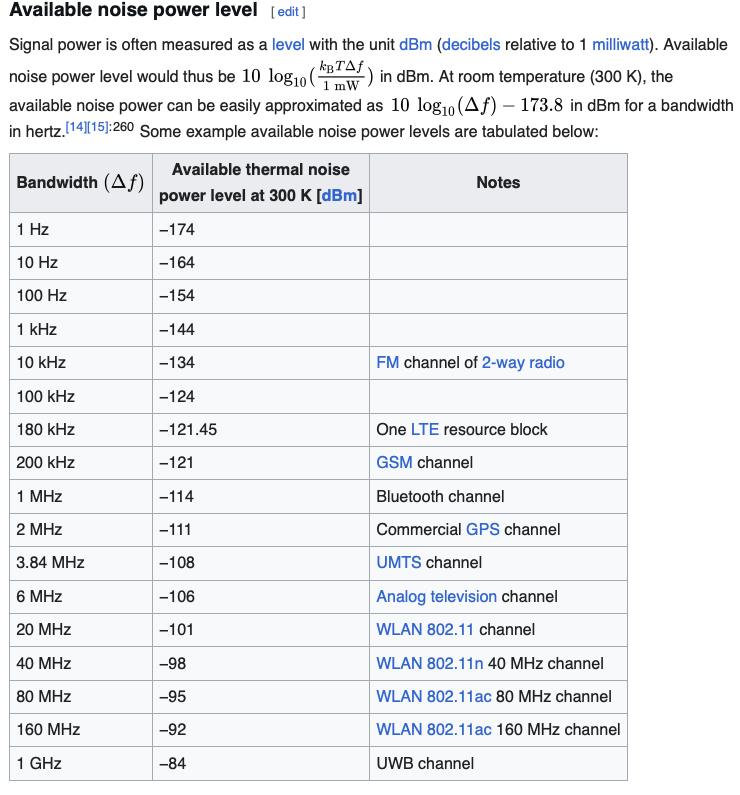
Thermal Noise is a functional measurement of frequency/signal power at operational temperatures expressed in dBm (milliwatts)
Signal to Noise Ratio (SNR) is a measurement of the aggregate platform topology inducted noise-level versus the fundamental signal amplitude, which can be correlated to dynamic-range, as it is the real-world expression of signal power.
To explain things using simple math:
Instead of a DAC that has an effective maximum dynamic range at output of 21-23 bits or so, we’re going to use a calculator that outputs only whole numbers, rounding off whatever its internal processing comes up with.
Instead of a music signal into a DAC, we’ll feed our calculator numbers. Let’s say we sell 20 items for $32.49 a piece.
One way we could process this is to feed the calculator only whole numbers, since that’s all it can output. This is equivalent to feeding a DAC a 21-bit signal. OK, 20x32=640.
Another way is to have our calculator use more “bits” internally (equivalent to 24 or 32-bit internal DAC processing). 20x32.49=649.8, which rounds off to 650.
650 is much closer to the exact value of 649.8 than 640. So that’s one reason why DACs use 24-bit or 32-bit processing internally, even though effectively their output is limited to ~21-23 bits of dynamic range.
Not that simple…
Theoretically the conversion is perfect… The ENOB is a measure of the output signal energy of the DAC platform architecture intrinsic to the slew-rate of the analog output component topology (D/A) expressed as signal waveform energy measured in millivolts.
In PCM audio [6db x (number of bits) + 1.75mv = Dynamic Range in millivolts]
(Where 1-bit = 6db)
From the Wikipedia link provided above regarding ENOB:
Effective number of bits (ENOB ) is a measure of the real dynamic range of an analog-to-digital converter (ADC), digital-to-analog converter (DAC), or associated circuitry.
Corollary to nature of ENOB measurement… In the D/A output circuitry it is all about signal voltage IN and signal voltage OUT… This is managed in the design process of the DAC architecture/topology.
From the Analog Devices MT-041 Tutorial linked below:
Op Amp Input and Output Common-Mode and Differential Voltage Range
INPUT AND OUTPUT VOLTAGE RANGE
Some practical basic points are now considered regarding the allowable input and output voltage ranges of a real op amp. This obviously varies with not only the specific device, but also the supply voltage. While we can always optimize this performance point with device selection, more fundamental considerations come first.
Any real op amp will have a finite voltage range of operation, at both input and output. In modern system designs, supply voltages are dropping rapidly, and 3 V to 5 V total supply voltages are now common for analog circuits such as op amps. This is a far cry from supply systems of the past, which were typically ±15 V (30 V total). Because of these smaller voltages, it is very important to understand the limitations of both the input and the output voltage ranges—especially during the op amp selection process.
https://www.analog.com/media/en/training-seminars/tutorials/MT-041.pdf
@Jud @Antonio @TribecaMikey
I believe you will find the following information linked below, regarding the ‘precision’ of calculations in digital-audio DSP, to be edifying in relationship to DAC system architecture and DSP generally, and can be extrapolated in relationship to the 64-bit math used in Audirvāna DSP calculations…
This Analog Devices article linked below, is one of the most descriptive explanations of the relationship of calculation precision dynamic-range in 24-bit and 32-bit Processing of Audio Signals I have personally ever read… It is relatively easy to grok, however, will require patience to absorb…
The quotes below provided from this Analog Devices article do not really cover the entirety of the subject of calculation precision in digital-audio DSP.
From the Analog Devices article:
Relationship of Data Word Size to Dynamic Range and Signal Quality in Digital Audio Processing Applications
"… the choice of components and the digital filter implementation will also determine the overall quality of the processed signal. For example, if we have a 75 dB D/A converter and a DSP which can maintain 144 dB dynamic range, the overall ‘System’ dynamic range will still only be 75 dB. So the D/A converter is the limiting factor. Even thought the DSP would compute a given algorithm and maintain a result that had 122 dB of precision and dynamic range, the result would have to be truncated in order for the DAC to properly convert it back to an analog signal. Now, if the choice is made to high quality analog, ADC, and DAC components, wouldn’t one want to be careful to ensure the signal quality is maintained by the DSP algorithm? Care must then be taken in a digital system to ensure the DSP is not the weakest chain in the ‘signal chain’.
“For a digital filter routine to operate transparently, the resolution of the processing system must be considerably greater than that of the input signal so that any errors introduced by the arithmetic computations are smaller than the precision of the ADC or DAC.”
"Using a 32-bit, fixed-point DSP will give additional benefit of ensuring 16-bit signal quality is not impaired during arithmetic computations. Thus, the higher resolution of the 32-bit DSP will eliminate quantization noise from showing up in the D/A converter output, providing improved Signal-to-Noise (SNR) ratio over 16- and 24-bit DSPs.
When processing 16-bit audio data, the use of 32-bit processing is especially useful for complex recursive processing using IIR filters. For example, parametric and graphic equalizer implementations using cascaded 2nd-order IIR filters, and comb/allpass filters for audio are more robust using 32-bit math. A 32-bit processor operating on 16- or 20-bit data removes the filter structure implementation restrictions that are present for 24-bit processors. Any filter structure of choice can then be uses without worrying about the level of the noise floor. Double-precision and error-feedback schemes are therefore eliminated. With 16-bits below the noise floor on a 32-bit DSP, quantization errors would have to accumulate up to 96 dB from the LSB before these errors can be seen by the 16-bit D/A converter.
At least 32 bits are required if 24-bit signals are to be preserved with complex, math-intensive, or recursive processing. Using 24-bit A-D and D-A converters will require a 32-bit DSP in order to offer sufficient precision to ensure that the noise floor of the algorithm will not exceed the 24-bit input signal."
(Below) A corollary to the above, in the context of Audirvāna operational precision.
Happy Reading!
P.S.-
This is probably the most important information that I have ever posted here to the Audirvāna Community… It is corollary to every aspect of the performance of the audio-engine and DSP processes of Audirvāna and definitively answers all questions regarding the value of up-sampling in relationship to appreciable sound-quality in any given Audirvāna + DAC synergy scenario.
Yes, 64-bit math is essential for the advanced upsampling r8brain does in Audirvana. Key for wide dynamic range calculations to push noise out of band.
After processing the output data still has the same dynamic range as originally. If 16 bit it will be 16 bit, if 24 bit it will be 24 bit.