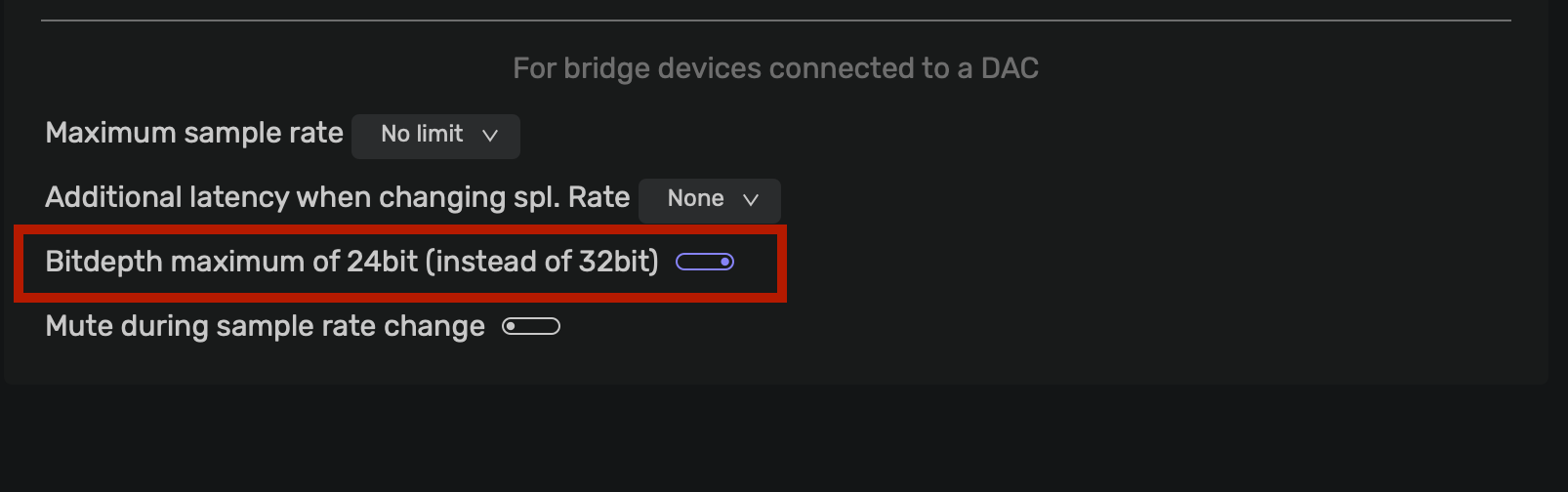
Does the setting:
Limit bitdepth to 24bit: ON
affect whats being sent to the DAC?
Does the setting:
Limit bitdepth to 24bit: ON
affect whats being sent to the DAC?
The digital-audio signal bit-depth…
This setting is dependent on the DAC set as the output device or a Digital to Digital Converter (DDC) used as a ‘Bridge’ to a DAC attached to the DDC.
When Audirvāna processes a PCM file it does so with 64-bit math and outputs the resulting signal as a 32-bit stream to DACs that are 32-bit capable…
Some DACs do not support 32-bit signals, so the option to limit the bit-depth of the PCM signal is provided… (For example) If a DAC only supports 24-bit S/PDIF protocol digital-audio signals on a coaxial or Toslink optical interface, a DDC is used to transition a 32-bit USB protocol or UPnP protocol transmission to the 24-bit S/PDIF protocol on the supported coaxial or Toslink optical interface… Even though the DDC may support 32-bit signals, it most likely is not a Sample-Rate Converter (SRC)… So, to deliver the proper signal bit-depth to the connected DAC through the DDC, the signal bit-depth must be set properly to limit the signal to 24-bit for proper file playback.


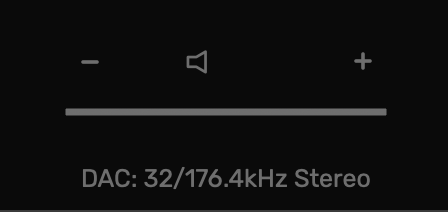
This display shows the file bit-depth and sample-rate being sent to the DAC… In this case, your DAC or DDC is capable of handling 32-bit files… 
The ‘Output Device’ display in the Settings window shows what sample-rate(s) the DAC is supporting… Bit-depth is something that the DAC specifications will provide… If the DAC does not support 32-bit signals, you won’t get playback…
This function applies to DAC and DDC + DAC interface connections that don’t support 32-bit signals…
The display attached below, is telling you that a 32-bit/176.4kHz signal is being transmitted to your DAC or DDC. However, does not reflect a scenario where the 32-bit signal is being transmitted to a DDC that is feeding signal to a DAC via 24-bit S/PDIF coaxial or Toslink optical interconnection, or a DAC that only supports 24-bit signals.
So if I’m playing a 16 bit 44.1K file it is being upsampled 4x to 176.4K and transmitted to the DAC in 32 bit containers with the bottom 16 bits padded with 0’s?
These should fill-in the gaps for you… 
OK, I used the wrong word - container. In the data stream being sent to my DAC for a 16 bitdepth 44.1K file, each item in the data stream is a 32 bit number with the lower 16 bits padded with 0’s?
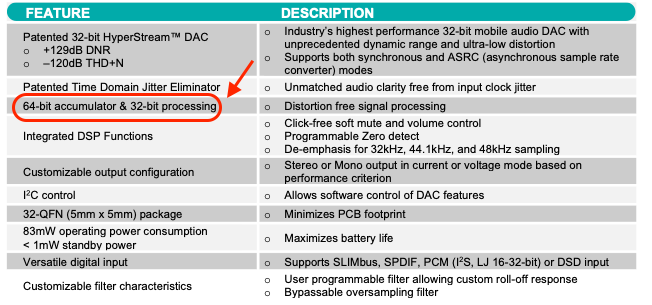
The entire PCM sample-stream is padded with zero (0) values to increase the number of samples to the chosen sample-rate target… The 32-bit depth is a product of the 64-bit DSP applied in the interpolation from 16/44.1kHz to 32/176.4kHz that your DAC supports… The interpolation is done with 64-bit math (dynamic-range) and must be truncated to 32-bit (dynamic-range) for compatibility with the 32-bit DAC architecture.
In the interpolation from 16-bit to 32-bit, the entirety of the source 16/44.1kHz file, 16-bit dynamic-range is revealed by virtue of the 32-bit dynamic range of the new file… The output signal is refined by virtue of pushing the Nyquist Frequency cut-off (Fc) to 88.2kHz (in the case of a 176.4kHz sample-rate) improving aliasing filtering as-well-as presenting a more refined signal waveform to the D/A circuitry for output by virtue of the increased sample-rate.
And if I use BitDepth Maximum of 24, is the bottom 8 bits of the 32 bit value zero’ed out?
… If the DAC or DDC was only capable of 24-bit dynamic-range the interpolation DSP would truncate the 64-bit signal to 24-bit for output, irrespective of the Device Input setting.
Funny about that: Even though the DAC tells origin that it handles 32 bits, the actual ESS converter chip inside the Modius E is a 24-bit device. It takes that 32-bit signal and truncates (ignores) the bottom 8 bits.
The ESS chipset is 32 bit, and applies sample-rate DSP in the Hyperstream processing:
The advantage of having Audirvāna do the up-sampling DSP (r8Brain or SoX) is that this offloads on-chip processing which reduces intrinsic noise (jitter) potentials…
You will be the abiter as to the subjective value in the final audition.
Yeah. It’s confusing. The Modius E certifies itself as being 24-bit capable even though the ES9028 can handle 32 bits. Go figure.
You are connecting via USB it appears, because the system would truncate the output to 24bit if the DAC was not capable of the dynamic-range… and we know this is not the case from the output signal display…
My guess is the Schiit folks are setting real-world rhetorical expectations from the platform topology… Theoretical 24-bit dynamic-range is 144dB… We see in the real-world, that very few DACs, if any, can achieve 21-bit dynamic-range (126db)
Thanks, @Agoldnear. So should I turn Max Bitdepth 24 off?
Sure… that is the default…
It appears the USB interface that Schiit was using in the MODIUS E DAC was limited to 192kHz as they have supplanted the USB interface in the new, similarly priced MIMIR DAC with what they call:
“Unison 384™, up to 32 bits/384kHz supported, full UAC2 compliance”
Maybe the MODIUS E USB interface is truncating to 24-bit… and then letting the ESS 9028 Hyperstream processing do its thing…
So… In this case… the ‘equalizer/limiter’ is the USB interface clocking as a potential intrinsic noise generator (jitter) and this may be the answer to why you were unable to discern the differences in your up-sampling strategy versus no up-sampling… This would be an argument for limiting the bit-depth to 24-bit in Audirvāna prior to sending the signal to the DAC…