Why Oversample?

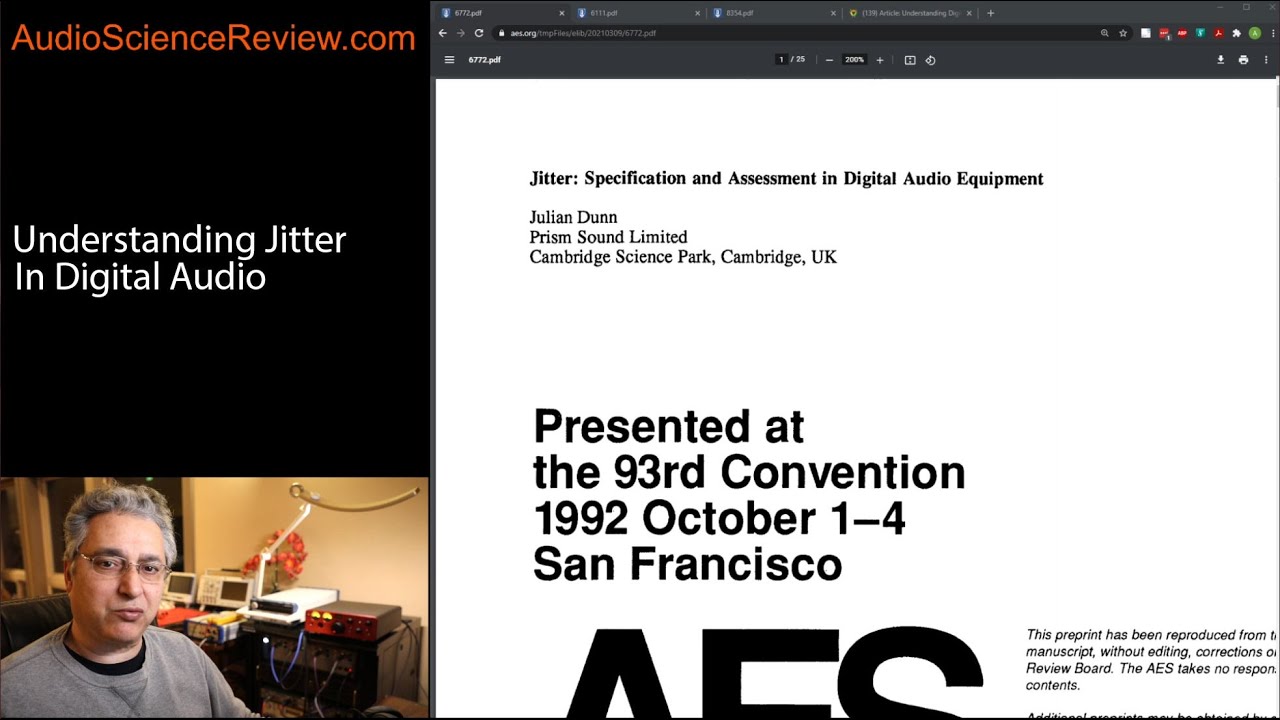
@Jud Since you veered-off into the realm of artifacts and audibility of influential elements of random noise and noise related jitter in the assessment of playback … We can then revisit the subject of jitter induced distortion and the theoretical audibility of precipitated distortions created in the upsampling processing. This video from Amir (Audio Science Review) will be a valuable resource, for all concerned about the listening/playback real-world reality. This will not be easy for some to grok.

:notes: :eye: :headphones: :eye: :notes:

Regarding oversampling I am of the same opinion as the well-known mastering engineer Brian Lucey.
He mentioned on another audio forum:

“Hi Res as you have come to be sold on it, has everything to do with marketing and nothing to o with quality or artistic intentions or “the sound in the mastering room” , etc. All marketing buzzword lies.
The best and only true master of a digital release is the one at the NATIVE RATE in the mastering session. Any alteration to that master is a LOSS in QUALITY and artistic intention, etc.
A great converter at 44.1 blows away a lesser converter at 96k, a great engineer at any rate blown away a lesser engineer. Quality is not a sample rate number.”

AFAIK, his favorite recording format is 24bit/44.1k:

“I often print at 44.1 with the Pacific Microsonics AD. This is not inferior to 96k or higher in a modern piece. Production CHOICES are more important than slices per second and cutoffs above human hearing. 44.1 has a density in the low end that 96k does not. HF details are not the prime currency of music, they are only one form of ear candy in a cocktail of musicality.”

2 Likes

This whole subject feels like a can of worms! I don’t think the role of cognitive biases is factored in enough.

Two major forms can influence this - confirmation bias, where we see/hear what we expect to see/hear, and cognitive dissonance, where we twist reality into our preconceptions/misconceptions. (This is very informal definition, BTW)

We all do it, and what is more, we don’t realise that we are doing it. Scott Adams’ book ‘Loserthink’ is one of the best informal discussions of this subject I have read.

When I worked as a professional photographer I saw it a lot - a person buys a mega-expensive lens and claims it is an order of magnitude better than his previous consumer level lens. Lab results show the pro lens may be a tiny bit better optically, but you’d hardly notice without examining photos under a microscope or massively enlarged on screen. But he’s paid over £1,000 for it, so it has to be better… (Pro lenses usually cost more because they are weatherproof, are built like tanks, and so on. Most lenses on the market, including consumer ones, are optically very, very good.)

I suspect something like this might occur in audio as well. For example, I have a CD that I like. I buy it again on Qobuz at the highest res and expect it to sound better. And it does! But is that because it sounds better or am I just listening to it more carefully, noticing things I haven’t noticed before? The same could be said about oversampling.

Without blind A/B testing there really is no way to tell through hearing alone. And @Jud has said A/B testing won’t work for 99% of us, and I don’t doubt he’s right… But that makes this untestable, unfalsifiable, and 100% subjective.

I could buy an Analog to Digital converter and then analyse the audio output from my DACs using the software @Jud mentioned. Assuming it could log its output to a file, I certainly have the programming skills to then analyse and identify the differences between oversampling, no oversampling, and fiddling with the oversampling parameters. But it seems a lot of effort to go to, for no particular reward, as it won’t make the music sound any better.
2 Likes

Regarding @matt ‘s comment: Insofar as Brian Lucey says good mastering outdoes hi res any day, and that some hi res pieces are marketing rather than substance, absolutely agreed. (You know you can check with Audirvāna whether a piece is truly hi res or something oversampled by the seller for marketing purposes, right?)

As far as saying 24/44.1 is superior to 24/96, that’s actually contradictory to his first proposition, that good mastering trumps resolution. There are vanishingly few of the Pacific Microsonics A/D converters he talks about in the world; it’s very possible you’ve never heard anything recorded with one. The overwhelming majority of A/D converters record to DSD or a hybrid format and are then downsampled for mastering, because there’s very little DSP that can be done to a true 1-bit DSD signal. So as a general rule, the lower the resolution, the further from the native resolution of the A/D converter. Thus according to what Brian Lucey is saying, you should seek out genuine hi res recordings because they are closer to the original recording resolution.

Regarding what he says about hi res and high frequencies, that’s something I mentioned in the original post in the thread is not a reason to listen to hi res or to oversample. Hearing high frequencies isn’t the purpose of oversampling (which you’ll recall is with very few exceptions done in the DAC anyway if you don’t do it in the computer). It’s to make possible good filtering that results in measurably lower distortion and noise. And as I’ve said all along, while distortion and noise is measurably lower, that doesn’t mean this is necessarily audible to you. For myself, I set things up to result in the lowest measured noise and distortion for my DAC, and if I like what I hear (which I do), I don’t worry about it any more. :man_shrugging:

1 Like

To be fair to Lucey he talks about the native rate in the mastering session not the recording session. I don’t know how many recordings get no mastering at all.

True. What that means though is that the rate in the mastering session can’t really be thought of as “native,” since part or all of the track has been downsampled for mastering.

Still, I think the important thing to take from Lucey is that really good mastering is what matters, and that can certainly be done at 44.1kHz as well as higher resolutions.

IMO, the important point according to Lucey is to have no SRC at all. If you must do SRC I see no point to be as close as possible to the original resolution. At least I have no quote where he did mention this. A high sample rate is just not very important for Lucey, there is a YT from him where he mentioned that the work of the mastering engineer and the gear he uses is so much more important than the sample rate and I think he is right. It is very interesting to read his posts on AudiophileStyle.

This is incorrect… Very few recordings are produced with 1-bit PDM analog to digital converters (A/D). The majority of digital music productions are encoded with LPCM A/D, mixed, edited and mastered as LPCM products… These are generally the source encodings that are upsampled and sold as higher resolution file formats. The Warner Music catalog is one example of archiving a large majority of their historical analog magnetic master-tape library at 24/96kHz… Unfortunately this is common across many record labels.

1-bit PDM is generally the primary format for the archival of analog magnetic-tape masters. However, these archival recordings are reaching the threshold of viability in the resale marketplace and generally limited to well known artists and their works. PS Audio’s Octave Records is one of the few record companies working in pure 1-bit PDM using now the Pyramix system. But, it will be very rare that a modern popular music production will be produced in 1-bit PDM.

The discussion is about 'Why Oversample?" … There is a huge difference in upsampling/modulation of low-resolution 16/24/44.1kHz file playback and the playback of a production, recorded, mixed and mastered at a higher LPCM/DXD or DSD sample-rate… It is a matter of resolution. More samples, more resolution… More dynamic-range, more subtleties.

It is plainly obvious that higher-resolution digital-audio (LPCM and 1-bit PDM) signals, more closely resemble the smoothness of a pure analog voltage signal to the output electronics, with more dynamic-range, than lower-resolution digital-audio files. If you could hear the analog magnetic-tape master in juxtaposition to the digitized iterations of that master recording, it is easy to spot the difference and what is lacking in those encodings… In the world of LPCM, there are no 768kHz recordings… 24/352.8 or 24/384kHz is the maximum resolution format for production work with limited DSP availability.

:notes: :eye: :headphones: :eye: :notes:

I doubt he’s ever done a single master without DSP. Edits, for example, were being done in 80 bits many years ago so they wouldn’t show up audibly; it could well be more now.

The Pacific Microsonics ADC he’s talking about was most popular as a 16-bit 44.1kHz converter in the 20th century (see for example Pacific Microsonics' HDCD: LOOKING BEYOND THE COMPACT DISC ). If he’s discussing 24-bit recording, he’s either doing DSP or using a different converter.

A lot of people loved that machine, and I have a number of CDs it produced. But around the time of the millennium, converters using DSD or hybrid formats quickly took over because they were much cheaper. This is the same reason there are vanishingly few DACs that don’t use these same formats. And there are even fewer that do no sample rate conversion at all.

Unless you are buying your music exclusively from NativeDSD, you are almost certainly getting a file that has had SRC done to it on the front end. (And even the vast majority of their files have sections that require SRC.) Then there are only certain DACs that will pass those DSD files through to the final analog filter without SRC of their own (I have one).

No SRC is a nice thought, but almost never the reality in today’s digital audio world.

After visiting HighEnd Munich I am just wondering why so much HighEnd manufacturers trust in NOS (non oversampling) DACs.
There are Soulnote, Audio Note, SW1X, Ypsilon, Thrax, Holo, Audio-GD, Aries Cerat and so much more. Even server manufacturers like Taiko prefer not to oversample. And many do not use oversampling via software like Audirvana, Roon or HQPlayer either. They claim it sounds better that way. Are they all wrong?

We have to be careful to differentiate marketing terminology, which is inexact and confusing, from what the DACs actually do. Holo, Audio-GD, and Aries are DACs like mine: They take a DSD signal and pass it unchanged to the final analog filter. Audio Note is famous for not doing any oversampling at all no matter what the input. So very different internal processing, but all marketed as NOS. The others I haven’t researched.

Regarding servers, they’re just leaving oversampling to the DAC.

Now, about true NOS DACs like Audio Note: They’ll have more intermodulation distortion. That may provide a particular sound signature (more ’warmth’ or ‘energy’) and therefore market differentiation.

Well… Yes and No…
Familiarity is an essential element of our ability to identify and recognize audible differences…

Yes, cognitive bias will always play into our subjective observations and interpretations, which are always biased by the acuity of our hearing and whether we are active listeners or passive listeners… However, these things are elements of our familiar reality that tend to be etched into our memories through constant refreshment of experience. So, for the active listener, when something changes for the better or for the worse in the sound of a familiar recording, they have identified a difference… Yes, a myriad of biases come to roost every time we sit down to audition a recording, and active listener audiophiles will be aware of being susceptible to cognitive bias at any given time in an assessment of contextual sound-quality of any given encoding or any tangible changes, in juxtaposition to the familiar.

A good corollary is one of eye-glasses and the differences in focal alignments… I wear glasses for reading… I become familiar with the quality of the image created by the focal alignments and when I get my eye-sight examined and the optometrist or doctor compares my old familiar prescription alignment with a new refinement by switching lenses in real-time, it is plainly obvious to me. I find this no different in my discernment of obvious and more subtle changes in playback sound-quality,

I see this differently than preferential biases of the emotional sort.

:notes: :eye: :headphones: :eye: :notes:

Interesting comparison.

I think it fair to say, some are more susceptible to bias than others.

Do you remember playing this trick at school? The whole class, with one ‘victim’ absent, agrees to make a false statement and defend it as though it were obvious. When the ‘victim’ arrives, the class make the statement. The ‘victim’ at first cannot understand it, but assumes the majority must be right, especially if the teacher was in on the trick. It would take someone with an iron will not to cave in.

I wonder what I would see if my optometrist tried that trick on me - he shows me what my current prescription looks like instead of the new one, and tells me it’s a big improvement. There’s a good chance I’d experience cognitive dissonance and hallucinate that there was an improvement, especially if I trust the optometrist.

As someone once said, humans are not logical. We rationalise things all the time, usually to fit our expectations/preconceptions.

There’s a little more subtlety here than simple preconception (I understand this was just one example you were giving).

Consider the situation at the optometrist. You are presented with simple, static, completely familiar sensory input, and the lens change is instant. The auditory equivalent would be an unvarying pure tone with instantaneous switch from one component or software situation (for example, changing filtering between computer and DAC) to another. I’ve never in my life been able to run such an A/B test, and with a simple static tone I’m not sure how much information we’d get from it (thus demonstrating that in the optometry example, the difference has to be fairly significant for you to notice - it isn’t as if you’re comparing the same prescription with two different manufacturers’ lenses).

Let’s take an example from the visual world that might be closer to audio A/B testing. You want to compare two televisions. Would you get a better idea of relative performance from the first or second demonstration below:

1 - You view the two televisions side by side simultaneously playing the same program content.

2 - You watch four or five minutes of program content on one television, take a break of a minute or so, then turn to the other television and watch the same four or five minutes.

The critical distinction is that in one situation you get an instantaneous sensory comparison; in the other, you’re attempting a feat of memory. Which do you suppose would be more effective at teasing out subtle differences between the two pieces of equipment?

@Jud Totally agree.

That’s why comparing the results of photography software is child’s play in comparison - on screen I can put, maybe 5 or 6, versions of a photograph side by side, zoom in and out, and compare sharpness and so on.

But I can’t listen to two pieces of music simultaneously.

I think this demonstrates the difficulty in determining whether audio processing makes an audible difference. It’s easy when it’s obvious (EQ for example, especially when done in real time) but detecting that upsampling removes a subtle interference is much harder.

One of the posts on this forum has the OP saying that a minor tweak to the upsampling parameters makes Mark Knopfler’s voice sound better, etc.

Maybe he is right and I don’t doubt he sincerely believes it. Then again, he’s spend many £1000s on his gear and I’ve spend just a few £100 - there is less pressure on me to ‘justify’ anything. No pressure, actually - I set aside money for some fun each month. Sometimes the result is fun and sometimes not, like a day trip to the UK Lake District where it rains all day! I’m used to disappointment.

And, of course, I do think what I now have sounds far better than an iPhone outputting by Bluetooth to cheap headphones. I could be hallucinating… But I know I’ve never enjoyed my music as much as this, so the expense was well worth it. Even if it’s just an illusion…

But I’m grateful for all the technical info these two threads have given me. It’s helped me to set realistic expectations. And I’m enjoying myself. In my opinion :joy: !!

1 Like

Ah, you can!

There’s software by the same fellow who makes Distort, called Delta Wave, that allows simultaneous comparison of left and right channels. So what you’d do to compare filtering, for example (supposing you would be motivated to do such a thing) is use software like Audacity to import a file using one collection of filter settings, then import the same file using another group of settings; then convert each of the two separate files to mono; and make a final “stereo” file with the two mono files as the left and right channels.

You could then listen to this file in Delta Wave and also compare various measurables with it if you wanted. If your preference for left or right ear changed when you switched left and right channels, then the difference between files is greater than any difference between ears; if your preference remained the same, then the difference between ears is greater than any difference between files.

I’ve never been sufficiently motivated to go to this amount of trouble. I have, however, done a similar experiment. I built a DAC, which came with populated circuit boards, leaving the final wiring and choice of some components to the user. Among the choices was selection of capacitors for the output side of the circuit, two capacitors per channel. To decide between two different brands with identical specifications, I installed a pair of one brand on the left channel, the other brand on the right channel. Then I listened to a good recording of Pet Sounds (famously recorded in mono, and this was a mono version). The audible difference was sufficient that I was able to easily select which capacitors to use for the final installation on both channels.

2 Likes

Yowser!

Like you, not sure I have motivation to go that far. But interesting, nonetheless.

1 Like

So, if you are using this as a metaphor for those audiophiles that set some folks as authority without question, because they themselves are not experienced or technically adept, then these folks are easily manipulated and probably not active listeners… In my opinion, the better you understand the fundamentals of sound and audio technology, this will lessen the potentials for an illusion of peer-group asymmetrical insight and media propaganda manipulation.

Experience and Familiarity are the cornerstones of subjective assessments. These are the fundamental cognitive biases.

One test that can be done to demonstrate audibility of changes to a digital-audio file is to isolate and reveal those elements… This can be done in a DAW (Digital Audio Workstation) by placing the source recording in juxtaposition to a 180° out-of-phase altered iteration of that source file, which will reveal the differences. This is not easily done, as these two files must be aligned with perfect sample level accuracy from the first sample at playback and latency compensated… When the source and the phase-inverted file are added together, the differences are precipitated and will be audible, if they have sufficient amplitude… The ability for these to be audible by human hearing neurophysical capacity will determine the relevance to any subjective perception… However, knowing these differences exist, will bias future assessment.

:notes: :eye: :headphones: :eye: :notes:

1 Like

@Jud
Are you still using the iFi DAC?

Hi Reynaldo, yes I am.

1 Like