Why Oversample? Imo it’s not necesary if you don’t hear any difference. Music is about feeling, hearing, living, perception, not about mathematical calculations, what others think or techical details. You will never have a “like in the studio” experience, this is just bullsh*t marketing and it’s really not important. Oversampling means more work for the computer and if you don’t hear an improvement it’s just wasting resources.
With my poor equipement I have the best sound (riched / well balanced) when upsampling all to 352.8 with ASIO, r8brain, 86/64 linear. I also use Audurvana EQ. It’s not mathematically correct to upsample anything to 352.8? I really don’t give a damn if for me in my room sounds best!
4 Likes
What is the DAC in your playback system? Do you think all DAC’s sound the same and handle the digital-audio signals presented to its electronics the same? I think these are valid questions in this context of 'Why Oversample?"
Yes it is about one’s emotional response to the artistry… Unfortunately for your argument, it is about mathematical calculations that influence the level of tangible appreciation of the artistry… Why do you use Audirvāna instead of listening to compressed audio files on a lesser playback audio-engine if it is just about the emotional response? You obviously find benefit in upsampling PCM to DXD sample-rates… If you are not using ‘Power or Two’ upsampling strategy, files that are multiples of 48kHz will be truncated, leaving potential for distortion in the decimation process to 352.8kHz, rather than the result being logically correct at 384kHz.
Not perceiving appreciably tangible results of the upsampling process, is a valid reason for questioning the value of the processing overhead which may or may not be of consequence, and will be computer system/resources dependent in regard to output signal integrity.


Corollary to the subject, because perception is seminal to appreciable value…
Some bedtime reading… 
From the 'Stanford Encyclopedia of Philosophy ’
“Auditory Perception”
“Auditory perception raises a variety of challenging philosophical questions. What do we hear? What are the objects of auditory awareness? What is the content of audition? Is hearing spatial? How does audition differ from vision and other sense modalities? How does the perception of sounds differ from that of colors and ordinary objects?”
https://plato.stanford.edu/entries/perception-auditory/
https://www.intos.de/en/InLine-AmpUSB-Hi-Res-AUDIO-HiFi-DSD-USB-Audio-DAC-Vacuum-Tube-amplifier
Of course not. I presented my use case and said it’s not the same for all.
I don’t care about that potential since I like what I hear. Of course I know the difference between Audirvana and other players, or lossy and lossless formats, this can be heard easily.
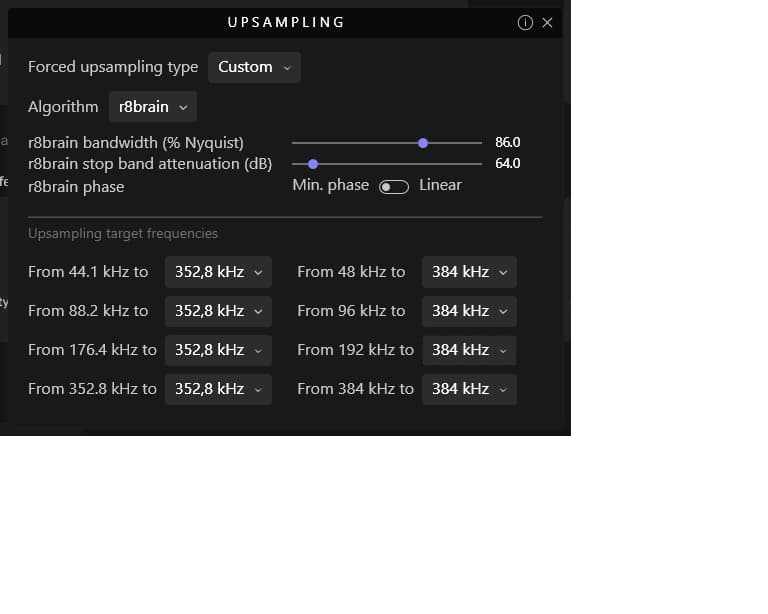
@DGrigorescu
The ‘Custom’ strategy results in your screenshot are exactly what ‘Power of Two’ upsampling strategy will produce, because your DAC supports up to 352.kHz and 384kHz maximum PCM sample-rates. They are clocking a fundamental 192kHz DAC at these PCM higher sample-rates in these cases.
Interesting little DAC/HPA…
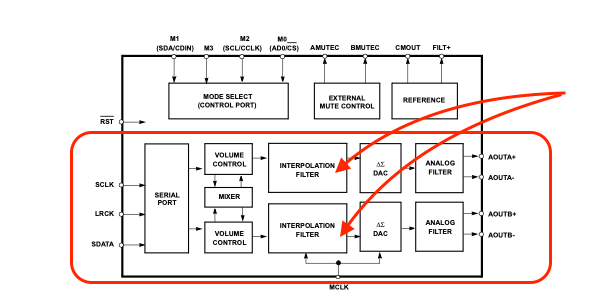
The Cirrus Logic CS4392 chipset is used in the InLine AmpUSB… You might like to try upsampling/modulating all PCM files to DSD128 and see if this produces a sound that appeals to your aesthetic… However, it is not clear if this DAC platform auto-switches between PCM mode to DSD mode when receiving raw DSD and DoP signals… This DAC may be designed to stay in PCM mode and if so, it will decimate the DSD files to 24/352.8kHz PCM… but if the system auto-switches to DSD output you might like the sound-quality.
Note: If you are employing the optical S/PDIF output you are throttled to PCM 192kHz and 196kHz… and if supported, DSD64.
Have you tried just sending your PCM files directly to the DAC without upsampling and letting the CS4392 Interpolation Filters handle the signals?
Here is the block diagram of the chipset architecture:
1 Like
I tried upsampling to DSD128. Sounds good, maybe better, but after some time I always return to PCM. Maybe because all my life listened to PCM, maybe because I feel PCM sound more “analog”, “natural”, didn’t compared to other DACs. What do you mean by “auto-switches to dsd”?. I can play DSD files with DoP without problems and switch between PCM and DSD files. I use USB. The sound is good also without upsampling, but after played with upsampling on/off many times decided to use it, make some little details audible in some tracks and the sound is more “studio like”.
Hi @Agoldnear
I might be imagining things but, using Audirvana, no sampling over/under, just the raw XLD 16/44 Rip or DSD 64 etc, and PS Audio Bitstream Jr, I hear only good things.
I think my Jr is doing unspeakable things to the feed it gets via USB and all albums sound excellent.
I played around with upsampling and can’t hear any difference.
Is it me?
Phil
The DAC has two modes… PCM mode and DSD mode, it defaults to PCM mode unless it is switched by the Control Module… One thing you must consider is your r8Brain stop band filter settings… it looks like you have quite a ‘dark’ filter value and you are using a Minimum Phase filter, which has more post cut-off ringing… I suggest spending a little time fine-tuning the r8Brain stop band level for PCM → DSD128 modulation with a Linear filter… This DAC converts all signals to 1-bit PDM (DSD) before hitting the output filters.
1 Like
Thanks. Will try.
1 Like
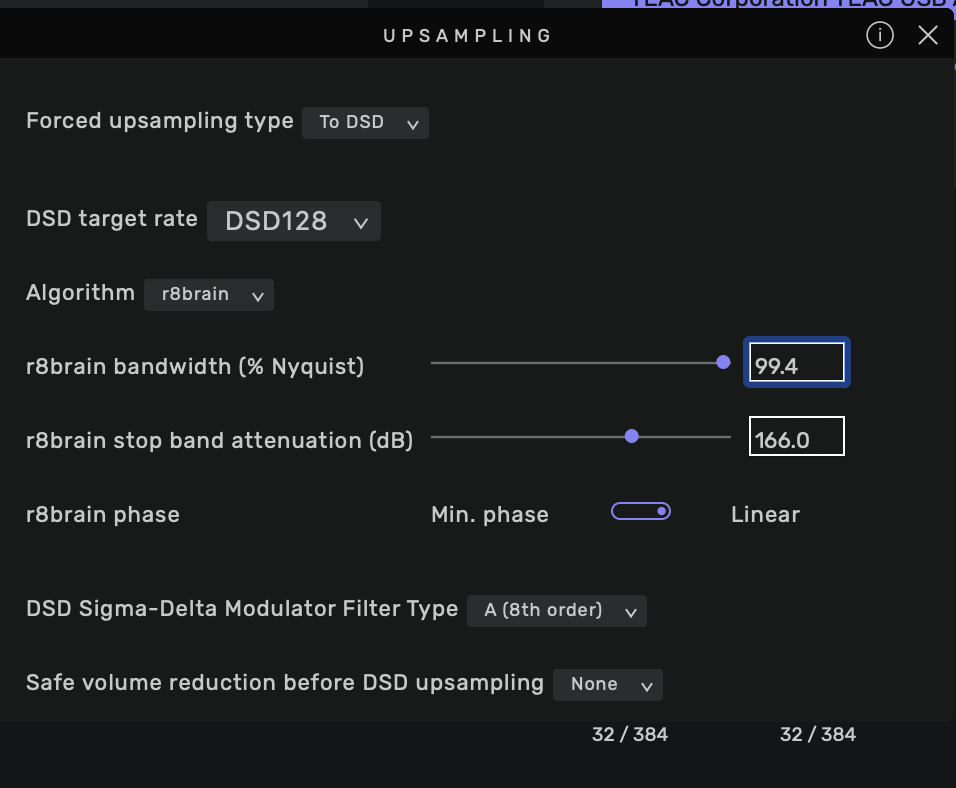
For reference, these are my r8Brain settings for modulating all PCM files to DSD128.
https://community.audirvana.com/uploads/default/original/2X/5/5dcf5a5aa2f1df74c4d4d0800571d80e1115122d.png
1 Like
I have an interesting sound with A8. The instruments have more presence. Sometimes I like this. But for long listening sessions and various genres (pop / rock / dance / classical / electronic / jazz) prefer A5 or B5. Sounds more natural for me with my equipement.
Another interesting thing for me: with DoP activated PCM sounds better. And DoP 1.0 sounds better than 1.1 if I listen carrefully. Maybe it’s not logical but that’s my case.
What about “safe volume reduction setting”? It’s not a good idea to be set to maximum (-6 db)? Or just if you hear distortion?
Tried your settings. Like the sound. Now with a 70s rock Qobuz playlist. Will listen more.
I currently apply -2dB of gain reduction just to prevent distortion and this helps to better match my binaural DSD files to the upsampled PCM signal output levels in my system.
In regard to filter algorithm choice… I use r8Brain in concert with the FIR filter in my TEAC DAC, so, it makes sense your choice will support your aesthetic in the context of your DAC and headphones and/or speaker system.
You must be careful to match the levels when comparing the DSD output with the PCM output, because just a very small difference in level will bias your assessment…
In regard to DoP1.0 and DoP1.1… How much system RAM does your computer platform have? How much playback pre-load memory are you allocating?
1 Like
8 gb. I allocate for AS 2048 mb. When start AS the RAM is 20% used. No problems so far. Only seeking in large files, have to wait for preload, not a problem since usually don’t seek. Also after days of usage noticed some AS memory leak and slutterings, also not a problem, the solution is to restart AS.
You want at least -3dB, -6dB is fine too. The DSD spec calls for -6dB. The reason is something commonly called “intersample overs.” If a digital recording is done near the 0dB limit, it can happen that an area of the reconstructed waveform between sample times will be above that limit, causing distortion. To avoid this distortion by a safe margin the DSD specification calls for volume reduction by 6dB before the process of DSD conversion. In practice I’ve found that at least with the tracks I listen to 3dB or 4dB reduction is adequate, but you can certainly choose 6dB if you like.
2 Likes
This is DAC platform dependent and recording dependent… not all PCM encodings are a result of the “Loudness Wars” mastering dogma… I have many early CD rips that were mastered with approximately 6dB of headroom and these are far from loud productions…. So, it is not a given to set the gain to -3 or -6dB before modulating the PCM file to DSD… The output dynamic range will generally be within the DAC’s capability for DSD… I insert a HRTF plug-in before modulating to DSD which adds approximately 2dB of gain and this is the primary reason I reduce the gain before the interpolation to DSD.
If there are files that reveal ISPs (InterSample Peaks)… these are generally less than +1 dB… typically less than .5dB in reality… My feeling is -1dB to -3dB is sufficient if no plug-ins are inserted… Again DAC and recording dependent… If more plug-ins are inserted, the level may need greater reduction… each plug-in before any DSP is applied, increases the signal gain by approximately 2dB… An active listener will detect the distortion in playback if created.
Managing the gain structure if using EQ Studio and/or plug-ins before modulation to DSD will avoid clipping distortion in addition to the increase in dynamic range produced in the interpolation…
Your “feeling” may certainly work for you. My recommendation of -3dB or more comes from software running on a computer, not a DAC, that detects intersample overs in the recording. I’ve used it on literally thousands of tracks from a very wide variety of musical genres.
As I noted, the DSD specification itself (“Scarlet Book”) calls for -6dB, but I have found at least on all the tracks I have tried that -3dB appears sufficient.
1 Like
You then have a library of poorly mastered PCM files… Or… you have normalized these files yourself and damaged them…
What software are you using to determine these ISP’s? 