Before the mega marketing influencer forces, the format that gave the most convenience to the consumer often won. Available content, easier to deal with than the old carrier. Quality has never been decisive.
I see no increased convenience for the consumer. I wouldn’t expect MQA to have a serious chance of becoming a new standard.
I’m just a little afraid of the huge amounts of money involved in and that there’s really no going back. It is already too big for MQA Ltd to fail.
Ultimately, I don’t believe that MQA has the future. I just hope that in the meantime the consumer will not be too limited in the choice of formats.
It‘s true that great mastering would make much bigger difference than MQA ever could. The problem is with motivation. It‘s not that they‘re mastering Mona Lisa level masterpieces every day.
When is a part of an instrument, instrument, ensemble, band, effect, well recorded. When is the mix right? What is a good mastering? What is a good production?
When is something a ‘Mona Lisa’? Which albums that we now say are a work of art were already seen that way back then?
What does the artist and producer aspire to? Something technically bad may just be the intent for the piece. Something that doesn’t fall into the spectrum of ‘standard’ music can simply be the intention of the artist. This can cause artifacts in the batch processing of MQA. Because the artist makes what does not fall into the ‘normal’ determined by MQA. This cannot be the future of studio/mastering.
A file format cannot define the boundaries of art.
Would be nice to have a format that would automatically adapt to the capabilities of the reproduction system. To some extent, MQA already does this, but would be interesting to go all the way. Something like automatic compression based on the bandwidth capabilities of the reproduction system, volume level, ambient information, and why not, compensation for shortcomings of the delivery chain.
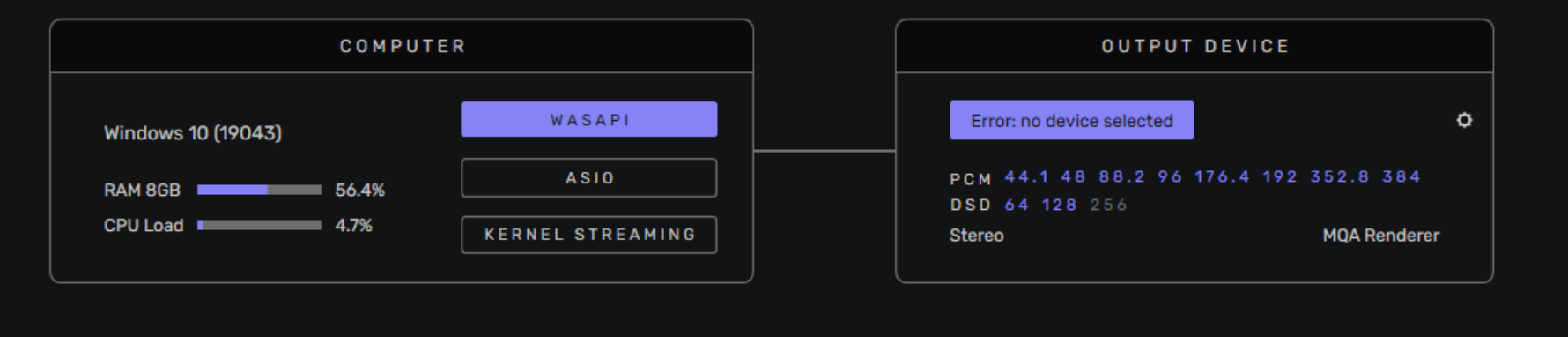
I was having some issues with MQA, intermittently not showing the purple light on Zen DAC Signature. It was only about 10% of the time and maybe even less. Once I switched the problem disappeared. I also get the full use of my DAC since wasapi I think was limiting me to my Surface capabilities.
Maybe you don’t have ASIO drivers installed? Check the official site of your DAC company and download the required software from there. Then install (or reinstall). Then restart.
Why? All that does is provide emulation to allow you to connect to software that only uses ASIO, like DAWs. For Windows, if you do not have an ASIO driver provided by the manufacturer, then it is best to use WASAPI in exclusive mode.