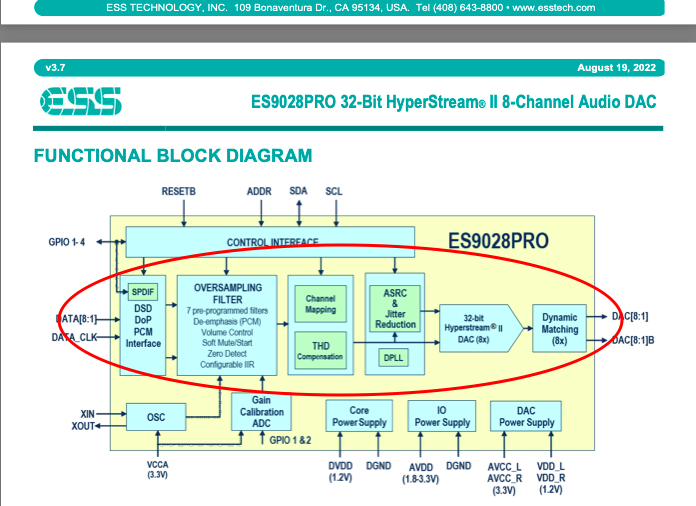
ESS chips ultimately produce the same product from DSD and PCM, though it’s correct to say they take slightly different paths to arrive there.
“Normal” PCM is 16 or 24-bit, while DSD is by definition 1-bit. The product of the ESS chips is an intermediate format between these two, sometimes called “DSD-wide,” other times derisively referred to as “PCM-narrow,” which is I believe a 5-bit datastream at extremely high data rates.
A lot of measurements have been done by the developer of HQPlayer on ESS DACs, and his conclusion is that the measurements come out better when fed by DSD256 or DSD512 than by PCM. Of course the more important thing for your own listening is the sound, so whatever pleases you is what you should use.
Very interesting. Thank you for sharing your in depth knowledge. You’re so right in saying “what we enjoy most is what we should use.” But to a “nerd” like me it’s nice to understand why I like the music better, as it leads me closer to an even further optimized system.
The cool thing is that my latest Audirvana tweaks didn’t only work for all my reference tracks, but also for almost all music I don’t know yet. I’ve been listening to recommendations on Qobuz all day. Awesomeness.
Thanks for sharing your setup. Cool that the settings I reached also sound good with your Wharfedale’s soft dome tweeters! I had a Chinese “Aune” DAC before I got the (much more expensive) Benchmark DAC, which is also a truly excellent pre-amp.
The Aune DAC also used an AKM DAC chip and had a similar “neutral” sound signature that I really liked.
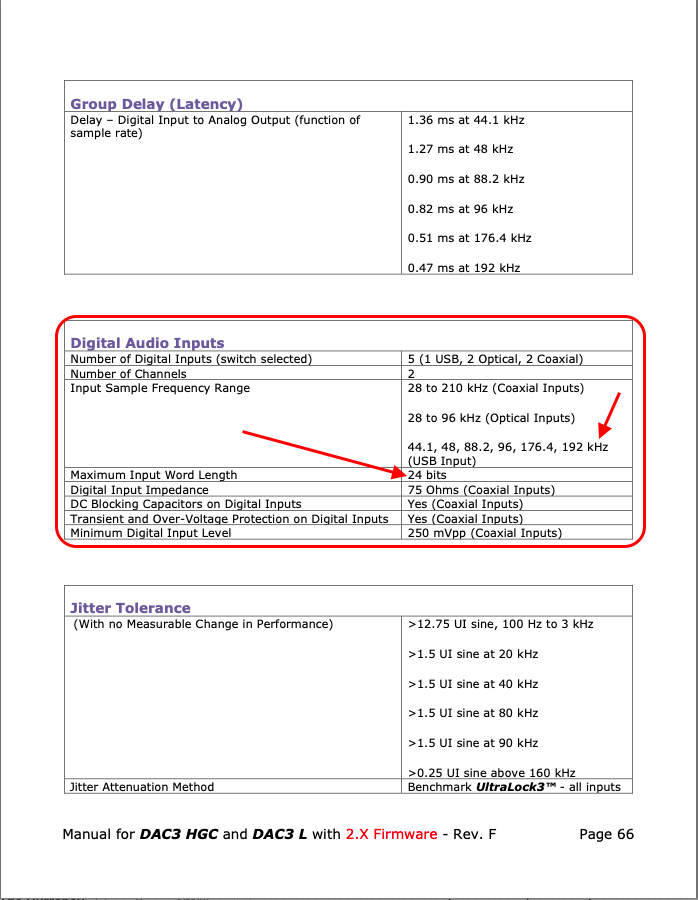
The DAC 3 is limited to 24/192kHz… You cannot gain resolution from a source 16/44.1kHz file… the only thing you gain in the modulation to DSD64 is a higher Nyquist Fs and dynamic range due to the noise-shaping… Your PCM files are limited to the Nyquist Fs of the master encoding, all resolution and bandwidth information is codified in that master… Modulation to DSD only produces a more refined signal, especially when it is presented as native 1-bit PDM to a simple low-pass filtered D/A circuit for output… However, what is happening with DSD in the 9028PRO chipset, is the 1-bit PDM signal is subsequently decimated to PCM again, which is superfluous and a waste of platform level resources…
One of your primary limitations in regard to ‘realism’ is that you are limiting your playback experience to 24/192kHz resolution and dynamic range… Your perspective will change with a DAC platform utilizing ESS chipset(s) that handle PCM to 352.8kHz and 705.6kHz or a DSD-centric DAC.
I agree with modulating PCM to DSD, however in your case with the ESS chipset(s) you are creating more operational noise in the decimation of the 1-bit PDM signal… Using the logic for off-loading computational processing from the DAC that creates noise (jitter), then sending the DAC a 1-bit signal to these chipsets to then be decimated in the chipset architecture is contrapuntal to the dogma you espouse… I believe there is a level of cognitive bias that is filtering your perceptual interpretations.
In Audirvāna the modulation processing is done with 64bit precision and decimated to 32bit for output, should the DAC have the capability to handle 32bit signals. The DAC 3 does not have this capacity.
Does it matter? What is important is the appreciable results of the algorithm in the subjective assessment on any given playback system…
In regard to the ESS Hyperstream output signal…
In the ESS chipset… this DSD-Wide signal is decimated to multi-bit PCM as part of the Hyperstream technology.
… A format and set of tools for PCM processing of DSD has been developed under the name Digital eXtreme Definition (DXD). This is a PCM format with 24-bit resolution sampled at 352.8 kHz. Another DSP technique uses a format commonly referred to as DSD-wide , which retains the high sample rate of standard DSD, but uses 8-bit samples with noise shaping. DSD-wide is sometimes disparagingly referred to as PCM-narrow . It has the benefit of making DSP operations practical while retaining the 2.8224 MHz sampling frequency. The processed DSD-wide signal is converted to the final 1-bit DSD product at the same sample rate. Direct Stream Digital - Wikipedia
Your AI buddy is wrong in all accounts except for the psychoacoustic aspects of DSD… The digital 1-bit PDM signal more closely resembles an analog signal, which is why it only needs a simple low-pass filter in the interpolation to analog voltages. (In reality, it is all analog… ) The only pure digital-bits (1’s and 0’s) are those encoded in the storage media before being read and lifted from that media…
This really makes me wish for a switch to be able to activate/deactivate any given Upsampling settings on the fly, while playing a tune. Maybe some future Audirvana Remote App feature …
The issue is level balance when switching formats which will bias the assessment… The best you can do is to listen to a production with and without up-sampling in a blind audition…
Such a switch wouldn’t be so easy to implement. AFAIK Audirvana upsamples a file progressively and starts playback as soon as sufficient part of a track is done. It doesn’t upsample in real time and tries to cache as much as possible. For good reason: the upsampling takes resources and you want the Audirvāna computer to be mostly idle (I.e., only streaming the already-upsampled file) during playback.
Also, with fine tweaks to the settings, I’ve personally found that listening to a few tracks and writing notes can be most helpful. Sometimes I can get excited about a seeming “cleaner” change, only to find out hours later that the music has become less engaging. To me, near-final adjustments can require days and listening to many different tracks.
I agree that for coarse adjustments an A/B switch would be very helpful. But that’d require a special testing mode in Audirvāna, whereby it’d upsample and cache the same music in two ways.
Aliasing noise is pushed out of the contextual range of human hearing and the signal presented to the output circuitry of the DAC is more refined as the sample-rate increases… The low bit-depth source dynamic range is unmasked by the increase in dynamic range…
The theoretical dynamic range of a 16bit file is 96dB, the theoretical dynamic range of a 24bit file is 144dB the theoretical of a 32bit file is 192dB… calculated as [6dB x number of bits + 1.75mv = dynamic range in millivolts]… In LPCM 1-bit = 6dB … No DAC is capable of producing more than 24 bits of dynamic range today… typically in the 20 bit range… So when you listen to a 16bit file up-sampled to 24bits, you are now hearing the full dynamic range of the recording that was masked by the 16bit sampling noise-floor.
Ultimately the Benchmark DAC is the rationalizer of the appreciable sound quality of any given playback… It is a specifically designed DAC to provide a very high level of PCM signal playback integrity, aimed at the production environment where 24/96kHz and 24/192kHz sample-rates are the majority of digital-audio production workflows… You will not find this DAC in the production flow of 2xHD Records mastering lab, as a reference.
If you like upsampling to DSD by Audirvana you are somewhat limited by your Benchmark DAC3. The perfect DAC for you would be a “Non-Oversampling-DAC” which allows native DSD decoding up to higher rate DSD. These DACs don’t change the data delivered by Audirvana and do only the conversion to analog.
IMO, one of the best and least expensive DACs is this one:
This DAC allows native DSD playback up to DSD512
As you are located in Sweden the link is from the nearest dealer to you located in the Netherlands.
One very interesting question for me:
Did you directly compare Audirvana 3.5.50 vs Audirvana Studio with the same settings and the same set-up?
Thank you
Thanks for the suggestion. However, I selected the DAC3 after listening to multiple DACs and love its sound. Also because of the quality of its pre-amp. I’m super happy with the system already :).
I have a big collection of SACDs, too. These are all DSD64 and have always sounded great to me. I understand that there are theoretical advantages to DSD128 and higher. But I’m already satisfied.
Yes and no: I do still use the same Mac mini. But I improved two upsampling settings after I upgraded to Studio, and my UltraRendu board was replaced later, by which I upgraded to a newer UR software/firmware version (2.9 with the latest patches). Both these improved SoX settings and the UltraRendu upgrade resulted in better sound than before.
Before installing Audirvana Studio I upgraded the Mac mini from macOS Mojave (32-bit) to Monterey (64-bit, installed with OpenCore Legacy Patcher). There were a few days between listening sessions.
Studio first impressions
My first impression of Audirvana Studio was that the upgrade from 3.5 did not immediately result in an audio improvement. But that could have been because I started with its default r8brain settings. After I configured Studio with the same SoX settings I had been using before, I felt my system sounded the same as before (i.e., really good). I rebooted back into Mojave and compared to verify this.
Comparison to Roon
This was also when I compared with Roon, which I evaluated in November. Both Audirvana 3.5 and Studio sounded better than Roon, with my old Audirvana settings. In Roon I had also activated DSD64 upsampling for the best sound. Roon’s filter settings didn’t enable me to tune to the same level (I picked “Smooth, Minimum Phase” and “5th order CLANS”) but it never sounded as magical as even my “old” Audirvana settings did.
Old and new Audirvāna settings
Here are my “old” Audirvana SoX settings with my “new” improved settings in bold:
With these updated settings my Mac mini (now running Audirvana Studio) definitely sounds better than it ever did. With or without the UltraRendu software/firmware update.
I was just thinking about this: I like the DSD upsampling and SoX settings because they sound so good with my Benchmark DAC. It’s actually the Benchmark DAC3 that became “magical” to my ears. I would not be surprised if a different DAC would have landed me at different settings,
Before I got the Benchmark DAC3 I remember also auditioning DACs from NAD, Cambridge Audio and Aune. Of these, the Aune sounded the most neutral to my ears. The NAD added warmth and the Cambridge Audio sounded very clean but lightweight.
I settled on the Benchmark also because it works great as a “pass through” pre-amp in my home theater setup through its “HT mode”: For stereo music it plays straight to the mono blocks through a set of really great balanced interconnects. And for surround it receives the main LR channel signal from a Yamaha RX-A8A receiver, which sounds awesome with multichannel SACDs as well.
 .
.