Very cool track, thanks! Definitely great demo material :).
I think every person needs their own set of reference tracks, because (to me) intimate familiarity with a track is required before one can determine whether the system sounds “right”. I’ve created a playlist of seven tracks that I’ve each heard countless times – not just on my audiophile setup but also in other environments. This enables me to hear deviations from what I have become to know as “right”.
I once was thrown off by a track suddenly sounding “off” (or at least: different) on my system, when it turned out I was accidentally listening to a different master on TIDAL. When I tweak Audirvana settings, I want to be sure that I’m doing it using the same “foundation” every time.
But now that my system is well calibrated, a track such as “Bubbles” really shines indeed! I was listening to Qobuz recommendations all day and almost all of them sound great now.
Does it make sense trying to set the upsampling/SoX values in direct accordance with the characteristics of a given DAC? Like: With DAC »A«, better chose a SoX filter bandwidth of 93 and a SoX Filter Anti-Aliasing of 98, while with DAC »B«, it should be a bandwidth of 90 and an Anti-Aliasing of 95 instead? Something like this?
I feel that the DAC is only one factor. Just like the different mathematical algorithms applied during Audirvana upsampling, a DAC then follows that up with additional processing. It would make sense to me if there is a strong correlation that is DAC-specific. But there are other factors:
A few years ago I read a comment where someone suggested that each tweeter responds slightly differently to high frequencies and that this translates into different ideal SoX Filter Phase settings.
And then there are external interference factors. For example, I now hear effects of the SoX upsampling that were masked before I cleaned up the power feeding my devices. Before I had a dedicated power line (even a separate phase) from the switching devices in my house (notably the LED dimmers), there was graininess in the upper mids. These probably steered my Audirvana parameters in a direction where I tried to suppress them. Now that the interference is gone, I likely prefer a different setting.
In theory, a DAC would not need external upsampling at all. Most DACs apply their own internal upsampling that its engineers considered “ideal”. But we also know that DAC processing power is usually more limited than what a computer can do. So perhaps Audirvana does help us to get closer to the theoretical ideal for a specific DAC.
Yet then there’s the human factor. Would you and I prefer the exact same setting? Probably not. Even if our ears were identical, we have very different room acoustics, cables and electronics.
I conclude that there is a market and a place for Audirvana. Its name is aptly chosen. In my experience, the software does enable me to get closer to audible nirvana
Depends on the DAC. Some DACs modify the signal coming from Audirvana, so for those you might change depending on the DAC. There are DACs that do not modify the signal, and among those it wouldn’t be necessary to change. See this link:
The synergy of your amalgamation of playback system components and electronic and mechanical environment all play into the aesthetics of the sound-quality you ultimately assess…
I posted this stuff on request in another thread…
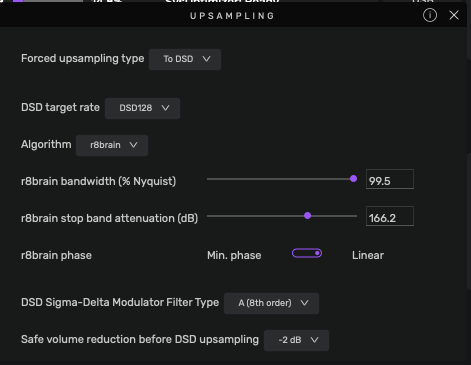
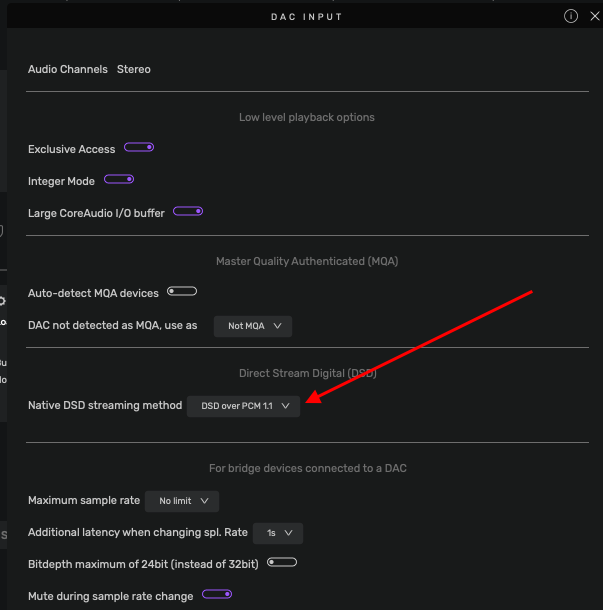
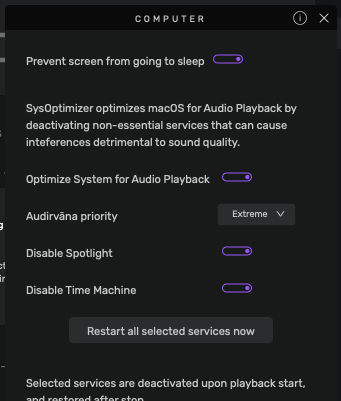
My settings relative to my DAC and playback system…
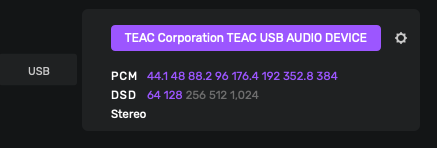
I use the DSD analog filter in the TEAC UD-501 (FIR 2, fc=90Hz, Gain= +0.3dB) in concert with my settings in r8Brain, to fine tune the sound-quality for my playback system and my personal aesthetics . I reduce the gain before DSD modulation because I employ an AU plug-in for HRTF processing which adds gain…
An overview of my playback system as related to r8Brain settings…
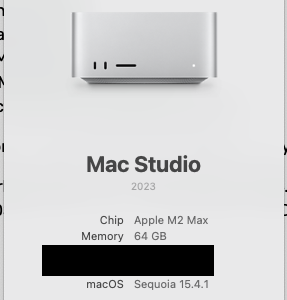
Mac Studio → Thunderbolt 3/4 → Thunderbolt 3/4 PCIe expansion chassis which hosts my USB 3.0 controller card and a ElFidelity AX-107 PCIe buss power filtering/buffering card. → USB 3.0 → iFI-Audio iGalvanic-3 (now discontinued) → 4" Up-tone Audio USBPC (USB 2.0 fully shielded printed circuit board ‘cable’) → DAC → 9" DH Labs Silver Sonic XLR balanced interconnects employing 99% pure OFC copper shells and pins (silver coated) → HPA
All cabling including power is WireWorld, except for the power cable to the Mac Studio, Thunderbolt cable and the USBPC 2.0 card and my custom DH Labs Silver Sonic interconnects to my HPA and my custom DH labs Silver Sonic headphone interconnect… all connections including power are treated with 99% silver contact enhancement except for Caig Labs Deoxit Gold on the headphone connections and I utilize specifically chosen ferrite chokes in strategic locations on both signal and power cables. Other tweaks are involved in the delivery of power/filtering.
You can squeeze the best performance possible with proper attention to fundamental system configuration axioms (electro-mechanical, power and ground/earth strategy, RF and EMF mitigation) and your configuration of Audirvāna
Why don’t you use the RX-A8A for high-resolution playback? It uses the ES9026PRO Hyperstream II chipset (2x) supporting up to 32/384kHz and DSD256… you say it sounds awesome… You would gain the room correction DSP in concert with up-sampling…You can connect your mono-blocks to the pre-amp outputs…
My receiver sounds best in Pure Direct mode. That’s how I listen to SACDs, even 5.1 ones (I’m lucky to have tonally matched B&W Diamond surround speakers and a decently treated room so I don’t need to EQ them). I use DSP processing only for movies;
I tried Qobuz directly playing on the receiver in Pure Direct mode last year. It sounded clean (reminded me of my recent JPlayer trial – I think JPlayer going to the UltraRendu and Benchmark sounded better though), but definitely not as good as my Benchmark DAC3 fed by Audirvana;
My previous Yamaha receiver did not support DSD over DNLA and I did not think of revisiting DNLA streaming when I upgraded (thank you for the suggestion!).
So in the past the Benchmark DAC3 definitely won out. But I am very grateful for your suggestion because I can now test how my Yamaha RX-A8A performs with DSD upsampling (plus 32 bit 384kHz PCM). And I can compare DSD64 upsampling to DSD256 upsampling. This will require some serious auditioning. I will report back!
Yamaha has been doing digital-audio for decades… well before Benchmark entered the marketplace, and they have the advantage of economy of scale, and vertical design acumen from which to draw from… How many DACs allow you to adjust the level of jitter attenuation? The RX-A8A does… If you are managing your noise and power potentials of your system architecture, I don’t see that the RX-A8A will not be equal to the DAC-3 and more revealing than the DAC-3… The common denominator is the ESS chipset architecture and the signals that you deliver to the DAC topologies.
Thank you again for suggesting I try the Yamaha RX-A8A as a DAC for high-resolution playback. I’ve completed extensive testing today comparing it with my UltraRendu → Benchmark DAC3 chain, and have posted a detailed review here.
You raised an interesting point about Yamaha’s long history in digital audio and their economy of scale advantage. While this is absolutely true (and this is actually my fourth Yamaha receiver), I’ve found that company focus and design priorities seem to matter more than history or scale. Benchmark’s singular focus on two-channel audio performance has resulted in a DAC implementation that, to my ears, creates a more emotionally engaging and three-dimensional listening experience, despite the more limited specifications.
The Benchmark DAC3’s price alone is approximately 2/3 the cost of the entire Yamaha receiver, which demonstrates the different priorities - Benchmark putting all their resources into stereo music playback, while Yamaha creates an excellent multi-purpose device with surround channels and DSP that balances many different requirements.
One particularly interesting discovery during my optimization journey has been how dramatically power supply quality affects digital performance. After adding linear power supplies to my digital components and optimizing cabling, I heard unexpected improvements that went well beyond what I thought possible. This suggests the DAC chip itself, while important, is just one element in a complex system where implementation quality and power delivery can be equally crucial for ultimate musical enjoyment.
The Yamaha performs impressively well with PCM 384kHz upsampling, especially considering all its other capabilities. I found its DAC performance best with PCM rather than DSD, which was an unexpected but interesting discovery.
It only shows the difference in the economy of scale not priorities…
The ESS chipsets are virtually identical except for sample-rate support…
You didn’t connect the RX-A8A directly to your mono-blocks from the pre-amp outputs and you employed the UltraRendu and the IsoRegen in the Benchmark system and not in the RX-A8A setup… Very difficult to remove the subjective bias in this audition… Definitely far from definitive… It is one observation limited by the implementation. I think you can do a better blind test and give us something less biased.
That is not what I suggested… I suggested connecting the RX-A8A to your mono-blocks from the pre-amp outputs… there is no way this is an unbiased test and observation.
I went through the testing to satisfy my own curiosity. And I shared my findings to give back to the community. I would not have reached the “magical” sound without reading countless experiences from others.
Take my personal observations however you like. If the Yamaha setup had matched the other more expensive one, that would certainly have been great.
I’ve seen other posts where you question other people’s integrity. That is entirely up to you. I am a consumer, not a vendor. I love music and know for sure that I’m going to continue using the Benchmark DAC and keep the UltraRendu powered despite also enjoying the receiver for surround :).
When the Benchmark’s balanced outputs were connected to the receiver, the receiver’s pre-amp went to the amps. The benchmark was not connected to the mono blocks during today’s audition. I’ll leave it at that.
What is the purpose of these things… Do you see a lot of personal opinions/reviews on this site? They are worth a dime-a-dozen… Maybe these reviews will be better reserved for forums that foster this sort of subjectivity…