You’re going to be oversampling in any case. The question is whether you want to do it with Audirvāna or in your DAC. If you send the DAC a non-oversampled signal, all the oversampling will be done by the DAC chip. If you send it an oversampled signal (for example DSD256 or DSD512), most or all of the oversampling will be done by Audirvāna. So the question is not whether to oversample, but where.
My preference is to do the oversampling with Audirvāna, because a computer CPU is more capable than a DAC chip and can run more sophisticated filters and delta-sigma modulators than the DAC chip has capacity for. But it is very easy for you to just listen to both and see what you might like better in your own system. If you do decide to oversample with Audirvāna, I would suggest DSD256 or DSD512 with the B7 or B8 modulator.
This is more likely related to the Volume control where the signal is up-sampled in-order to produce a bit-perfect output with maximum dynamic-range. (Note that no Volume control is applied to DSD signals)
From the link to the Stanford CCRMA (Center for Computer Research in Music and Acoustics) article “Zero Padding Applications”:
Zero padding in the time domain is used extensively in practice to compute heavily interpolatedspectra by taking the DFT of the zero-padded signal. Such spectral interpolation is ideal when the original signal is time limited (nonzero only over some finite duration spanned by the orignal samples).
This statement needs more contextual specificity regarding the term “DAC chip” … There exists more than one type of “DAC chip”… Some FPGA (Field Programmable Gate Array) based DAC platforms have very capable up-sampling capabilities intrinsic to their design criteria… In the context of the C100 DAC(and many other similar chipsets) more-likely-than-not, the AKM AK4493S chipset does not have the computational power of the PCM up-sampling processing in Audirvana…
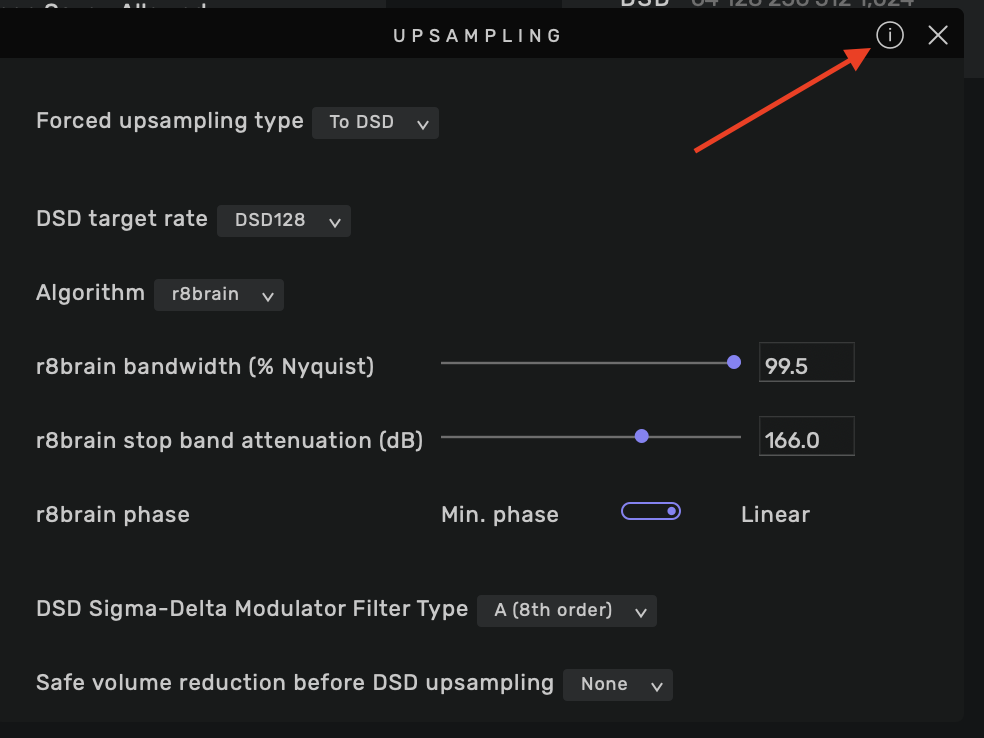
Bandwidth % Nyquist and Stopband. Playing with the values until I reach a delightful result for me or are there any guidelines? Searched in the internet but I felt I need a doctor title for this stuff
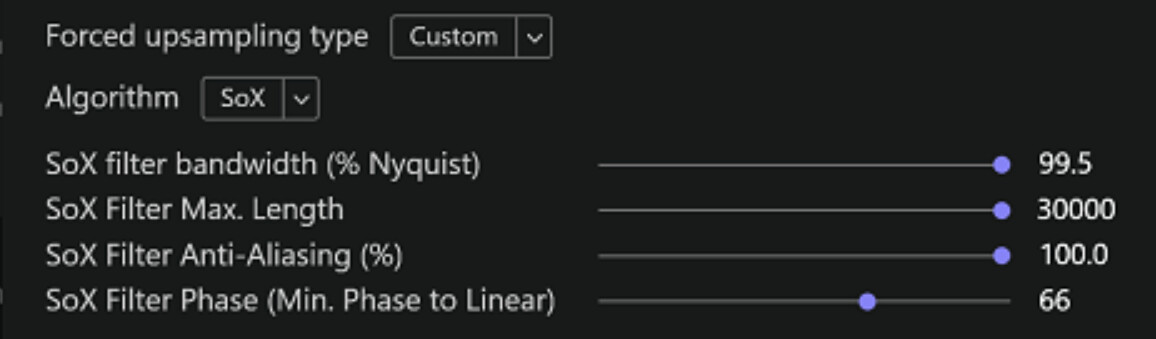
Don’t alter the % Nyquist grossly.… very small increments are prudent and more-likely-than-not, you don’t need to monkey with the default setting… However adjusting the Stop-band level works like a high-frequency attenuator (tone control)… Keep the Linear Phase setting… I’m not entirely sure the Sigma-Delta Modulator Filter type is active in r8Brain… it is active in SoX… You can experiment to find a sound that you find satisfactory…
You will find all the information regarding up-sampling in Audirvana here:
A good starting point is ‘power of 2’ and listen. If you want to upsample to DSD choose ‘DSD 128’ or ‘DSD 256’.
SoX and R8Brain are simply two different algorithms (basically from 2 different developers) to accomplish the same. Just choose what your ears prefer.
Keep in mind that the higher the upsampling the more work the CPU in your computer has to do. So if you hear strange things (like hickups on DSD 256) lower it to DSD 128 (or DSD 64).
If you hear no differences at all, simply don’t upsample . I probably get whipped by other forum members if I say this, but this kind of tinkering is mainly used by audiophiles who want to squeeze the last quality drop out off there system. I admit I am one of them too. In my ears R8Brain with DSD256 sounds very nice, but that all depends on your DAC, amplifier, speakers etc. etc.
Edit: @Agoldnear also posted before me. I totally missed that (probably while I was typing this post). As he says the ‘i’ button in the upper right corner gives a lot of information.
As you can see from my screen-shot, that I have found lowering the stop band level produces a quality of sound that works extremely well in concert with the FIR filters of my DAC.
166 dB… You can see it in the screen-shot that I posted above… You can also see the filter type setting, but not sure this is being applied or not… this is the filter type I used with SoX.
Thanks! Sorry, I did not look high enough. I was probably typing my post when you where posting your screenshot. I only looked at your post after that. Now I see the original Grandpa is getting old…
My system has an i5 10400, so sample to DSD256 is no problem (15% utilisation), even with DSD512 the CPU utilisation was just 20%. When I hear music, only other thing I do on that machine is probably surfing. Will play with the suggested settings tomorrow after work. Thanks guys for the suggestions and explanations. This community is for sure one of the few that deserves the name!
The way modulation to DSD works is essentially to divide the signal into lower frequency music and higher frequency noise. Higher DSD rates will push the noise to higher frequencies and make it easier for your DAC’s filter to get rid of them. For this reason, DSD256 and DSD512 rates produce the lowest noise and distortion with DACs like yours. The noise and distortion levels are very low in any case, so you may not hear a difference. (It’s for similar reasons I suggested the B7 or B8 modulator.)
In the PCM upsampling step, the stop band level that @Agoldnear mentioned works this way:
Ultrasonic noise and something commonly referred to as filter “ringing” (technically the Gibbs effect, you can look it up in Wikipedia) vary inversely with each other. The more steeply the filter cuts out ultrasonic noise, the greater the Gibbs effect, and vice versa. The Gibbs effect “ringing” is itself ultrasonic, so you won’t hear it directly, but many people feel it leads to a “smearing” of transients. So you can experiment with this setting and see whether you hear any difference.
‘Gibbs phenomenon’ is typically associated with pre-ringing, a product of the digitization process induced by the ADC devices (Analog to Digital Conversion) which distort the leading and trailing edges of the digital-audio signal it produces…
Depends. If linear phase, there’s both pre- and post-ringing. If minimum phase, pre-ringing is minimized and most ringing energy is pushed to after the impulse/transient.
 The question is whether you want to do it with Audirvāna or in your DAC. If you send the DAC a non-oversampled signal, all the oversampling will be done by the DAC chip. If you send it an oversampled signal (for example DSD256 or DSD512), most or all of the oversampling will be done by Audirvāna. So the question is not whether to oversample, but where.




 . I probably get whipped by other forum members if I say this, but this kind of tinkering is mainly used by audiophiles who want to squeeze the last quality drop out off there system. I admit I am one of them too. In my ears R8Brain with DSD256 sounds very nice, but that all depends on your DAC, amplifier, speakers etc. etc.


