According to this treatise… In regard to ‘post-ringing Energy’ he describes ‘minimum phase filter’ having higher than post-ringing energy of linear phase filter.
Yep, agreed!
There are trade-offs… I’m in favor of reducing the ADC pre-ringing in the digitization process (higher sample-rates) and the minimum post-ringing of the linear phase filter application… The level of stop-band energy being parametrically adjusted in r8Brain allows for fine tuning…
You need to help him with the website layout 

@Jud
Today I took courage and updated the FW of the iFi Neo.
Everything is OK.
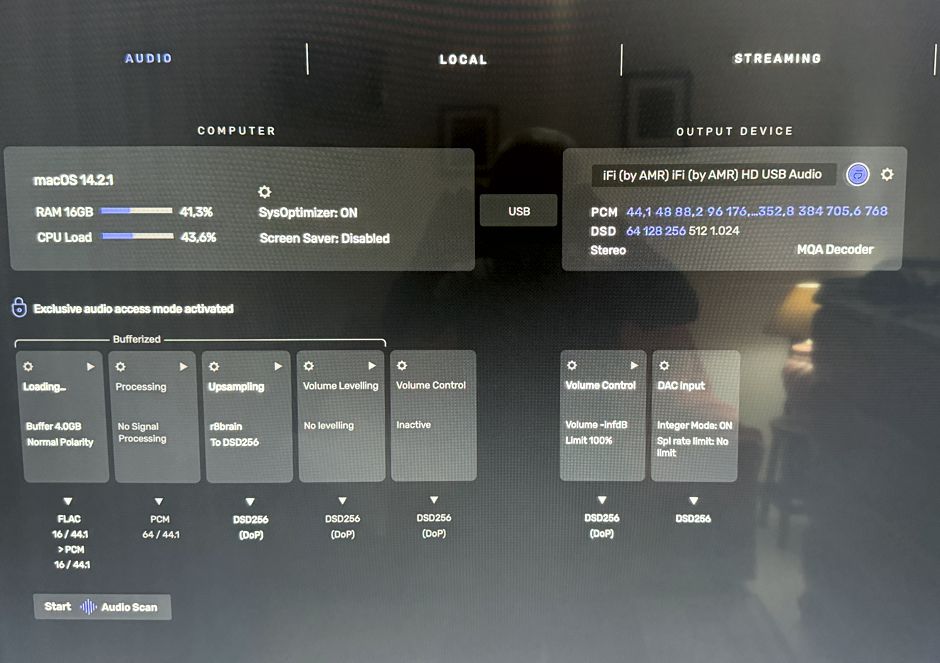
I left it at BP=Bit perfect and Upsampling it in Audirvana for DSD256.
I really liked the result.
1 Like
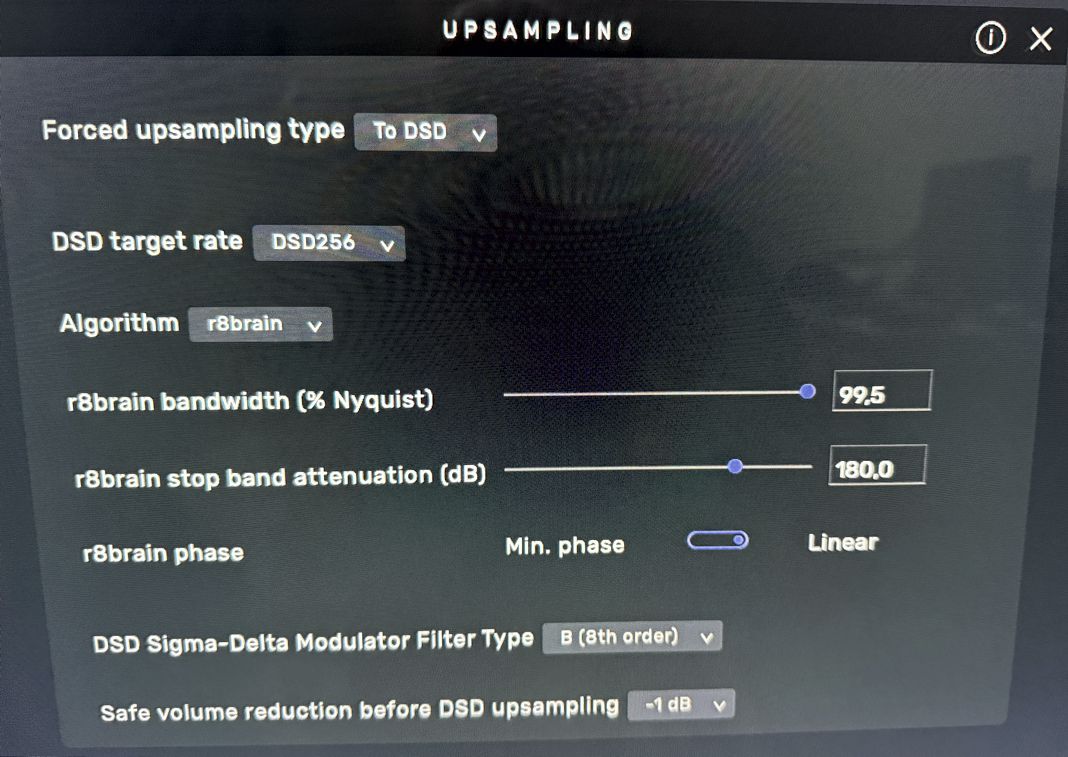
I’m completing some tests, and I’ll leave my opinion after I’ve updated the DAC’s FW, and upsampled the PCM files to DSD256.
1 Like
This is just my opinion, I believe everyone will find their best fit.
Initially I updated the FW of the DAC to have the Bit perfect or NOS option.
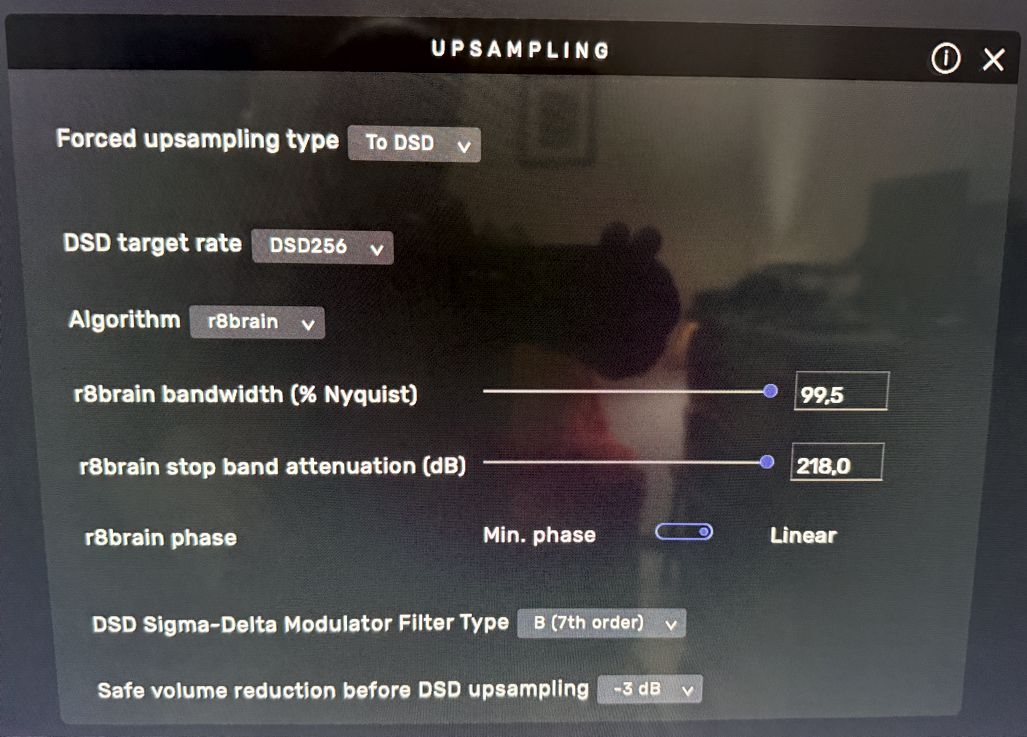
Using r8brain to Upsample to DSD256.
In the standard configuration it comes with, it was fine, but in some songs the high frequencies were very accentuated.
My speakers are the Musical Fidelity Gold 200 V4, which use a ribbon tweeter.
That’s why I adjusted the attenuation band from 218 to 180db.
The high frequencies were excellent on all the records I listened to.
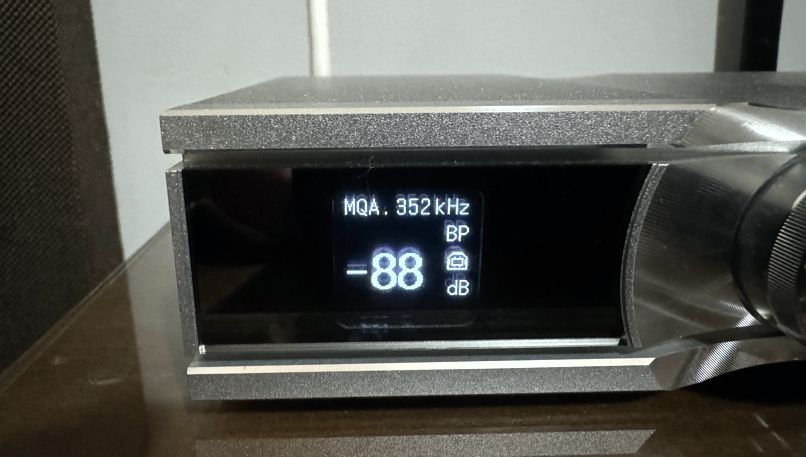
I have a single disc in MQA that I leave for testing.
Even though it is a FLAC file, upsampling was not done. Audirvana probably already read that it was an MQA.
Interesting that the MQA disc goes up to 352Khz, however on Audirvana it only shows 24/44Khz but on the DAC it reports 352Khz.
The memory intended for Audirvana was 4Gb and I changed it to 6Gb for a total of 16Gb that I have on the Mac min M2.
Basically that’s it, I really liked the result and that’s how I’m going to listen to my PCM files.
Thank you @Jud for the posts that helped a lot.
2 Likes
The DAC is set to FIXED setting, so the value on the screen does not influence the volume.
Hi @Reynaldo ,
This is because of how MQA decoders work, no audio processing is done in Audirvāna, as the DAC is doing all of the MQA decoding.
2 Likes
Taking advantage, is there a possibility of also doing Upsampling with DSD files?
I would like to upsample my DSD64 and DSD128 files to DSD256.
I am very glad you have found settings you like. As you say wisely, everyone will find the settings they personally enjoy most.
I wanted to give you some information about how the attenuation setting works. The dB setting there cuts deeper as the number increases. So at 180 dB you are actually cutting the high frequencies more slowly than at 218dB. These high frequencies are in the low ultrasonic range, so you wouldn’t actually hear them. The filter shape in that low ultrasonic range has a slightly more gradual slope at 180dB than at 218dB.
That’s the technical part. What matters, of course, is what you like.
1 Like
What is your impression of the sound quality when you engage the ‘STD’ and ‘MIN’ filter with your current stop band attenuation setting or a slightly lower stop band attenuation setting?


Sorry I didn’t understand your question correctly.
Are you referring to the filters on the DAC or on Audirvana?
The filters available in the iFi NEO in concert with the current settings you are using with r8Brain in Audirvana…
@Reynaldo, I thought a couple of images might be useful to illustrate what I was talking about in my previous comment. The first one shows the filter curve for r8brain Pro linear phase, and the second for r8brain Pro linear phase “ultra steep.” The first corresponds roughly to your setting, and the second corresponds roughly to the 218dB setting. As you will see from the graphs, the filter curve drops off just slightly more steeply with the second setting. But this is all above the range you can hear in any case.
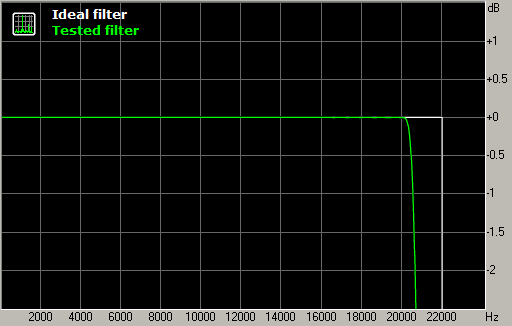
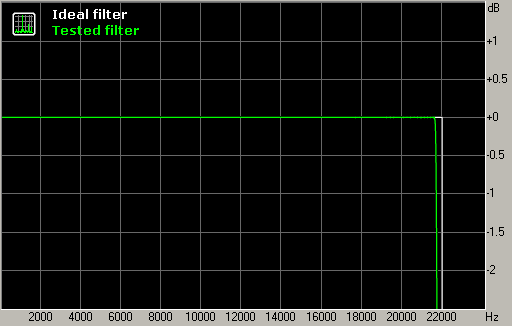
Please provide the reference/source information, so to corroborate the statements with the images posted here…
The r8Brain PRO sample-rate conversion algorithms have these delineations:

*We also see there is no adjustment of ‘stop band attenuation’ in the r8Brain Pro stand-alone application…
I’ll try to do some more testing by changing this value.
Are you leaving the value at 218db?
Before updating the DAC it already worked with Mini Phase.
The intention of updating the DAC was precisely that it did not use any filters and everything was done by Audirvana.
I have been leaving it at 218dB, but since I have been content with the sound I haven’t tried to experiment with that setting at all. So who is to say whether it might sound better at a different value? It’s just my own tendency as I get older to leave things as they are once I’m happy with the sound. If you would like to experiment a little, I will be interested to read what you find out. 

1 Like