I personally find people’s actual experiences more interesting than vendor specifications and also vendor-specific forums. There are plenty of expensive DACs and streamers. My picking the equipment I have (and going back to Audirvana every time) now is the direct result of forums like this. I usually test a few devices and then keep the one that works best.
The experiences are with Audirvana Studio and involve its upsampling and DSD conversion settings. If this is not the place to share these experiences, then a moderator can always remove my posts.
I got the iFi LAN iSilencer and replaced my TPLink Switch (which is upstream from the EtherRegen) by a cheap Zyxel one earlier this year. Then replaced the Zyxel’s wall wart by a Meanwell power supply. All three steps improved the sound of the system noticeably. The iSilencer is on the ethernet input of the Zyxel (coming from my remote fiber router). I’m now considering testing a better Ethernet cable.
Some thoughts, and of course if you have already tried them, or feel they would be too much fuss or not the direction you want to go, please feel free to ignore them.
Intona USB isolators have a sterling reputation both among people who do measurements and those who do listening. Not inexpensive (at least for a USB isolator), but you might consider one.
I personally love what optical Ethernet has done in my system. Luckily, one doesn’t need to spend a huge amount to get excellent specs. If your “last mile” must be copper Ethernet, you could consider optically isolating it from the rest of the system with a couple of QNAP switches with 10G optical ports (usually about $120 each at Amazon), and power them with the inexpensive medical grade CUI power supplies that have excellent specifications, in particular very low noise and leakage current. I have eliminated the need for copper Ethernet by using a Fitlet3 mini-PC with optional SFP+ optical input, but that involves installing and maintaining Linux, which I have the impression you’d rather not be bothered with.
If any of this is helpful, great, and if not I hope I haven’t wasted too much of your time.
The iFI-Audio LAN iPurifier Pro connected with a very short copper RJ-45 cable to the Yamaha would do the optical isolation and provide some level of noise filtering, regen…
[quote=“Jud, post:84, topic:44392”]
Intona USB isolators have a sterling reputation both among people who do measurements and those who do listening. Not inexpensive (at least for a USB isolator), but you might consider one.[/quote]
Tips like this are much appreciated, thanks. I have to say that the IsoRegen (which also galvanically isolates) has been one of my best upgrades. It improved the sound more than the later upgrade to the UltraRendu did (initially I used my Mac’s USB output straight to the Benchmark DAC3, and before that to an Aune 16 DAC. So if the Intona USB isolator is newer than the IsoRegen (which is no longer available I think), then that could indeed be great. Even though I feel that the UltraRendu-IsoRegen combination is quite amazing already.
Another great tip. I actually do have a stretch of optical going from one side of my house to my living room, but from one side of the room to the other there is a ~10m stretch of in-wall ethernet until I reach a LAN iSilencer, then a Zyxel switch, and then go to the EtherRegen, again using ethernet. The recent improvements have already brought me to amazing sound. But I heard from others that optical brought further improvements. It would be relatively easy to move the EtherRegen (to which UltraRendu, Mac mini and Yamaha receiver are connected) to fiber. It already has a socket. Your guess about me not wanting to add a Linux setup is correct
Do you have experience with the last ethernet cable going into the UltraRendu/Ethernet-to-USB converter? I tried a few about two years ago and picked Supra Cat8 cables as my then-favorites. But since I’ve upgraded the LPSes and the system is now much more resolving. So I’m considering revisiting the “last stretch” ethernet cable. Of course there’s also the OpticalRendu. My issue with these things is that my budget, although I have spent quite a bit, is still not unlimited. The UltraRendu sounds pretty great. And the OpticalRendu or similar optical solutions aren’t cheap.
My view is that the closer you get to the computer with optical all the way to the device/DAC the better… The issue is accumulated noise related jitter from interface transitions and interpolations in the transmission path among other power/ground and RF and EMF gremlins.
I had an EtherRegen and copper Ethernet together with optical. When I replaced it with all optical I thought the sound improved significantly. However, I don’t think this is the path for you, because as you say the Optical Rendu involves significant expense and the alternative is an adventure with Linux that we’ve established isn’t what you want.
Let me suggest the following as a possibility: The two QNAP switches I mentioned with optical between for electrical isolation, with good transceiver modules from Coherent (was Finisar). The switches would be about $250 for the two of them, the transceivers and cable perhaps another $90, two CUI medical grade power supplies $70-$80. So a little more than $400 all in. If it turned out you didn’t like the result, Amazon returns are easy; don’t know exactly what the return policy would be on the transceivers and power supplies. (I might even buy the transceivers from you if it came to that. Most of my home Ethernet is optical and I could always use them somewhere.)
Regarding copper Ethernet cable for “the last mile,” two things:
Do not use Cat 7 or Cat 8. These have ground connected to shielding at both ends and can therefore propagate electrical noise. Use Cat 6a instead.
The best copper Ethernet cable I’ve found in my subjective evaluation is the Ghent JSSG360. It’s not terribly expensive. It is very stiff due to lots of shielding, so get a sufficient length if it needs to bend.
That’s one of the Ethernet cables I’m considering auditioning, thanks. I can testify that a WireWorld Silver Sphere HDMI cable greatly improved the sound of my Pioneer UHD Blu-ray player connected to the Yamaha receiver (replacing an older Supra HDMI cable).
I also read raving reviews of the Polish JCat (I believe made by the same company that developed JPlayer) and GFmod cables. But these are considerably more expensive. It is astonishing that, the more revealing our system gets, even an Ethernet cable starts making an audible difference.
Thanks for this good reminder. I can confirm that this made a difference for the “upstream” cable between my EtherRegen switch and the Zyxel switch. Yet, the Supra CAT8 cable sounded better than two Cat6 cables on the UltraRendu connected to EtherRegen. And better than the AudioQuest Cinnamon (which I believe also doesn’t have earth connected on both sides).
There is solid engineering application and there is brute-force engineering application and there is market driven engineering application… I’ll choose solid engineering dogma in cable design every time… Otherwise you are just buying expensive tone-controls… When one understands the dynamics of transmission-lines it is easy to appreciate the WireWorld engineering strategy.
Cognitive perceptual bias in subjective assessment is a real thing… Don’t get caught in that vortex in system design and interpretive assessment… I know in the audio production world it is important to impress the less informed client(s)…
Obviously, system familiarity plays a big part in the qualitative assessment of changes… However, this is always a purely subjective observation, beholding to the conditional circumstantial biases surrounding the assessment, unless the assessment is augmented by objective evidence.
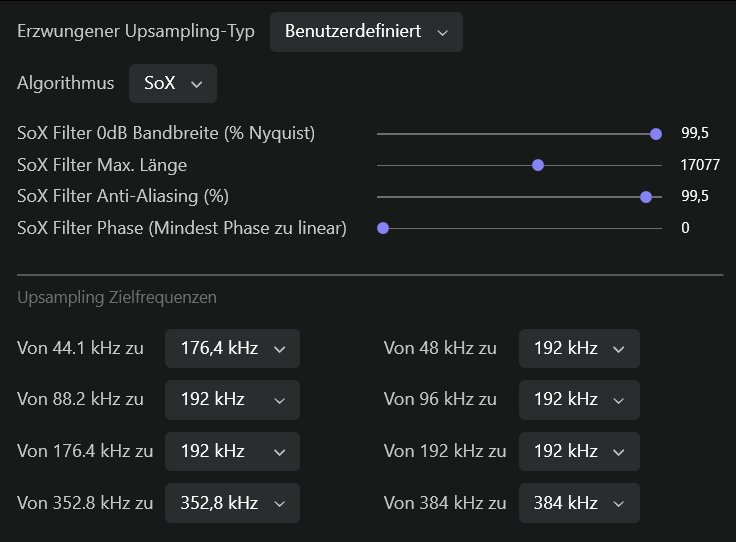
You will be best served by using ‘Power of Two’ up-sampling strategy…
This will produce the proper logical results for the given sample-rate input relative to your DAC capabilities.
For example:
44.1kHz → 705.6kHz
48kHz → 768kHz
88.2kHz → 705.6kHz
96kHz → 768kHz
176.4kHz → 705.5kHz
192kHz → 768kHz
352.8kHz → 705.6kHz
384kHz → 768kHz
705.6kHz → 705.6kHz
768kHz → 768kHz
Or alternately using a ‘Custom’ strategy:
44.1kHz → 352.8kHz
48kHz → 384kHz
88.2kHz → 352.8kHz
96kHz → 384kHz
176.4kHz → 352.8kHz
192kHz → 384kHz
352.8kHz → 352.8kHz
384kHz → 384kHz
705.6kHz → 705.6kHz
768kHz → 768kHz
Or… just modulate all PCM files to DSD128 or DSD256 using Forced up-sampling type ‘to DSD’ and setting the DSD sample-rate target to DSD128 or DSD256
Note: DSD files will play natively on your PC (I presume this is a Windows PC)…
Please paste your debug information report here so we can see your Audirvāna configuration and tell us about how you are connected to your DAC.
Just tried your Power-of-Two proposal on Peter Gabriel’s »Mercy Street«. That tingling cymbals’ part within the first minute sounds better than ever, it seems.
Try modulating/up-sampling that Peter Gabriel PCM file to DSD128 and then to DSD256 using ‘to DSD’ strategy you may need to tweak your algorithm parameters… As you can see in my configurations I modulate all PCM files to DSD128 …The AKM chipset in your DAC has a pure 1-bit signal path to the low-pass D/A circuitry.
How much System RAM do you have available and how much RAM is allocated for playback pre-load?
Note:
Make very small incremental changes to the up-sampling filter parameters when fine-tuning… a tiny adjustment can make a big difference.
Really appreciate your thorough walkthrough! Nice gear as well!
My system chain is not as complex: I7 laptop > IFI ipurifier3 > Dac-3L > AHB2 > Revel F226Be and x2 Rythmik E15s. Some treatment RT60<400 above 100hz (good enough to me and still natural sounding). Considering going with a proper reclocker but I am leaning towards buying another AHB2 to run as monoblocks. The AHB2 and dac3 combo is dead silent at unity gain with no music playing - no hiss ; truly amazing but since Audioholics did a couple benchmark videos used market dried up or happenstance but I hope Benchmark is getting more business as well - really a great company and very accessible to answer questions etc. very impressed.
I could never get upsampling quite right but very happy with your settings, well done!!
One caveat, I don’t use DSD as I use Hangloose convolver and filters using Focus Fidelity. Really necessary given my room challenges (not symmetrical space in open basement). I use convolution to achieve speaker matching (FR, Phase) and correct step response - tightens up imaging with flat phase through the midrange addressing crossover induced delays. Maybe worth a free trial for some.
I dont personally subscribe to a flat response but that is a personal preference and can also be genre specific IMO. My goal has been establishing a solid foundation with excellent clarity, imaging and resolution and tuning FR to taste.
Anyone here tried to use Audirvana’s Remote App to fine-tune upsampling/SoX settings? My first impression while doing so was that some sort of live editing seems to be possible, as the sliders can be moved while playing music. But unfortunately no instant effect can be heard