I suppose it’s due to the synergistic relationship of the system amalgamation.
Slightly more seriously, I’ve been careful to assemble a system that sounds very real to me (obviously subjective), the component parts and design of which produce extremely low noise and distortion as measured by others (objective). But the components and system are only what I’ve personally chosen and what I’m happy with, and certainly everyone else should do just as they please.
The Mano Ultra I mentioned in the thread will probably receive a certificate from Audirvana at the turn of May and June.
Of course, this is not official, so please do not quote me.
I don’t know what effect this will have on the stability of the entire system. I don’t think the hardware is the weakest link here. I would rather bet on Audirvana working with GentooPlayer.
Audirvāna is a subroutine of the operating system… How do you think they run Roon Server?
As stated…
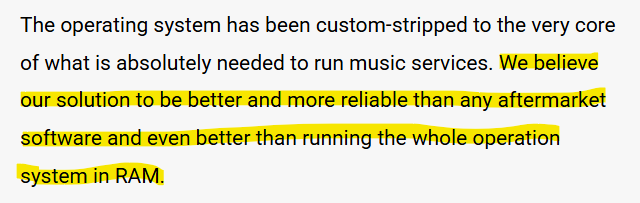
*"The operating system has been custom-stripped to the very core of what is absolutely needed to run music services."
This means they have designed a hardware OS that is free of any superfluous non-essential operational functionality…
From the marketing rhetoric:
DUAL CPU DESIGN
Previously, you would always have to make a tradeoff when planning your digital source: Sound quality or user experience and ease of use. For us, there is no better software to browse your own music as well as finding new music through the countless streaming services than Roon. Since the start of the SGM project in 2015, Roon has, therefore, been at the center of what we are doing.*
*> * > The choice to design a dual CPU system was, for a large part, fuelled by finding a way around the impact Roon’s luxury interface has on sound quality. It does enable Roon processing to become virtually inaudible, a world’s first in our experience.
*> *
*> With our groundbreaking custom allocation of processes, you can now have both: The best sound quality, as well as the best user interface. Moreover, due to the low amount of heat generated by this design, you can expect a much longer component life than a single CPU design.
Almost certainly a minimal Linux, which is something several folks here and on other forums have found to their liking. Linux variants run virtually all server and streamer appliances.
Seems logical to me… In the case of the Extreme Server, the hardware platform plays heavily on the ultimate digital-audio signal presented to the output bus(s)… the latencies are reduced to minimal influence, especially when the music library is stored locally on platform.
It is the axiom for all digital-audio signal flows… Your approach is valid and so is the design of Audirvāna running on Core Audio in macOS… Hardware latencies create the noise (jitter) in the clocking topologies which influence computational operations… How the API’s are implemented and exploited is dynamic… The CPU and memory/memory bus (hardware) synergistically play into the ultimate level of signal integrity of the bit-data lifted from the storage medium… If the clocking is interrupted through operational influences, noise is precipitated and ultimately the level of accumulated jitter influences the perceivable quality of sound output of the DAC.
Neither is Taiko Extreme endgame, nor will they run Audirvana on it.
You can go to WBF, search for “Audirvana” and “Taiko Audio” and see what you will find…